
Local AI Hardware for Robotics
Explore local AI hardware for robotics, focusing on system design, memory, latency, and multimodal AI models for effective robot deployment.
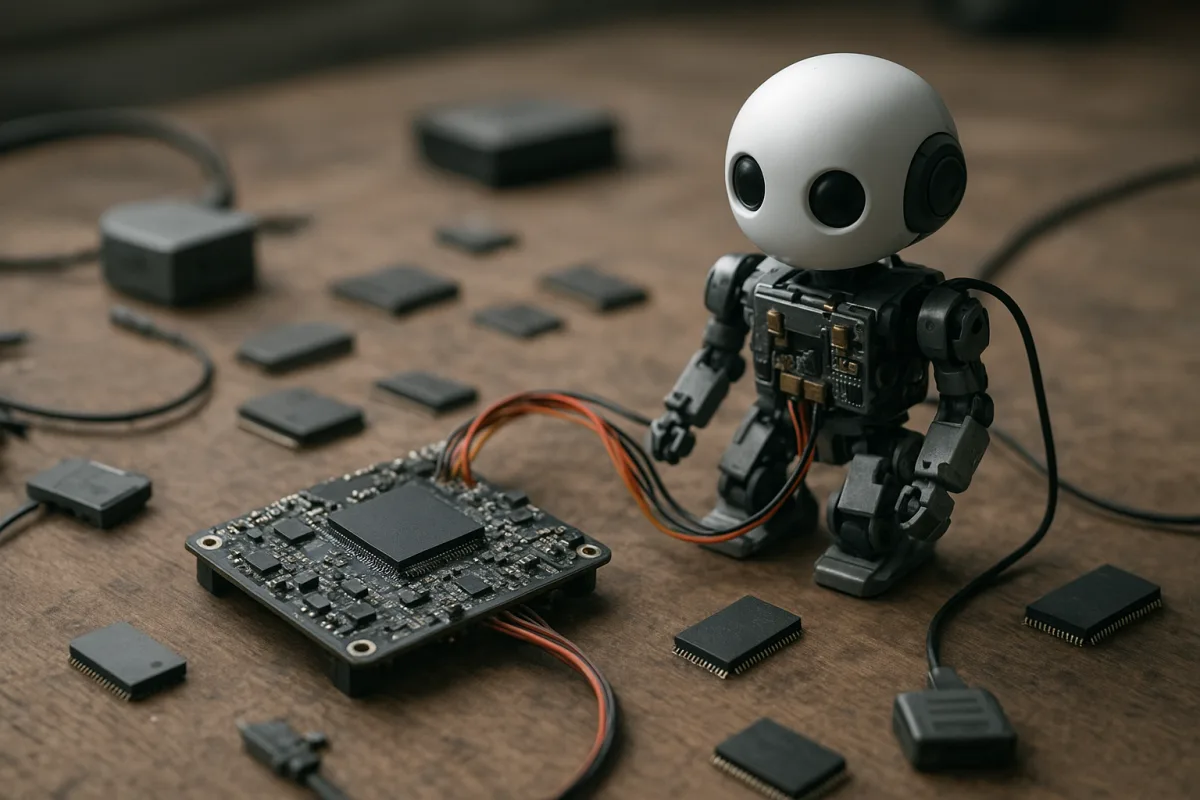
The shift is from AI chips to embodied systems
AI hardware is moving in two directions at once. Data-centre accelerators are being packaged into increasingly self-contained systems, while robotics developers are trying to turn multimodal foundation models into machines that can perceive contact, motion and failure.
That shift is real because several independent parts of the market are converging on the same problem. NVIDIA is packaging compute, networking and cooling together. Robot builders are adding local inference hardware. Model developers are expanding beyond camera-based action policies.
The common requirement is not merely more arithmetic throughput. It is predictable performance under physical constraints: limited power, limited bandwidth, sensor noise, safety requirements, and the need to act before a moving object becomes a collision.
NVIDIA’s strategy, described by the AI News channel in coverage of GTC Berlin, spans laptop-class development machines, containerised data-centre systems and reference humanoids. That breadth matters more than any single launch, because it connects training, simulation and deployment.
The caution is that the announcements do not prove broad commercial adoption. Much of the evidence remains vendor roadmaps, demonstrations and reference designs. Robotics has repeatedly shown that a convincing demo is easier to build than a reliable shift-running system.
Local AI hardware is becoming a systems problem
The ASUS ET900N G3, ASUS’s DGX Station-class workstation based on NVIDIA’s GB300 platform, illustrates the new packaging. The base system combines a GB300 chipset, 748GB of coherent memory and two 2TB PCIe 5.0 SSDs, with ASUS claiming up to 20 PFLOPS of AI performance.
In a review, sentdex described the machine as a workstation-sized system rather than a conventional multi-GPU tower. The relevant distinction is operational simplicity: compute, cooling and high-speed interconnect arrive as one supported appliance instead of a project involving motherboards, PCIe topology and power distribution.
That packaging can be valuable, but coherent memory should not be confused with uniformly fast memory. Sentdex noted that the system’s LPDDR5X tier is substantially slower than the GB300’s HBM3E memory, so spilling a model or cache into system memory can materially reduce performance.
This is a familiar issue in another form. Accelerator buyers often focus on total memory capacity, then discover that bandwidth, placement and communication paths decide throughput. A large memory number can enable a workload without making it fast enough for interactive use.
The review’s DeepSeek mixture-of-experts configuration makes that point well. It used high-bandwidth memory for weights and frequently used experts, an RTX Pro 6000 as a sidecar for less frequently selected experts, and system memory for larger auxiliary tables.
That is not a general recipe for every model. It is a workload-specific memory hierarchy. Teams considering local serving should profile prefill, decode, context length, concurrency and expert routing before deciding that one large shared-memory machine replaces several ordinary GPUs.
The ET900N G3 also illustrates why appliance economics are more complicated than a single purchase price. It has a 1,600W 80 PLUS Titanium power supply and sealed liquid cooling, which suggests serious attention to thermal design, but published operational and maintenance costs are unavailable.
Neither ASUS nor NVIDIA has published a confirmed retail price for every ET900N G3 configuration or for an RTX Pro 6000 upgrade variant. Estimates around $100,000 to $120,000 cited in reviews are not official pricing, so prospective buyers need a vendor quote.
For that money, the system suits organisations needing private, local inference with large models, repeatable support arrangements and limited appetite for multi-GPU integration work. It does not automatically suit a small research group whose bottleneck is data, evaluation or model engineering.
NVIDIA’s proposed RTX Spark laptops, also reported by AI News, target a lower tier of the same workflow. The claimed appeal is local agent development on Blackwell RTX graphics with up to 128GB of unified memory, but no prices were supplied.
A laptop that can run components of an agent stack locally is useful for iteration and privacy-sensitive experimentation. It is not a substitute for large-scale policy training, broad simulation sweeps or production robotic validation, all of which remain compute and data intensive.
At the opposite scale, NVIDIA’s Vera Rubin DSX pod is intended as pre-integrated infrastructure, with seven liquid-cooled Vera Rubin NVL72 racks in transportable containers according to AI News. No price was announced, and it plainly suits data-centre operators rather than individual laboratories.
The more consequential claim is deployment speed. NVIDIA says a prepared site could receive a pod in roughly 14 days rather than the months associated with conventional integration. That claim depends on power, cooling, permitting and network readiness, which are rarely trivial.
Robots need more than vision-language-action
The model shift is clearest in NEURA Robotics’ Neuron AI, covered by the AI News channel as a perception-language-action, or PLA, model. The company’s premise is straightforward: a robot should combine vision, language, touch, force, sound and joint-state information.
This is directionally sensible. A camera cannot reliably determine whether a threaded fastener has cross-threaded, whether a latch actually engaged, or whether a container is empty. Force, audio and proprioception can provide the evidence absent from a single image.
NEURA Robotics says Neuron AI can run locally on its robots and can be trained from real robot data, simulation and sensor-equipped human demonstrations. The company also positions it across several robot types, including its 4NE-1 humanoid platform. [4]
The important qualification is that this is an architectural claim, not yet a demonstrated benchmark lead. Public material does not provide a direct, independently reproduced comparison of Neuron AI’s latency, hardware requirements, task success rate or recovery behaviour against major VLA systems. [4]
That missing comparison matters because action generation is already a measurable bottleneck. The authors of Characterizing VLA Models found that generating actions can account for up to 75 percent of end-to-end latency on edge hardware such as NVIDIA Jetson Orin. [1]
Adding touch, sound and state history could improve task observability, but it can also increase synchronisation, preprocessing and model costs. A multimodal model is only an advance in deployment if it responds quickly enough and fails more safely than the system it replaces.
There are credible algorithmic attempts to address latency without simply scaling hardware. A system called VLASH plans future actions while the current action executes, and researchers reported reaction-delay reductions of up to 11.8 times in their evaluation. [5]
That result should be read as evidence that scheduling and control architecture matter, not as a blanket claim that all robot policies are now fast. Teams need to inspect task setup, robot platform, action horizon and evaluation conditions before transferring reported speedups.
Humanoid hardware is improving, deployment is not settled
Unitree’s H2-X humanoid is a good example of the widening gap between physical capability and operational readiness. The H2-X is reported to stand around 182cm tall, weigh about 70kg and have 31 degrees of freedom. [3]
The AI News channel framed the H2-X as a security and emergency-response machine, and Unitree has shown dramatic movement capabilities around the related H2 platform. Reported H2-X capabilities include backflips and survival of a four-metre jump, though these demonstrations are not workplace safety validation. [2][3]
Unitree claims around eight hours of battery life while standing. That is not the same measure as eight hours of manipulation, walking, perception and recovery from disturbances, all of which draw more power and generate more heat. [3]
The H2-X has no announced retail price or release date. AI News mentioned a $29,900 top configuration for the earlier H2 platform with NVIDIA Jetson AGX Thor, but that figure should not be treated as a price for the H2-X.
For a research lab, a humanoid such as Unitree’s H2-X would suit controlled locomotion research, teleoperation data collection or narrowly supervised demonstrations, if procurement and regional rules allow it. It does not yet suit unsupervised work in a shared public environment.
Regulatory conditions make that distinction more than theoretical. The research brief notes that existing industrial robot standards, including ISO 10218:2025 and ANSI/A3 R15.06-2025, do not fully address humanoids operating around untrained people in shared spaces.
It also notes a July 2026 FCC ban affecting foreign-made humanoid and quadruped robots, including Unitree products, on cybersecurity grounds. That creates a procurement constraint for US teams independent of the robot’s motion quality or nominal compute specification.
Safety remains unresolved at the mechanics level. Humanoids can fall after perception failures, collisions or power loss, and the so-called fail-passive gap means a machine may not stop harmlessly when power is removed. A 70kg moving system requires serious risk assessment.
Manufacturing speed is part of the robotics race
Boston Dynamics is attacking a different bottleneck: iteration speed. AI News reported that its Prototype Operations group has brought machining, gear cutting, assembly and feedback loops closer together for development of the company’s electric Atlas humanoid.
The reported change is substantial. Boston Dynamics says a robot build that was an event a year earlier can now take about a day, with an hour as the next target. Those are internal development claims, not proof of mature volume manufacturing.
Still, the logic is sound. Robot design is difficult partly because every hardware revision changes control, calibration, durability and service assumptions. Faster in-house fabrication enables more experiments, but it also demands rigorous configuration management and test discipline.
Agile Robots’ Agile One reference humanoid, described by AI News as planned for the first quarter of 2027, fits the same trend. It is pitched as a preassembled research starting point with NVIDIA Jetson Thor and Isaac GR00T software integrated.
The reported Agile One SN configuration is over 4.5 feet tall, weighs just under 95lb, has 31 degrees of freedom and offers more than 6.5lb of payload per arm. No price was announced, so its eventual position remains uncertain.
Reference hardware can reduce integration time, particularly for teams whose expertise is manipulation learning rather than actuator design. It does not remove the harder work: defining an economically useful task, gathering demonstrations, evaluating edge cases and building safe recovery behaviours.
What to build now
A sensible project starts with a constrained physical task, not a general humanoid ambition. Select objects, lighting, surfaces, failure states and a measurable success criterion. Then decide whether cameras alone can observe success, or whether force, tactile or audio sensing is necessary.
If the work involves local language-model serving, treat the ASUS ET900N G3 as an infrastructure option for large private workloads, pending a formal configuration and price quote. Compare it against conventional GPU servers only after measuring model memory and concurrency requirements.
If the work involves robot learning, spend early money on data capture, simulation and instrumentation. A wrist force-torque sensor, repeatable fixtures and timestamped logs may contribute more to task reliability than a more capable robot body with poorly observed contacts.
Finally, separate research claims from deployment claims. Neuron AI, Unitree’s H2-X, Boston Dynamics’ faster Atlas prototyping and NVIDIA’s reference systems all indicate real momentum toward physical AI, but the evidence is strongest for enabling infrastructure, not autonomous general-purpose labour.
Frequently Asked Questions
What are the challenges of local AI hardware in robotics?
Local AI hardware must handle constraints such as limited power, bandwidth, sensor noise, and safety requirements while delivering predictable performance. Memory bandwidth and placement critically affect throughput, and spilling data into slower system memory can reduce performance. Additionally, operational and maintenance costs, including cooling and power consumption, are often unclear, complicating budgeting and deployment decisions.
How does local AI hardware impact robot performance?
Local AI hardware enables robots to run large models and react safely with low latency, which is essential for tasks like collision avoidance. However, performance depends not just on raw compute power but also on memory hierarchy and data movement. Systems like the ASUS ET900N G3 offer integrated compute and cooling to simplify deployment but may not suit all robotics teams, especially smaller groups focused on data and evaluation.
What is the role of memory and latency in AI hardware for robots?
Memory bandwidth, placement, and communication paths determine whether a model can run fast enough for interactive use. High-bandwidth memory is necessary for weights and frequently accessed data, while slower system memory can bottleneck performance. Latency is critical because robots must act before collisions occur, so hardware must support predictable, low-latency inference rather than just high throughput.
How do multimodal AI models improve robotic perception?
Multimodal models combine vision, language, touch, force, sound, and joint-state information to provide a more complete understanding of the environment. This helps robots detect conditions that cameras alone cannot, such as whether a latch is engaged or a container is empty. Although promising, these perception-language-action systems still lack independent latency and reliability benchmarks needed for procurement decisions.
What are the benefits of integrated AI hardware systems for robotics?
Integrated systems like the ASUS ET900N G3 package compute, cooling, and high-speed interconnects as a single appliance, simplifying deployment and support. They enable private, local inference with large models and reduce the complexity of multi-GPU integration. However, their high cost and operational requirements mean they are better suited for organizations with established infrastructure rather than small research teams.
How we researched this
This article was assembled from 3 video sources across 2 channels, 5 cited references.
Nothing here is based on hands-on testing. Where a figure or finding appears, it belongs to the source cited beside it, and the writing says so rather than implying otherwise. Every source is listed below so you can check it.
Sources
Datacenter at Home - GB300 GPU - w/ Asus DGX Station (ET900N G3) — sentdex
NVIDIA GTC Berlin 2026 Drops 4 New AI Hardware Gamechangers (H2-X ROBOT) — AI News
Neuron AI, Boston Dynamics New ATLAS Factory, New DeepSeek AI, Argon 3D Animation — AI News
Characterizing VLA Models: Identifying the Action Generation Bottleneck for Edge AI Architectures
Unitree H2-X Capabilities, Specs & Price 2026 | OriginOfBots
NEURA Robotics Neuron AI Multimodal Physical AI Model | Data Studios
New AI technique helps robots complete tasks twice as fast by letting them 'think ahead'
Watch AI Hardware Innovations and Robotics on Youtube
Also from the sources
Related Articles

AI in Robotics and Real-Time Applications
Explore how AI integrates with robotics for real-time control, challenges in deployment, and practical lessons from recent demos and projects.

On-Device Private AI Agents for Enhanced Privacy
Explore how on-device private AI agents improve privacy by processing data locally and reducing exposure to cloud risks.
AI Robotics Platforms Comparison and Physical AGI
Compare leading AI robotics platforms and physical AGI progress, including Gemini Robotics 2, Dex5-S hand, HomeBody, and teleoperated robots.
AI Model Infrastructure Optimization Techniques Explained
Learn AI model infrastructure optimization techniques to improve inference latency, local deployment, tokenization, and GPU utilization effectively.