
AI Data Center Environmental Impact and Pollution Explained
Explore how AI data center emissions vary by power source and location, and the pollution risks of onsite generation.
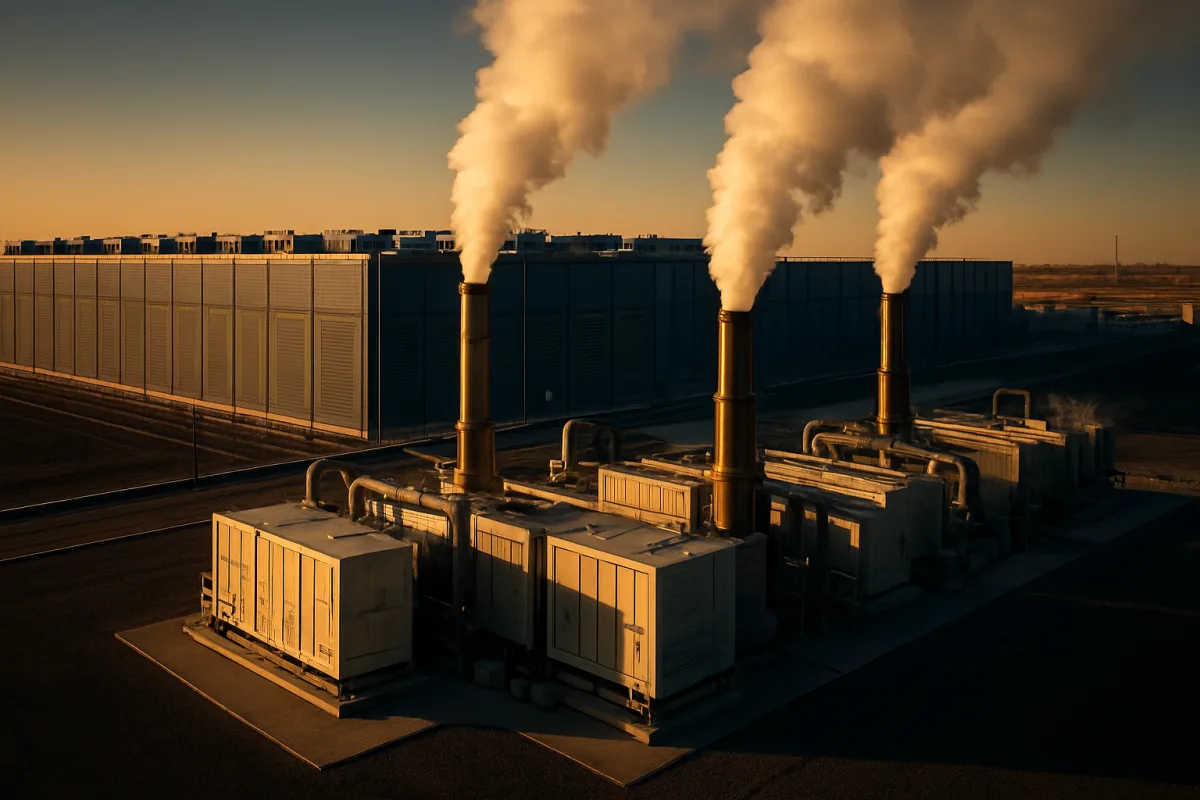
The number that matters is not “emissions per query”
It is tempting to ask how much carbon an AI query emits. The question sounds precise, and it produces suitably compact headlines. But the answer is usually a location-dependent estimate, not an intrinsic property of a model.
A model execution consumes electricity in servers, networking equipment, storage, and cooling systems. Carbon dioxide enters the calculation one step later, when that electricity is mapped to the generation supplying the facility at that moment.
That distinction explains the figure highlighted in the CIO report supplied for this article: the same AI question is estimated to emit 8.5 times more carbon dioxide in Texas than in Sweden. The model is not behaving differently. The power system is.
This is the useful concept to understand: grid carbon intensity. It measures the greenhouse-gas emissions associated with a unit of electricity, typically expressed as carbon-dioxide equivalent per megawatt-hour. Multiply electricity use by that intensity, and one gets an emissions estimate.
The arithmetic is uncomplicated. The assumptions are not. Electricity use varies with the model, response length, hardware, utilization, cooling design, and whether the calculation includes training, inference, or only the chip’s direct power draw.
Then comes the harder question: which electricity source should be assigned to that consumption? A grid is not a traceable pipe running from a particular wind turbine or gas plant to one particular GPU rack.
Why Texas and Sweden can produce different answers
Texas illustrates why regional averages matter. Its 2026 electricity mix is reported as 47.8 percent natural gas, with wind at 22.1 percent, solar at 11.8 percent, coal at 11.0 percent, and nuclear at 6.6 percent. [11]
That mix does not mean every Texas data center runs on gas, nor does it establish the fuel mix of AI facilities specifically. The available research does not provide a precise Texas-wide split between gas, renewables, and other supplies for data centers.
Still, a gas-heavy system has an obvious implication for average carbon accounting. When fossil plants supply a large share of annual electricity, each additional megawatt-hour is generally assigned more emissions than in a system dominated by low-carbon generation.
Sweden provides the contrast in the 8.5-times figure because its electricity system has far more low-carbon generation. The important point is comparative, not mystical: an identical computational workload inherits the characteristics of the electricity system around it.
This also means that a company statement saying an AI service is “powered by renewables” needs inspection. It may describe annual renewable-energy certificate purchases, a long-term power contract, a particular facility, or actual coincident clean power during operation.
Those claims are not interchangeable. A contract can finance clean generation somewhere, which may be valuable, while a data center still draws from a local grid whose marginal supply at 7pm is a fossil plant.
Average electricity is not always the electricity added by AI
For policy and siting decisions, the marginal generator can matter more than the annual average. Marginal electricity means the source that increases output because a new or growing load needs another increment of power.
If a grid has spare wind generation at a given hour, added demand might be met without much additional combustion. If demand arrives during a hot evening after solar output declines, a gas-fired plant may be the unit that ramps up.
That is why a single annual “grams of CO2 per query” number is informative but incomplete. It describes an average accounting relationship. It does not reliably tell a nearby resident what changed when a new facility came online.
The same limitation applies to comparisons between models. A smaller model may use less electricity per response than a larger one, but regional generation, hardware efficiency, and operational timing can change the real-world emissions ranking of two deployments.
The local air-quality problem is more distinct still. Carbon dioxide is a global pollutant, so its climate effect does not depend on where it is released. Nitrogen oxides and fine particles, by contrast, matter intensely near the source.
Why onsite generation changes the pollution question
Data centers are built around continuity of service. A power interruption can take expensive compute capacity offline, damage workloads, and violate customer commitments. Traditionally, backup diesel generators handle short emergencies while the main supply comes from the grid.
The current AI construction boom changes the incentives. In some regions, developers face a wait of up to 14 years for a grid connection, according to TechRadar’s reporting on interconnection and thermal constraints. [9]
A developer facing that delay can seek dedicated electricity generation, including gas turbines or engines built at or near the data center. This can accelerate construction, but it converts an infrastructure bottleneck into a local combustion source.
Gas generation emits carbon dioxide when burned. It can also emit nitrogen oxides, known as NOx, which contribute to ground-level ozone, plus particulate pollution and other pollutants depending on the engine, fuel, controls, and operating conditions.
The environmental outcome depends on mechanics that are often blurred together. Backup generators used occasionally for testing are one category. Equipment operated frequently because the grid cannot supply enough electricity is another, with very different annual emissions.
Texas has become a focal point because of the scale of proposed projects. A Global Energy Monitor analysis reported 189 gigawatts of proposed gas power for US data centers, with 77 gigawatts associated with Texas. [5]
Proposed capacity is not operating capacity, and it should not be read as a forecast that all those plants will be built. It does show why regulators and communities are treating onsite power as more than a routine backup-generator issue.
Air pollution is not captured by a carbon score
The Houston Advanced Research Center scenario reported by The Verge makes the distinction concrete. If planned Texas data centers connect to the grid under an anticipated generation mix, its modeling projects power-sector fine-particle pollution more than tripling within five years.
The same scenario projects a 136 percent increase in smog-forming NOx and a 90 percent rise in carbon dioxide relative to 2025. Those are modeled outcomes, not measurements of existing data-center emissions, and depend on development and fuel assumptions.
The report also models a substantially cleaner route. Pairing grid electricity with onsite renewable generation could cut NOx emissions by as much as tenfold compared with a more fossil-dependent pathway, according to The Verge’s account of the analysis.
That conditionality matters. “Data centers will erase air-quality gains” is too categorical if treated as a prediction. The research is better read as a warning about infrastructure choices, particularly whether new demand induces gas combustion or additional clean generation.
It also omits a distributional question hidden by statewide totals: where are the engines, turbines, transmission lines, and power plants located? Air-quality burdens are experienced by people living downwind, not by a state-average emissions inventory.
Permitting is the mechanism for making these choices visible
The Clean Air Act does not ban data centers. It regulates emissions sources, including stationary engines and turbines, through permits, emission limits, monitoring, and enforcement pathways that vary with the facility and jurisdiction.
That arrangement can be fragmented. EPA policy and state implementation leave states and local authorities with substantial responsibilities for air permits and data-center development decisions, which makes compliance a site-specific project rather than a national checklist. [6]
For operators, the practical questions are mundane but consequential: how many generators are installed, what fuel and engine technology they use, how many hours they will run, whether they are emergency-only, and what controls are required.
These details decide whether a project needs particular permits and whether the public gets an opportunity to scrutinize the plan. They also determine whether a facility’s claimed resilience rests on rarely used backup equipment or regular fossil generation.
The financial cost of compliance is often invoked in debates, but the available reporting does not provide reliable, broadly comparable figures for the cost of permitting, pollution controls, or delayed interconnection across AI data centers. That gap should not be filled with guesses.
What is documented is the cost of getting the permitting question wrong. New Jersey regulators imposed a $1.07 million penalty on DataOne’s Vineland facility for 62 unpermitted generators in September 2026. [3]
The case is useful because it counters the assumption that violations bring merely symbolic penalties. Judicial Clean Air Act penalties can reach $124,426 per violation per day, while administrative penalties can reach $59,114 per day, subject to a $472,901 proceeding cap. [3]
The Memphis dispute is about enforcement, not an abstract AI risk
The legal case surrounding SpaceXAI’s Colossus data center in Memphis shows the same system from the community side. The NAACP sued over allegations that unpermitted gas turbines were operating near predominantly Black neighborhoods. [4]
The suit sought pollution controls and civil penalties, arguing that the turbines could worsen air pollution in already vulnerable communities. The allegations remain allegations, but the procedural ruling is significant for future enforcement. [4]
In October 2026, US District Judge Debra Brown rejected the Trump administration’s claim that the EPA could unilaterally dismiss Clean Air Act citizen suits. The court held that the statute did not grant that power in these circumstances. [4]
That does not establish that every community challenge will win, nor does it determine the merits of the Memphis pollution claims. It preserves a route for affected residents and organizations to pursue alleged violations when federal enforcement is absent.
The pressure is likely to increase as local governments weigh tax revenue and construction jobs against infrastructure demands. Axios has reported that data-center growth has become a local-election issue, not simply a technical planning matter. [1]
The central environmental question is therefore more specific than whether AI is “good” or “bad” for the climate. It is whether a particular facility adds clean capacity, competes for constrained grid power, or begins burning fuel beside the people who did not choose its workload.
Frequently Asked Questions
How does electricity source affect AI data center emissions?
The emissions from an AI data center depend largely on the carbon intensity of the electricity source supplying it. Electricity generated from fossil fuels like natural gas produces more carbon dioxide per megawatt-hour than low-carbon sources such as wind or nuclear. Thus, the same AI workload can have very different emissions depending on the local electricity mix.
Why do AI data centers in Texas emit more CO2 than in Sweden?
Texas’s electricity mix in 2026 is dominated by natural gas (47.8%) and coal (11%), which have higher carbon emissions, whereas Sweden’s grid relies more on low-carbon generation. This difference means that running identical AI computations in Texas results in about 8.5 times more carbon dioxide emissions than in Sweden, reflecting the regional power system rather than the AI model itself.
What are the pollution risks of onsite gas generation at AI data centers?
Onsite gas generation emits carbon dioxide and local air pollutants such as nitrogen oxides (NOx) and particulate matter, which can degrade local air quality and contribute to ground-level ozone. While onsite generation can speed up data center construction by avoiding grid interconnection delays, it shifts combustion emissions directly into the host community and creates complex air-permitting challenges.
How does grid carbon intensity influence AI data center environmental impact?
Grid carbon intensity measures the greenhouse gas emissions per unit of electricity generated. AI data centers consuming power from grids with high carbon intensity inherit higher emissions, while those on low-carbon grids have a smaller environmental footprint. This metric is key to estimating the climate impact of AI workloads but varies by location and time.
What local air pollution concerns arise from AI data center power choices?
When AI data centers rely on onsite gas-fired generators, they emit nitrogen oxides and particulates that affect local air quality and public health. These pollutants differ from carbon dioxide, which is a global climate pollutant, because their effects are concentrated near the emission source. Regulatory compliance and community opposition often focus on these local pollution impacts.
How we researched this
This article was assembled from 3 published articles, 13 cited references.
Nothing here is based on hands-on testing. Where a figure or finding appears, it belongs to the source cited beside it, and the writing says so rather than implying otherwise. Every source is listed below so you can check it.
Sources
Judge rejects Trump’s wild claim EPA can dismiss data center pollution lawsuits — Ars Technica AI
Data centers could erase decades of air quality gains — The Verge AI
The same AI question emits more carbon dioxide in Texas than in Sweden — CIO
Facing pushback on data centers, tech giants are promising hosts more money and fewer secrets
Judge rejects Trump’s wild claim EPA can dismiss data center pollution lawsuits - Ars Technica
Gas Power Proposed for US Data Centers Doubled to 189 GW in Six Months, and Texas Holds 77 GW of It
Air pollution from data center power projects is a rising concern amid build-out | S&P Global
EPA Guts Clean Air Rules, Enables AI Data Center Pollution - Earthjustice
Related Articles
AI Data Center Power Challenges and Infrastructure Impact
Explore AI data center power challenges, infrastructure demands, and local impacts behind 500 MW commitments in AI data centers.

AI in Data Analytics and Visualization
Explore AI in data analytics and visualization with Slackforce Surfaces, Power BI Copilot, and Tableau AI training options compared.

Nvidia Acquisition of Hugging Face and Its Impact
Explore Nvidia's acquisition of Hugging Face and its effects on open-source AI platforms, neutrality, and the AI ecosystem.

AI Tools for Marketing Workflow Optimization and Asset
Explore AI tools that optimize marketing workflows by generating ads, managing assets, and creating virtual influencers for efficient campaigns.