
AI Data Center Power Challenges and Infrastructure Impact
Explore AI data center power challenges, infrastructure demands, and local impacts behind 500 MW commitments in AI data centers.
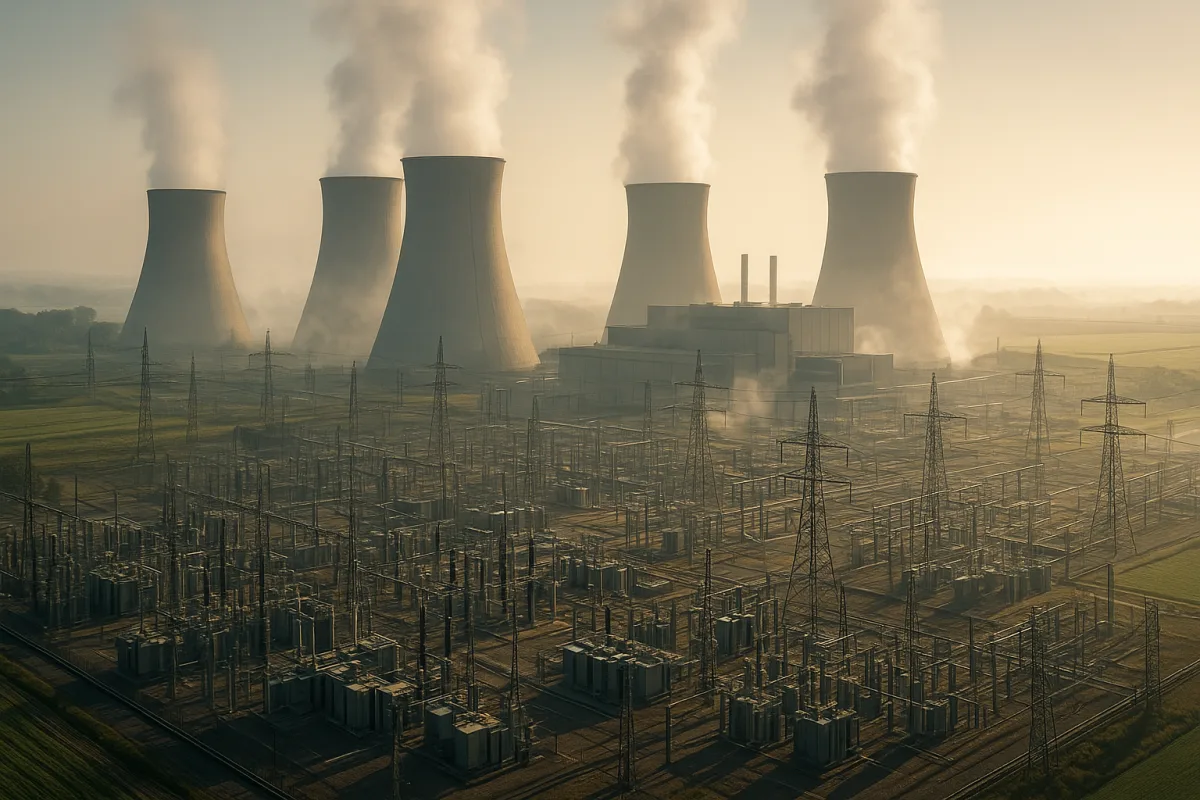
AI data centers: what a 500 MW commitment actually means
The number that matters is 500 MW
The most revealing number in an AI data-center announcement is usually not the model name or GPU count. It is the power commitment. Lake Mariner’s planned buildout in Somerset is described as drawing up to 500 megawatts. [3]
A megawatt measures power, the rate at which electricity is consumed. A 500 MW facility operating at full draw for one hour consumes 500 megawatt-hours of energy. Run continuously for a year, that becomes roughly 4.38 terawatt-hours.
That arithmetic is useful because AI workloads are often marketed as elastic cloud services, while their physical infrastructure behaves more like heavy industry. A large training run may be scheduled, but an inference cluster, cooling plant, network fabric, and standby equipment cannot simply disappear overnight.
Still, “500 MW” should not be read as a measurement of actual annual consumption. It is the site’s prospective maximum load or interconnection scale. Utilisation depends on how much capacity is built, how many servers arrive, which customers use them, and whether power can be delivered when needed.
It also does not mean that 500 MW reaches GPUs. Electricity first passes through substations, transformers, switchgear, uninterruptible power systems, and power-distribution equipment. Some is consumed by cooling, pumps, fans, networking, lighting, controls, and losses in electrical conversion.
This distinction matters for AI economics. A model developer buying compute sees an hourly GPU price. The developer does not necessarily see the transmission upgrades, backup generation, cooling equipment, land arrangements, or debt service required to make that GPU-hour available.
Why AI makes the load politically difficult
A factory may have a substantial load but operate in shifts. A data center designed to serve always-on cloud inference or long training jobs is valuable partly because it can consume power around the clock. That profile changes grid planning.
Leah Stokes, a University of California, Santa Barbara researcher quoted by Ars Technica, describes the core issue plainly: a very large 24/7 load makes the whole electricity system more expensive. Costs can include grid upgrades and peak-period backup generation. [3]
Those costs do not automatically remain with the data-center customer. They can be allocated through utility rates, meaning households and businesses pay part of the cost even if they never use the AI service supported by the site. [3]
Anthropic has said it will cover consumer electricity price increases associated with its data centers, including grid infrastructure costs and new generation intended to match its demand. Ars Technica reports that Lake Mariner falls under this commitment. [3]
That is a meaningful commitment, but it is not a complete accountability mechanism. It addresses electricity pricing, not construction safety, local noise, water use, land impacts, emergency planning, or whether claimed clean-energy attributes can be independently verified.
The capacity number also explains why power availability has become a gating item rather than a procurement detail. Industry reporting has found that grid interconnection delays, permitting complexity, labour availability, and supply-chain bottlenecks can cancel or delay planned data-center projects. [8]
A 500 MW campus cannot be solved by ordering more servers. The project needs transmission capacity, substations, transformers, cooling systems, permits, construction crews, and an operating plan. A delay in any one of these can strand expensive equipment or financing.
Lake Mariner’s corporate structure is part of the infrastructure
Lake Mariner is a useful case because the facility is not simply “Anthropic’s data center,” even though Anthropic’s demand is central to its economics. Several firms play distinct roles, with different legal incentives and different degrees of public visibility. [3]
TeraWulf owns and operates the Lake Mariner campus, located on a former coal-mining site on Lake Ontario. The land is leased from an entity owned by TeraWulf chief executive Paul Prager, according to Ars Technica’s reporting. [3]
Fluidstack, a UK-based AI infrastructure company, is set to operate the facility. Google has agreed to provide credit support for Fluidstack’s lease obligations and holds warrants that could eventually give it a 14 percent equity stake in TeraWulf. [3][12]
Anthropic is a major compute customer, the company whose need for training and inference capacity helps justify the physical buildout. Its role is commercially consequential, but that does not make it the site operator or the party directly managing local emergency response. [3]
This arrangement distributes risk. The property owner and developer needs capital. The operator needs a site and customers. The AI company needs compute without necessarily putting a multi-billion-dollar project directly on its own balance sheet. Financial supporters reduce lender risk.
Private credit has become important in such structures. Capital and Compute reports that private credit can provide 60 to 75 percent of early-stage AI data-center funding, often through special-purpose vehicles that shift debt exposure toward institutional investors. [6]
None of that is inherently improper. Project finance exists because infrastructure is expensive, long-lived, and risky. The problem is practical rather than philosophical: when a community asks who is responsible for a consequence, the answer may depend on the consequence.
For safety, TeraWulf told Ars Technica it was responsible for operational safety and emergency preparedness. For lease payments, Google’s credit support matters. For compute demand, Anthropic matters. For day-to-day operations, Fluidstack matters. [3]
That fragmentation can leave public commitments hard to audit. A cloud customer may promise to manage ratepayer impacts, while the owner makes environmental statements based on the regional grid, and the operator controls equipment whose specifications are not publicly disclosed.
Capital cost is not the cost of running the facility
Lake Mariner is reported as a $3.2 billion campus by TeraWulf and in Ars Technica’s account. Epoch AI, however, lists the same facility at $2.2 billion. The available reporting does not resolve whether this reflects timing or differing project scopes. [3][5]
The discrepancy is not trivial. A billion dollars is large enough to change a project’s financing assumptions, expected returns, and the scale of subsidies or guarantees required. It is also a reminder that headline investment figures are not audited operating-cost models.
TeraWulf reported fiscal 2025 revenue of $168.5 million and a non-GAAP adjusted EBITDA loss of $23.1 million. Those company-level figures do not reveal Lake Mariner’s electricity bill, maintenance cost, cooling cost, debt service, or customer profitability. [1]
That missing information limits what outsiders can conclude. It is reasonable to say that power will be a major expense at a facility of this scale. It is not possible, from public disclosures, to calculate Lake Mariner’s precise cost per GPU-hour.
The common shorthand that AI requires “more data centers” also obscures the economic constraint. The question is not just whether a model company wants compute. It is whether it can sign a sufficiently durable contract to support power, construction, and financing commitments.
TeraWulf’s separate 20-year, $19 billion lease with Anthropic for the Justified Data campus in Kentucky illustrates the scale of these contracts. Long leases make infrastructure finance more plausible, but they also lock customers and communities into long planning horizons. [11]
The backlash is about accountability, not just aesthetics
Opposition to data centers has become material enough to alter project schedules. Tom’s Hardware reported that more than 75 projects worth $130 billion were blocked or delayed during the first quarter of 2026, alongside more than 500 local bans nationwide by July. [7]
Those figures should not be treated as a referendum on whether AI is useful. They show that local approval is now a hard project dependency. A capable model cannot make a proposed substation, water connection, sound barrier, or zoning approval arrive faster.
At Lake Mariner, residents have raised noise complaints. Ars Technica reported that Somerset resident Beth Staples described a persistent hum audible inside her insulated home as the campus expanded. [3]
Employment is another point of friction. A 2024 planning presentation projected 35 to 40 jobs at full buildout, according to Ars Technica, compared with 165 permanent jobs associated with an earlier application for power-discount benefits. [3]
Construction employment is real, but temporary. Pilar Thomas, a former US Department of the Interior official quoted by Ars Technica, characterised the pattern as hundreds of workers during construction followed by a very small operations workforce unless local training commitments exist. [3]
That mismatch explains the politics. A town may absorb visible construction, continuous industrial noise, and a large grid load, then receive relatively few permanent jobs. The value is often captured by cloud customers and investors located far from the facility.
The fire made the abstract problem concrete
A June 2026 fire in an unfinished Lake Mariner building exposed a more immediate form of accountability. Firefighters reportedly encountered no working alarm, no suppression system, and three non-functioning hydrants, while safety documents were unavailable during the response. [3]
No one was injured, and construction continued. But the incident matters because data centers are often treated as clean, automated, and low-touch infrastructure. In reality, they contain high-voltage electrical systems, batteries, fuel arrangements, cooling equipment, cabling, and construction hazards.
The research brief notes that NFPA 75 and NFPA 2001 provide established fire-protection frameworks for IT equipment and clean-agent suppression systems. Local code adoption and enforcement vary, however, so the existence of a standard does not demonstrate compliance at a particular site.
TeraWulf said it implemented Knox boxes, additional hydrants, and safety-data-sheet “go-bags” after an after-action review. Yet Barker Fire Department chief Steve Matisz told Ars Technica in mid-August that, to his knowledge, the hydrants remained dry. [3]
That is not evidence that every AI data center is unsafe. It is evidence that the operational reality of one unfinished, high-profile project did not match the public expectation that emergency access, suppression, alarms, and hazardous-material information would already be reliable.
For local governments, the practical lesson is straightforward. A development agreement should identify the responsible entity for emergency planning, specify what information first responders receive, require inspection milestones, and make compliance independently checkable before capacity is energised.
For AI companies, the equivalent lesson is less comfortable. Buying capacity through a layered lease structure may be financially efficient, but it does not remove reputational exposure when the facility enabling the model service becomes a source of local safety or grid controversy.
Frequently Asked Questions
What does a 500 MW power commitment mean for AI data centers?
A 500 MW power commitment indicates the maximum continuous electrical load the data center can draw, including servers, cooling, backup systems, and losses. It is not the actual power consumption but the upper limit of power the site may use when fully operational. This figure helps understand the scale of infrastructure and grid capacity needed to support the facility.
How do AI data centers impact local power grids and infrastructure?
AI data centers with large, always-on power loads require significant grid upgrades, including transmission capacity, substations, and backup generation. These upgrades increase overall electricity system costs, which can be passed on to local consumers through utility rates, even if they do not use the AI services. The inflexible, continuous demand also complicates grid planning and reliability.
Why are AI data centers causing local backlash and regulatory challenges?
Local opposition stems from concerns about large, inflexible power consumption, water use, noise, limited job creation, and unclear responsibility for grid upgrade costs. Residents and regulators worry about the broader community impact and accountability, not just the AI technology itself. This has led to numerous project delays, denials, and local bans.
What are the hidden costs behind AI data center power consumption?
Beyond the hourly GPU compute price, hidden costs include infrastructure upgrades, backup power, cooling systems, land arrangements, and debt servicing. These expenses are often not visible to model developers but are essential to support the continuous power demand. They may also affect local electricity prices and require significant capital investment.
How do corporate structures affect accountability in AI data centers?
Complex ownership and operational arrangements—such as TeraWulf owning the site, Fluidstack operating it, Google backing leases, and Anthropic as a major customer—create opacity in management and responsibility. This complexity makes it difficult to assign clear accountability for environmental, safety, and community concerns, complicating regulatory oversight and public transparency.
How we researched this
This article was assembled from 1 video source, 6 published articles, 12 cited references.
Nothing here is based on hands-on testing. Where a figure or finding appears, it belongs to the source cited beside it, and the writing says so rather than implying otherwise. Every source is listed below so you can check it.
Sources
NVIDIA Doubles Down on Local AI With PAIR — Sam Witteveen
The complex corporate web behind a $3.2 billion AI data center — Ars Technica AI
The complex corporate web behind a $3.2 billion AI data center — Ars Technica AI
University of Hawaiʻi receives $2M for development of artificial intelligence tools to protect food production systems — kauainownews.com
When machines analyze ideas, has artificial intelligence reached the stage of critical thinking? — صوت الإمارات
Got $1,000? 3 Stocks Building the Physical Artificial Intelligence (AI) Era — Yahoo Finance
Anthropic releases new models, cost structures and safeguards
The complex corporate web behind a $3.2 billion AI data center - Ars Technica
Inside the Corporate Web Behind Lake Mariner’s $3.2 Billion AI Data Center // Tech Beat
Bitcoin miner TeraWulf soars on a $19 billion AI data-center lease with Anthropic
Watch AI Data Centers and Infrastructure Challenges on Youtube
Related Articles
AI Data Center Environmental Impact and Pollution Explained
Explore how AI data center emissions vary by power source and location, and the pollution risks of onsite generation.
AI Safety and Security Incidents, Research, and Funding
Explore AI safety and security incidents, research progress, and funding efforts shaping AI deployment and operational safeguards.

AI in Data Analytics and Visualization
Explore AI in data analytics and visualization with Slackforce Surfaces, Power BI Copilot, and Tableau AI training options compared.
AI Market Dynamics: Nvidia, Bill Gates, and Investment
Explore AI market dynamics covering Nvidia's pricing, Bill Gates' AI policy, and current investment trends shaping the AI industry.