
AI Agents Loop Engineering for Improved AI Systems
Learn how AI agents loop engineering improves AI systems with best practices for context, verification, and reliable task completion.

Start with a task that can actually terminate
The first practical problem is not model choice. It is choosing work an agent can finish without inventing its own definition of success. “Improve support quality” is a management objective, not an executable agent goal.
IBM Technology’s loop-engineering example is useful here: “make checkout faster” has no clear finish line, while “stop when every checkout unit test passes” can be checked after each iteration. The distinction determines whether a loop converges, wanders, or stops after cosmetic progress.
Write the task as four parts: a target, allowed actions, an acceptance test, and a budget. For example: inspect failing checkout tests, edit only files under a named service directory, stop when the test suite passes, and make at most five edit-test cycles.
That last limit matters. A loop needs both a success condition and a stopping condition. Without the latter, a transient API failure, malformed tool response, or repeated bad hypothesis becomes an infinite retry loop. Production reports consistently identify retry cascades and tool-call cascades as common agent failures. [7]
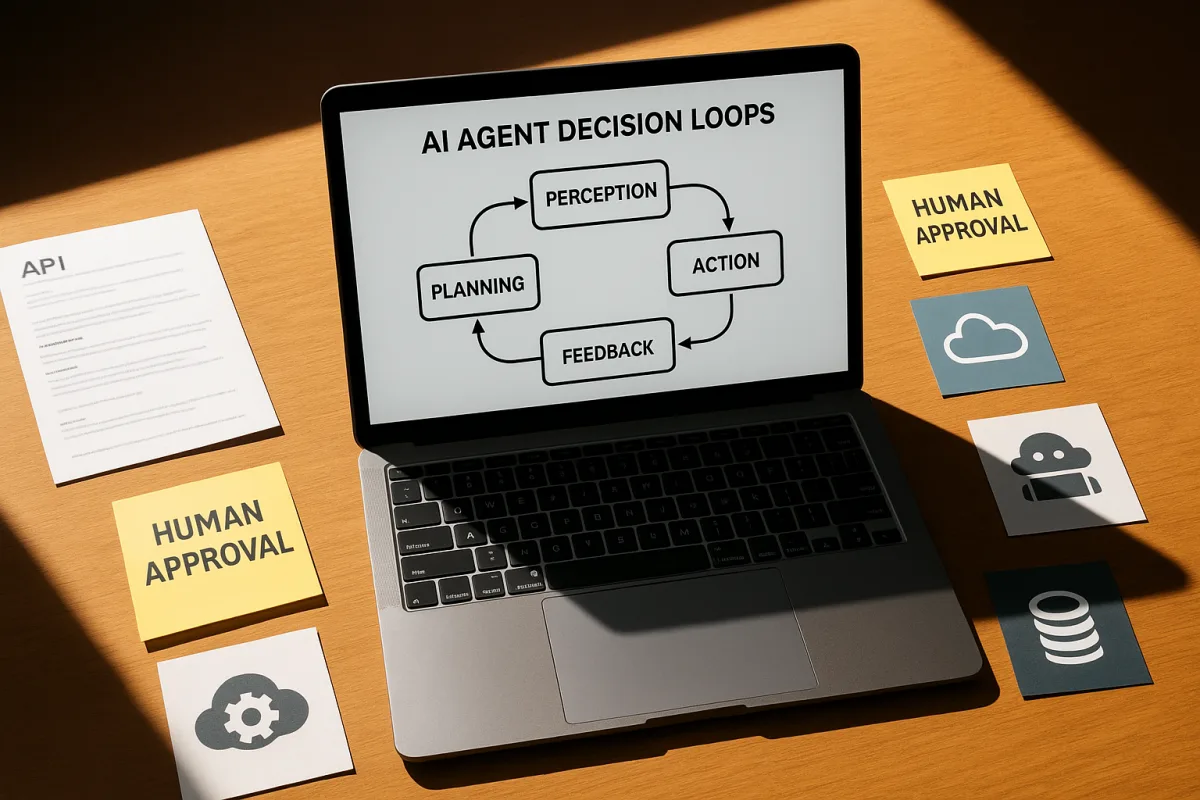
A minimal implementation has four stages: goal, action, observation, and adjustment. The agent proposes or performs an action, receives evidence from a tool, compares the result with the acceptance test, then either continues or stops. That is loop engineering in its useful sense.
Do not begin with a multi-agent architecture. The independent research behind current loop-engineering guidance recommends simple architectures first, adding complexity only when evaluation shows a single loop is bottlenecked. [2][4] A planner, executor, reviewer, and memory agent can produce more logs without producing better work.
Make the verifier independent of the actor
The next failure arrives when the agent grades its own homework. An agent that generated a patch can often explain why it seems sensible, but that is not equivalent to testing the patch against the system’s actual requirements.
Use deterministic checks wherever possible. For software tasks, run unit tests, type checks, linters, security scans, and a targeted integration test. For document workflows, validate required fields, totals, output schema, and source references before an agent can mark work complete.
A second model can be helpful as a reviewer, as IBM Technology notes, especially when checking whether an output follows a rubric. But it is not an independent ground truth. A reviewer model can share the same blind spot, misread evidence, or simply endorse polished nonsense.
The practical pattern is layered verification. First, check structural constraints in code. Next, run domain-specific tests. Then use a model-based reviewer for ambiguities that cannot be reduced to rules. Finally, require human sign-off for actions with material consequences.
For example, an expense-report agent can extract receipts, categorize spending, and flag unclear entries. The Claude Cowork walkthrough from Simplilearn describes this kind of folder-based workflow. The system should still require a human to approve reimbursement categories, tax treatment, and any report submitted externally.
Give the agent less context, more deliberately
Once the loop runs for more than a few turns, context becomes the dominant engineering problem. A long context window is not a reliable substitute for memory design.
IBM Technology calls the resulting decline in reliability “context rot.” Research cited in the brief suggests effective context capacity may be only 60 to 70 percent of a stated maximum, with quality degrading well before the nominal token limit. [8] A million-token window is capacity, not guaranteed usable attention.
An agent context commonly accumulates system instructions, the task prompt, project rules, tool schemas, previous messages, file contents, logs, screenshots, test output, and the agent’s own notes. Most of that material is not needed for the next decision.
Use a context packet for every loop iteration. Include the current goal, current state, explicit constraints, the smallest relevant evidence set, and the next action options. Do not replay the entire transcript by default.
Four failure modes are especially worth designing against. Context poisoning occurs when an agent writes an incorrect conclusion into memory and later treats that note as fact. Context distraction occurs when the action history becomes the strongest pattern and the agent repeats previous work rather than reassessing the task.
Context confusion is usually tool sprawl. IBM Technology cites an example in which a model failed with 46 available tools but passed the same task with 19. The point is not that 19 is a universal limit. It is that irrelevant tool definitions make selection harder.
Context clash happens when the window includes conflicting instructions or outdated conclusions. An agent may discover that an earlier assumption was false, but retain both versions in its working context. It then has no stable basis for deciding which instruction governs.
The corresponding remedies are concrete. Validate facts before storing them as durable memory. Compact verbose history into a short state summary. Curate tool access for the specific task. Prune invalidated notes, or begin a clean context with the corrected state. [8]
Keep detailed evidence outside the prompt in durable files or a database, then retrieve it only when needed. This is where retrieval-augmented generation is useful, not because retrieval makes answers inherently true, but because it limits the working set to relevant source material.
The Simplilearn RAG course correctly distinguishes this from fine-tuning. Fine-tuning can suit stable, repeated behavioural tasks, but it is an expensive way to keep changing company policies current. Retrieval is generally a better fit for documents that change and need citations.
Build memory that records intent, not just events
A running log saying “edited file, ran test, test failed” is not enough for a long-running agent. It preserves events but not why a constraint exists, why a previous approach was rejected, or which business rule must not be altered.
IBM Technology describes this as intent debt. An agent can infer what code does, but may not know why it does it. A test failure may be fixed by relaxing discount validation, for example, while violating the commercial rule the validation was meant to enforce.
Create a short project instruction file with non-negotiables: protected data classes, business rules, ownership boundaries, environments the agent must not touch, and approval requirements. Keep this file versioned and visible to the loop.
Then maintain a structured state record with: validated facts, open hypotheses, attempted actions, rejected approaches, current risks, and links to evidence. Do not allow the agent to overwrite validated facts without attaching new evidence and marking the previous conclusion superseded.
This is more useful than asking a model to “remember everything.” The model does not need every terminal line. It needs a reliable statement of the current world, with enough provenance to challenge it.
Restrict tools before you connect everything
Tool access turns a language model into an operational system. It also creates the most direct route from a bad inference to an expensive or irreversible outcome.
The Claude Cowork example from Simplilearn shows the attraction: an agent can access selected folders, create documents, connect services such as Google Drive and Google Calendar, and reuse repeated instructions as custom skills. These are practical capabilities, but each connector expands the permission surface.
Use least privilege at the tool level. A reporting agent needs read access to a designated source folder and write access to an output folder. It does not need repository administration, production database access, unrestricted email sending, or every calendar in the organisation.
Separate tools by consequence. Read-only search and file inspection can be automated with relatively broad access. Draft creation can be automated in a sandbox. Sending, merging, deleting, paying, changing permissions, and publishing should require a confirmation gate.
Do not assume agent workspaces share uniform security properties. Claude Cowork is reported to offer isolated cloud sandboxes, local execution options, role-based access control, and data deletion policies, but the research brief found no comprehensive public comparison of workspace security across competing products. [9]
That uncertainty is not theoretical. Recent reporting identified serious vulnerabilities in LiteLLM, an open-source AI gateway, that could affect millions of users. [9] Security architecture, patching practice, credential storage, and auditability matter more than an agent platform’s marketing label.
Add observability before adding autonomy
A useful agent trace should answer five questions: what goal was active, what context was supplied, which tool was called, what result came back, and why the agent chose its next action.
Log tool inputs and outputs with appropriate redaction. Record model version, prompt or policy version, retrieval sources, latency, token use, loop count, and final termination reason. Without this, silent quality drift appears as a vague complaint weeks after deployment.
Evaluate at two levels. Outcome evaluation asks whether the task was completed correctly. Process evaluation asks whether the agent used permitted tools, retrieved appropriate sources, stayed inside the loop budget, and escalated uncertainty instead of guessing.
Build a small test set from real failures, not only ideal examples. Include missing documents, contradictory policies, malformed tool responses, permission denials, stale data, and ambiguous requests. Re-run it whenever you change models, prompts, tools, retrieval settings, or policies.
This is also how to decide whether multi-agent decomposition is justified. If traces show the primary agent repeatedly fails to verify calculations, add a narrowly scoped calculator or verifier. If it fails because source documents are missing, another “reasoning” agent will not solve the retrieval problem.
Choose tooling by operating model, not hype
There is no settled default platform for loop engineering. The current ecosystem includes ZeroShot, LangGraph, the OpenAI Agents SDK, Braintrust, LangSmith, and Langfuse, alongside broader frameworks such as LangChain and CrewAI. [5]
LangGraph and LangChain suit teams that want open-source building blocks and are prepared to operate their own application infrastructure. CrewAI similarly suits role-based multi-agent experiments, but should not be chosen merely because a workflow can be described as a team of agents.
The OpenAI Agents SDK suits applications already committed to OpenAI’s model and tool ecosystem. Braintrust, LangSmith, and Langfuse suit teams whose immediate gap is evaluation, tracing, and observability rather than orchestration itself. ZeroShot is another option in a fragmented tooling market, not evidence that a standard has emerged. [5]
Microsoft Copilot Studio suits organisations that value managed enterprise integration and are comfortable with subscription and usage-based AI-credit billing. [5] It may reduce platform work, but it does not remove the need to define permissions, approval gates, evaluation, and ownership.
Price comparisons need care. Open-source cores such as LangChain and CrewAI are free to use, but production infrastructure, hosted observability tiers, vector storage, engineering time, and model inference are not. [5][10] “Free framework” is not a total cost of ownership.
The research brief places model inference roughly between $0.002 and $0.015 per 1,000 tokens, while reserved capacity plans can run from $8,000 to $22,000 per month. Self-hosted GPU deployments may require $15,000 to $40,000 upfront plus $3,000 to $8,000 in monthly operations. [10]
Those figures are not a recommendation to self-host. They show why loop design matters financially. An unbounded agent that repeatedly retrieves documents, calls expensive models, and retries failed tools can turn a modest per-request cost into a material operating bill.
Put humans where judgment is genuinely required
Human-in-the-loop does not mean a person manually approves every harmless file read. It means people retain responsibility for goals, business intent, high-impact decisions, and final review of consequential output.
IBM Technology warns that automated code generation can create comprehension debt. If agents generate changes faster than engineers can understand them, an organisation accumulates code it cannot safely debug or evolve. That is not solved by asking another agent for a summary.
Set escalation rules in advance. Escalate when evidence conflicts, confidence is low, a tool fails repeatedly, the task touches sensitive data, the action is irreversible, or the loop reaches its budget without meeting its acceptance test.
This is the practical alternative to both hype and panic. Agents can reduce repetitive work when their scope is constrained, their evidence is curated, and their results are verified. They are not autonomous colleagues with independent accountability.
Frequently Asked Questions
What is loop engineering in AI agents?
Loop engineering is the design of an iterative process where an AI agent performs actions, observes results, compares those results to acceptance criteria, and then decides whether to continue or stop. It involves defining a clear goal, allowed actions, stopping conditions, and a budget for iterations to ensure the loop converges and does not run indefinitely.
How does loop engineering improve AI system reliability?
By establishing machine-checkable stopping conditions and acceptance tests, loop engineering prevents infinite retry loops and cascading failures common in AI agents. Starting with simple single-agent loops before adding complexity helps isolate bottlenecks and reduces the risk of error propagation, improving overall system stability.
What are best practices for designing AI agent loops?
Begin with a narrowly scoped task that has a clear finish line, use a minimal architecture with one agent and limited tools, and define explicit success and stopping criteria. Incrementally add complexity only if necessary, and budget for the full operational costs including inference, observability, and security.
How can context be managed effectively in AI agents?
Treat context as a constrained working memory by including only the current goal, state, explicit constraints, relevant evidence, and next action options in each iteration’s context packet. Avoid replaying entire conversation transcripts, as effective context capacity is less than the model’s token limit and excessive context leads to degraded performance known as “context rot.”
Why is independent verification important for AI agents?
Independent verification prevents agents from grading their own work, which can lead to false positives or overlooked errors. Using deterministic checks like unit tests, linters, and domain-specific validations, combined with model-based reviewers and human approval for critical actions, ensures outputs meet actual requirements rather than just appearing plausible.
How we researched this
This article was assembled from 5 video sources across 2 channels, 10 cited references.
Nothing here is based on hands-on testing. Where a figure or finding appears, it belongs to the source cited beside it, and the writing says so rather than implying otherwise. Every source is listed below so you can check it.
Sources
Agentic AI Full Course 2027 | Complete Agentic AI Course For Beginners | Simplilearn — Simplilearn
What Is Loop Engineering? Building Better AI Agents — IBM Technology
How to Use Claude Cowork? | Claude Cowork Full Tutorial | Use Cases of Claude Cowork | Simplilearn — Simplilearn
Context Engineering for AI Agents: 4 Failure Modes to Avoid — IBM Technology
RAG Full Course For Beginners in 1 Hour 2027 | Complete Agentic RAG Crash Course | Simplilearn — Simplilearn
Why AI Agents Fail in Production: 7 Failure Modes and How to Prevent Them | OpenNash Blog
AI agents aren't lacking intelligence - they're lacking context
AI agents have a mind of their own - and that's a problem for businesses
Watch AI Agents and Loop Engineering for Improved AI Systems on Youtube
Also from the sources
Related Articles

AI Agent Development and Multi-Agent Systems Best Practices
Learn AI agent development essentials, from single-agent workflows to multi-agent systems and tool integration challenges.

AI Automation Workflow Best Practices for Reliable Systems
Explore AI automation workflow best practices and tools to build secure, reliable, and manageable AI-driven processes.
AI Agents Action Selection
Explore AI agents' action selection, integration challenges, and security in automation. Learn about personal AI agents and best practices.

AI Model Observability and Training Infrastructure Explained
Learn how AI model observability and training infrastructure improve agent reliability using trace-verifier loops and structured telemetry.