
On-Device Private AI Agents for Enhanced Privacy
Explore how on-device private AI agents improve privacy by processing data locally and reducing exposure to cloud risks.
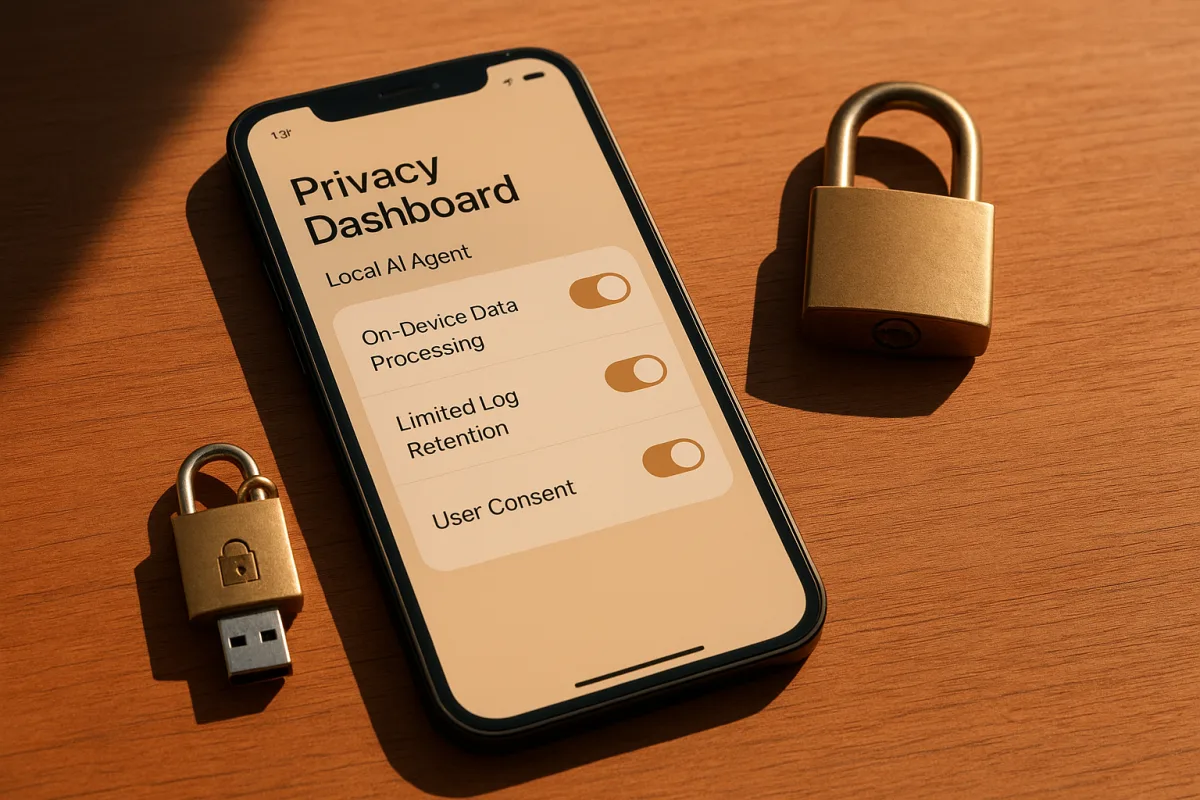
The shift is real, but it is not a wholesale move away from the cloud
AI agents are increasingly being designed to run where the data already lives: on a phone, laptop, workstation, or private server. The practical goal is less “AI without the internet” than reducing unnecessary data transfer and round trips.
Multiple groups are now pursuing that same pattern from different directions. Google DeepMind and Singapore’s Government Technology Agency are building local scam detection for conversations, while Liquid AI is releasing an open-weight agent model designed for local inference. [1][5]
That overlap matters. A scam classifier embedded in a messaging app and a general-purpose tool-using model are not the same product, but both reflect a market constraint that cloud-first AI often sidesteps: sensitive context is difficult to send elsewhere safely.
The evidence should not be overstated. Most useful agent systems still depend on networks for search, SaaS tools, enterprise systems, and software updates. On-device inference can remove one cloud dependency, but it does not automatically make an entire workflow private.
Privacy is becoming an architecture requirement
The strongest case for local inference is not simply that it feels faster. It is that some data should not become prompt traffic to a third-party service in the first place: private chats, internal documents, customer records, financial information, or proprietary source code.
That concern is moving beyond abstract policy language. A September report covered restrictions by companies including Nvidia and Palantir on advanced AI model use over fears that customer intellectual property could be exposed through external systems. [2]
There is a tension here worth stating plainly. Teams want AI to see more context because context improves answers and automation. Security and legal teams often want the model to see less, because every new data flow expands exposure.
Running inference locally can narrow that exposure, particularly when the task works on a self-contained corpus or a private conversation. It does not eliminate risk from malicious prompts, compromised devices, unsafe tools, or an agent that is authorised to take damaging actions.
Regulation is adding pressure as well. Singapore’s Personal Data Protection Commission issued generative-AI guidance effective 20 July 2026 that requires explicit consent and clear notification when personal data is used for AI training or fine-tuning. [1]
The rules are not uniform. The EU’s GDPR emphasises data minimisation, purpose limitation, and transparency; China’s PIPL has strict consent and cross-border transfer provisions; and the US still relies on a patchwork of state and sector-specific laws rather than one federal privacy statute. [3]
For project planners, “it stays on device” is therefore useful but incomplete. You still need to establish why the agent may access the data, what it stores, which tools receive derived information, and how users can understand and control that access.
Singapore’s scam detector shows the narrow, credible version of private AI
Google DeepMind and GovTech Singapore have fine-tuned a lightweight Gemma-based model on local scam conversations, including impersonation of public institutions, banks, and regional scams. The intended deployment processes conversations on the user’s device rather than scanning them on servers. [1]
This is a more disciplined application than a vague promise of an all-purpose “private agent.” The model’s job is to identify manipulative conversational patterns and issue a warning before a user shares money, credentials, or sensitive information. [1]
The local context is important because Singapore reported more than S$4 billion in scam losses since 2019, and DeepMind says socially engineered scams account for up to 80% of losses. Those are conditions where delaying analysis for a remote service may be undesirable. [1]
DeepMind describes a two-stage pipeline, using a lightweight classifier before the fine-tuned Gemma model. That is an engineering signal worth noticing: efficient on-device AI often comes from routing most inputs away from the expensive model, not simply shrinking a model until it fits. [1]
The project also makes a specific privacy claim. When deployed, the model is meant to access conversations only with user consent, and because processing runs locally, Google and the Singapore government say they cannot access the conversations through that deployment. [1]
That claim is meaningful, but it is not equivalent to a public security evaluation. There are no disclosed figures for latency or energy use on current consumer smartphones, despite the emphasis on real-time detection and battery efficiency. [1]
Nor are there public real-world accuracy results, detailed failure cases, or evidence showing how the model adapts to new scam campaigns. Synthetic voices, deepfakes, and rapidly changing social-engineering scripts are precisely the cases where a static local classifier may age badly.
This is not a reason to dismiss the approach. It is a reason to distinguish a promising privacy-preserving deployment design from demonstrated protection. A warning model can reduce some risk while still missing scams, falsely warning on benign conversations, or being bypassed by novel tactics.
Local agents are becoming more technically plausible
Liquid AI’s LFM2.5-24B-A2B illustrates why this trend is accelerating now. It is a 24-billion-parameter mixture-of-experts model, but routes only about two billion parameters per token, reducing active compute relative to a dense model of similar total size. [5][7]
Its architecture combines 40 layers, 64 experts per mixture-of-experts block, top-four routing, gated short convolutions, and grouped-query attention. The details matter because local inference depends on memory traffic and active parameters, not parameter count alone. [5]
Liquid AI expanded the model’s context window from 32,000 to 131,000 tokens and its vocabulary from 65,000 to 128,000 tokens. The company says the vocabulary expansion improves handling of non-Latin languages, an important practical consideration for global deployments. [5]
The model is positioned for agentic work, meaning it is trained to follow instructions, use tools, and operate across multiple turns. Liquid AI’s evaluation reports leads or ties on five of eight tool-use and agent benchmarks, including AutomationBench and ToolSandbox. [5]
Benchmark results should be read carefully. The company evaluated LFM2.5-24B-A2B against Qwen, Gemma, and Nemotron mixture-of-experts models using vLLM and benchmark-recommended generation settings, which is useful but not equivalent to a production deployment. [5]
The tests measure structured tool calling, instruction following, and task completion under particular harnesses. They do not fully measure permission errors, confusing user interfaces, poor tool documentation, private-data leakage through integrations, or the cost of recovering from a wrong automated action.
Liquid AI also reports that larger models retain an edge on knowledge-heavy tests such as GPQA Diamond and HLE, and on coding evaluations including SWE-Bench Verified and SciCode. Its own recommendation is to pair the local model with retrieval or web search for knowledge-intensive work. [5]
That is the right caveat. An efficient local model can decide which tool to call or extract information from a private document, while a retrieval layer supplies changing facts. But web search reintroduces external data flows, which need their own privacy review.
Performance claims are useful, not universal
Liquid AI reports 184 generated tokens per second on an Apple M5 Max and 114 tokens per second on an AMD Ryzen AI Max+ 395. These are strong figures for local interactive use, but they are hardware-specific vendor-reported results, not phone performance. [5]
The company also reports more than 21,000 output tokens per second at high concurrency on a single Nvidia B300. That result speaks to server throughput rather than personal-device inference, and should not be used to imply that a laptop or handset will behave similarly. [5]
This distinction matters when planning a product. “On-device” can mean a flagship phone, an employee MacBook, a workstation with a discrete GPU, or an appliance on a local network. Those environments have radically different memory, thermal, power, and management constraints.
LFM2.5-24B-A2B has day-one support in llama.cpp, MLX, vLLM, SGLang, and ONNX, according to Hugging Face’s release announcement. That ecosystem support lowers integration friction, particularly for teams that need an OpenAI-compatible local endpoint. [5]
The model’s weights are available for self-hosting without a disclosed licensing fee. For teams preferring an API, listed pricing is $0.10 per million input tokens, $1.00 per million output tokens, and $0.05 per million cached input tokens, with $5 in new-user credits every 30 days. [6]
Those options suit different projects. Self-hosting suits organisations with sensitive records, predictable workloads, and hardware operations capability. The API suits prototypes and variable demand, but it is no longer an entirely local privacy model, regardless of the model’s edge credentials.
The overlooked problem is maintenance, not inference
A local model is not frozen in a useful state forever. Scam techniques change, internal policies change, tools change, and vulnerabilities are found. Updating model weights safely can be as important as selecting the initial model.
For LFM2.5-24B-A2B, open weights mean users can download and deploy updated releases locally. However, neither Liquid AI nor the available release material describes a dedicated secure update or verification framework for privacy-preserving offline deployments. [5][7]
That gap is normal for an early platform layer, but teams should not ignore it. A serious local-agent deployment needs signed artifacts, version pinning, rollback procedures, audit records, and a clear process for retiring models that no longer meet policy or security requirements.
The same applies to prompts, retrieval indexes, tool schemas, and policy rules. An agent can keep prompts local while leaking private data through a tool call, a diagnostic log, an analytics SDK, or a poorly controlled remote retrieval service.
What to build first
Start with a bounded task whose privacy case is obvious: local document extraction, offline meeting-note organisation, support-ticket triage on a private workstation, or an approval assistant that proposes actions but does not execute them automatically.
Use a smaller classifier or deterministic rule before invoking the generative model where possible. DeepMind’s two-stage scam pipeline is the relevant design pattern: reserve costly reasoning for ambiguous cases, and make the cheap path observable and easy to evaluate. [1]
Define the trust boundary before choosing a model. Specify what never leaves the device, what may leave after redaction, whether the model can call networked tools, and whether users can inspect or revoke permissions without navigating an administrative maze.
Finally, evaluate the workflow rather than only the model. Measure task completion, false actions, latency on your target hardware, battery or thermal impact where relevant, data retained by each component, and recovery time after an incorrect recommendation.
The trend toward private, local agents is real because the underlying incentives are real: privacy risk, regulatory pressure, latency, and the improving efficiency of open models. But the credible near-term future is hybrid and selective, not a clean replacement of cloud AI.
Frequently Asked Questions
What are on-device private AI agents and how do they enhance privacy?
On-device private AI agents are AI models that run locally on devices such as phones or laptops, processing data where it is generated rather than sending it to the cloud. This approach reduces unnecessary data transfer, helping to keep sensitive information like private chats or customer records from being exposed to third-party servers. However, on-device AI is a deployment choice and does not guarantee privacy without careful design, including clear user consent and minimal data retention.
How does running AI agents locally improve data security?
Running AI agents locally narrows data exposure by keeping raw conversations and sensitive information on the user’s device, avoiding prompt traffic to external services. This limits the risk of data interception or misuse during transmission. However, local inference does not eliminate all risks, such as those from compromised devices, malicious prompts, or unsafe tool integrations.
What are the limitations of on-device AI for privacy protection?
On-device AI does not fully guarantee privacy because it still requires careful management of data access, storage, and tool interactions. There are also engineering costs related to hardware, security updates, and permissions design. Additionally, the effectiveness of on-device models against evolving threats like new social engineering tactics or AI-generated deepfakes is uncertain, as detailed performance data and failure analyses are not publicly available.
How do regulations impact the design of private AI agents?
Regulations such as Singapore’s PDPC guidelines require explicit consent and clear notification when personal data is used for AI training or fine-tuning. The EU’s GDPR emphasizes data minimization and transparency, while China’s PIPL imposes strict consent and cross-border data transfer rules. These frameworks compel AI developers to design agents that limit data exposure, obtain clear user permissions, and provide transparency about data use, though regulatory requirements vary by jurisdiction.
What are examples of on-device AI agents used for scam detection?
Google DeepMind and Singapore’s Government Technology Agency developed a lightweight Gemma-based model fine-tuned on local scam conversations to detect manipulative patterns in real time on users’ devices. This model warns users before they share sensitive information, aiming to reduce losses from scams that have cost Singapore billions. The model uses a two-stage pipeline and processes data locally to maintain privacy.
How we researched this
This article was assembled from 2 published articles, 7 cited references.
Nothing here is based on hands-on testing. Where a figure or finding appears, it belongs to the source cited beside it, and the writing says so rather than implying otherwise. Every source is listed below so you can check it.
Sources
Google DeepMind and Singapore Government announce new AI tool to protect citizens against scams — Google DeepMind Blog
Run fast, private agents on-device with LFM2.5-24B-A2B — Hugging Face Blog
On-Device AI Against Scams: Google DeepMind & MDDI — Google DeepMind
Google DeepMind, GovTech Singapore Unveil Private On-Device Scam Detector // Tech Beat
LFM2.5-24B-A2B API, Pricing & Playground | Vercel AI Gateway
LFM2.5-24B-A2B: Built for Fast On-Device Agents | Blog | Liquid AI
Related Articles
AI Model Infrastructure Optimization Techniques Explained
Learn AI model infrastructure optimization techniques to improve inference latency, local deployment, tokenization, and GPU utilization effectively.

Meta Muse AI Agent and Ecosystem: Devices and Interaction
Explore Meta Muse AI agent, its Charm device, persistent virtual machine, and security in Meta's consumer AI ecosystem and interactions.
TrueForge vs Hermes Agent
Compare TrueForge and Hermes Agent, two open source AI agent platforms, to find the best fit for deployment, security, and personal assistant use cases.

AI in Robotics and Real-Time Applications
Explore how AI integrates with robotics for real-time control, challenges in deployment, and practical lessons from recent demos and projects.