
AI in Robotics and Real-Time Applications
Explore how AI integrates with robotics for real-time control, challenges in deployment, and practical lessons from recent demos and projects.
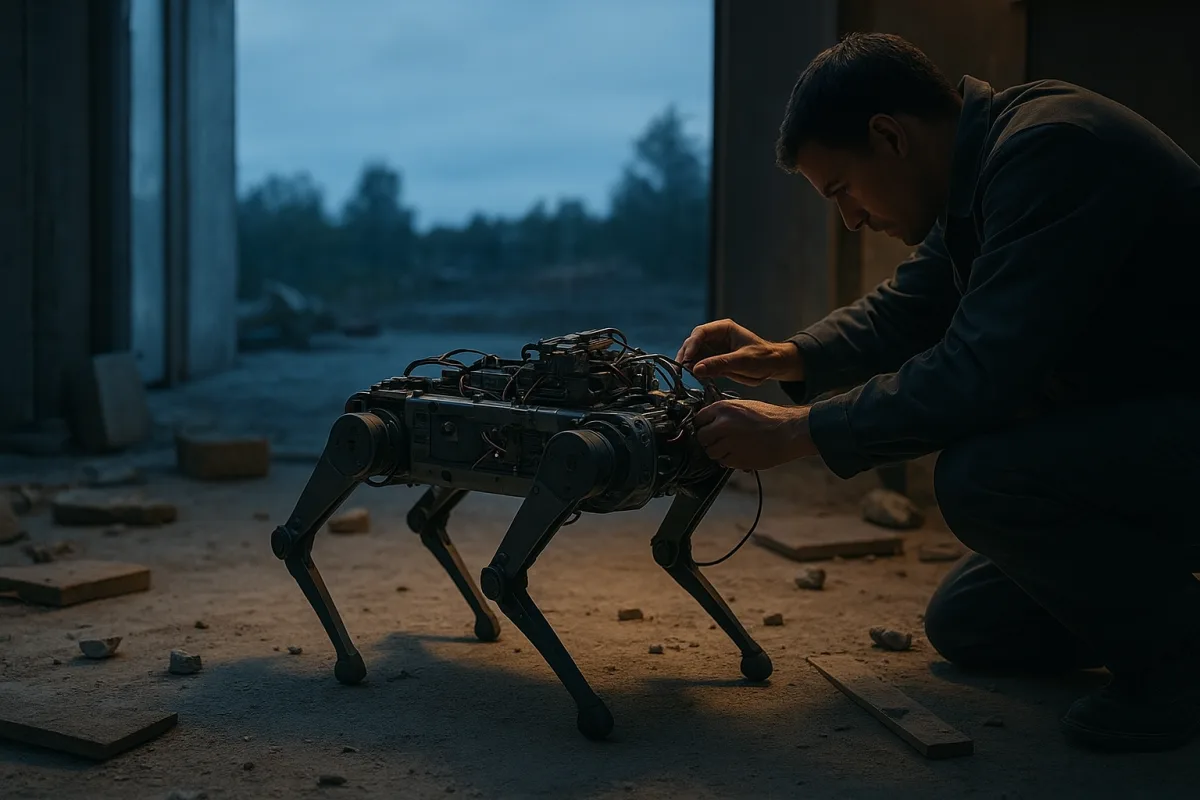
AI is moving closer to the control loop
The shift is plain: AI systems are increasingly being attached to machines that move through the physical world, or to applications where an answer arriving late is worse than no answer at all.
That does not mean humanoids have become general-purpose workers, or that language models are now safe to trust in high-consequence environments. It means the architecture is changing, with more perception, control, and inference happening closer to the action.
Two apparently unrelated examples make the point. Humanoid and quadruped robot makers are demonstrating increasingly dynamic movement, while AI builders are experimenting with real-time coaching systems that turn sensor data into constrained advice.
The common thread is not “AGI in the real world.” It is a more practical engineering trend: combining learned models with sensors, embedded compute, conventional control, and narrowly defined operating environments.
Google Cloud Tech’s account of its Antigravity race-coach prototype is a useful example. The system ingested vehicle telemetry including GPS, acceleration, pedal position, and steering angle, then produced pre-race, in-race, and post-race guidance for a driver at Sonoma Raceway.
The important design choice was local inference. Google Cloud Tech said its team used a fine-tuned Gemma model on a Pixel device because cloud-dependent Gemini inference could not be assumed to work when connectivity disappeared on track.
That is a familiar pattern in robotics. A remote model can be useful for development, fleet analysis, or high-level planning, but a machine operating around people, vehicles, or rapidly changing conditions needs a local fallback.
The race coach is an engineering lesson, not evidence of autonomous driving
The Antigravity project is notable precisely because its first version did not work smoothly. Google Cloud Tech described an early system that talked continuously, distracted the driver, and gave corner-specific advice at the wrong point on the circuit.
Those are not minor interface bugs. In a time-sensitive setting, advice that is correct but late can be hazardous, while excessive output can create a new cognitive burden for the operator.
The team iterated during track sessions, adding track-aware logic and making the system more selective. That is closer to what real deployment looks like than a clean product demo: sensor data must be aligned, context must be explicit, and silence is often safer than uncertain advice.
Google Cloud Tech framed the prototype around trust, but the available evidence supports a narrower claim. The project showed that a local model can turn structured telemetry and human-provided coaching knowledge into contextual feedback under limited connectivity.
It did not publish a rigorous safety case, comparative study against expert race engineers, or a full latency breakdown. A July Sonoma demonstration reportedly improved lap times by 0.1 seconds, but that is a small result without enough methodology to separate coaching quality from driver adaptation or normal lap variability.
No precise real-world latency figure for the Antigravity coach has been publicly disclosed. General API benchmarks are not substitutes for end-to-end timing, because sensor ingestion, filtering, location estimation, prompt construction, inference, audio generation, and human reaction all add delay.
The regulatory position is similarly incomplete. There are no dedicated motorsport standards for AI-powered real-time coaching systems, even as racing organizations and commercial fleet-coaching products experiment with AI-assisted analysis.
For a builder, the lesson is straightforward. Do not start with an open-ended conversational agent that “coaches” a human in a fast-moving environment. Start with explicit state estimation, fixed safety constraints, calibrated alerts, and a measurable threshold for when the system says nothing.
Robots are gaining athletic skills, but utility remains the harder benchmark
The robotics side of the trend is real too. AI News highlighted demonstrations from Chinese robotics company AgiBot, including jumping, rope-skipping, balancing, obstacle responses, and other whole-body locomotion behaviours.
These demonstrations matter because dynamic balance is hard. A legged machine has to estimate contact, account for actuator limits, recover from disturbances, and coordinate movement across many joints in fractions of a second.
But an athletic demo is not the same as useful autonomy. A robot that can jump onto a box or balance on a ball has demonstrated impressive control, yet that does not establish reliability in warehouses, homes, hospitals, or construction sites.
AI News also attributed 46 medals and 18 gold medals at the World Humanoid Robot Games to AgiBot’s Agile 2.0 system. Competition results can show repeatable performance under event conditions, but they say little about uptime, maintenance burden, recovery after faults, or task economics.
The channel reported that AgiBot’s X2 is about 4.3 feet tall, weighs about 77 pounds, has a stated two-hour runtime, and can carry roughly 3 kg. Independent cost estimates put X2 hardware at about $27,000 before deployment work, making it most plausible for research, demonstrations, or tightly designed pilot tasks.
That sticker price is not the project price. Estimates for integration and setup range from $10,000 to $30,000, with additional annual costs for maintenance, software, energy, and staff training. Those figures vary widely by environment and are not vendor quotes.
No public material identifies the specific hand hardware or sensing stack used in AgiBot’s dexterous demonstrations. That omission matters, because manipulation performance often depends as much on tactile sensing, compliance, grasp planning, and data collection as on the visible robot body.
AgiBot is not alone in pursuing this direction. AI News reported that electric-vehicle maker Xpeng is moving its Iron humanoid from research prototypes toward production, using automotive manufacturing methods and on-board AI compute rather than relying entirely on remote servers.
Xpeng has not published a firm price for Iron. AI News described expectations above $100,000, making it a candidate for enterprise pilots or controlled commercial environments rather than a consumer household purchase.
The gap between an approximately $27,000 smaller humanoid and a $100,000-plus full-sized platform is also a reminder that “humanoid robot” is not a meaningful purchasing category on its own. Size, payload, hands, runtime, support, software access, and safety integration determine what is actually feasible.
Cheap quadrupeds have changed who can experiment
Ars Technica AI’s reporting on Chinese robotics company Unitree offers a less theatrical but more consequential trend: legged robots have become cheap enough for many labs, developers, and enthusiasts to obtain.
The publication’s reporter paid $4,017 for a Unitree Go2 Pro after tariffs and shipping. Unitree had listed the Go2 Air at $1,600 and the more capable Go2 Pro at $2,800, though the real delivered cost clearly depends on import conditions and accessories.
For comparison, Ars Technica AI reported that Boston Dynamics’ Spot starts around $75,000, while research labs may pay around $15,000 for other Unitree quadruped configurations. Spot suits heavier-duty research and industrial applications, while Go2-class machines suit lower-cost experimentation and education.
Unitree’s consumer-oriented G1 humanoid starts at $13,500, according to Ars Technica AI, while a research-grade EDU version can cost around $50,000. The lower-priced model may suit software development and motion research, but it should not be read as a turnkey workplace automation system.
The article’s field experience is more valuable than a specification sheet. The Go2 Pro could walk roughly two miles downhill with battery capacity remaining, but struggled on the uphill return in heat, eventually collapsing near home with 5 percent battery and an internal temperature reading of 84°C.
That is the actual frontier for many commercially available legged systems. They can perform compelling motions, navigate some terrain, and support research, but endurance, thermal limits, payload, recovery behaviour, and environmental robustness constrain their day-to-day usefulness.
Ars Technica AI’s broader conclusion was blunt: the reporter found few immediately practical uses for a quadruped without arms. Wheeled machines remain more energy-efficient for delivery, and drones often remain better suited to surveying and inspection.
The research literature supports the caution. A systematic analysis published by The Oxford Journal found that quadruped locomotion policies can fail when transferred from simulation to real hardware because of errors in contact modeling, inertia estimates, sensing, and environmental assumptions [1].
This does not invalidate simulation or reinforcement learning. It means successful simulation results should be treated as a starting point for hardware validation, especially where terrain, loads, contacts, and sensor conditions differ from the training environment.
Security and procurement are also now part of robot engineering. TechTimes reported that the FCC banned imports of Chinese humanoid and quadruped robots connected to confirmed backdoors, affecting the availability of some platforms in the United States [2].
Whether or not a team agrees with the policy framing, the operational implication is clear. A robot is a networked computer with motors, cameras, microphones, firmware, cloud dependencies, and potentially sensitive environmental data.
Why this is happening now
Several technology curves are converging. Motors, batteries, embedded processors, cameras, and inertial sensors have improved enough that smaller manufacturers can build platforms that would once have required a specialist research lab.
Unitree’s approach, described by Ars Technica AI, also illustrates the hardware side. It uses relatively powerful motors and lower-ratio gearboxes, reducing component complexity and enabling more backdrivable, dynamic motion than conventional high-reduction industrial designs.
At the software layer, more capable perception models, imitation learning pipelines, simulation environments, and foundation-model interfaces make it easier to build demonstrations and prototype task policies. The hard part remains turning those ingredients into dependable systems.
On-device AI matters because it reduces network dependence and can lower response times. It also changes privacy and reliability properties, since raw sensor data need not always leave the device before a local decision is made.
Still, local language-model inference should not be confused with real-time motor control. The stable architecture is usually layered: conventional controllers handle immediate joint and safety behaviour, learned policies manage perception or locomotion, and language models assist with task interpretation or explanations.
What project teams should do next
A sensible first project is not an autonomous humanoid receptionist, warehouse worker, or home assistant. It is a bounded task where the environment, failure modes, handoff conditions, and success metric can all be written down before model selection begins.
For a real-time advisory system, record the full latency budget. Measure from sensor event to delivered instruction, then include the human’s response time. Evaluate wrong, late, repetitive, and missing alerts separately, because averaging them together hides the dangerous failures.
For a robot project, start with an instrumented environment and a supervised workflow. Define terrain, lighting, temperature, network assumptions, payload, permitted contacts, emergency-stop behavior, and how the system recovers after it falls or loses localization.
The recent demonstrations are evidence of progress, particularly in low-cost legged hardware and local AI-assisted interfaces. They are not yet evidence that broad physical autonomy has been solved.
That distinction should not be read as doom or dismissal. It is the useful middle position: the underlying components are becoming accessible enough to build serious applications, provided teams choose problems that respect what the machines can actually observe, control, and recover from.
Frequently Asked Questions
How is AI used in real-time robotics control?
AI is increasingly integrated with robots to improve perception, control, and inference close to the physical action. For example, AI models process sensor data locally to provide timely advice or control signals, as seen in Google Cloud Tech’s Antigravity race-coach prototype, which uses a fine-tuned model on-device to deliver real-time coaching under limited connectivity. This approach combines learned models with sensors and conventional control software to handle latency-critical decisions effectively.
What are the challenges of AI in robotics deployment?
Deploying AI in robotics faces challenges such as ensuring low latency for time-sensitive decisions, avoiding cognitive overload from excessive or late advice, and handling real-world variability like terrain changes, heat, connectivity loss, and security risks. Demonstrations often do not reflect these complexities, so validating autonomous systems in messy, realistic environments is crucial. Additionally, integration, safety certification, maintenance, staff training, and software costs can exceed the initial hardware price.
Why is local AI inference important in robotics?
Local AI inference is essential because robots operating in dynamic or connectivity-limited environments cannot rely on cloud-based models for timely decisions. In the Antigravity race-coach example, local inference on a Pixel device ensured the system could function reliably even when network connectivity was unavailable. This reduces latency and provides a fallback that supports safety and responsiveness in real-time control.
How do AI models improve robot locomotion and perception?
AI models contribute to dynamic and athletic robot behaviors such as jumping, balancing, and obstacle response by enabling rapid estimation of contact points, actuator limits, and disturbance recovery. For instance, AgiBot’s Agile 2.0 robot demonstrated complex whole-body locomotion using AI-enhanced control. However, while these models improve movement capabilities, they do not yet guarantee reliable utility or autonomy in practical settings like warehouses or hospitals.
What costs beyond hardware affect AI robotics projects?
Beyond the robot’s hardware price, significant costs include integration and setup (workflow mapping, safety work, training), which can range from $10,000 to $30,000. Annual expenses cover maintenance (10–15% of hardware cost), software subscriptions for AI updates and cloud services, energy consumption, and staff training. Over five years, total ownership costs for advanced robots can be more than double the initial hardware cost, with insurance and compliance costs also contributing but less well defined.
How we researched this
This article was assembled from 2 video sources across 2 channels, 1 published article, 2 cited references.
Nothing here is based on hands-on testing. Where a figure or finding appears, it belongs to the source cited beside it, and the writing says so rather than implying otherwise. Every source is listed below so you can check it.
Sources
Google Antigravity: Building a Real-Time AI Race Coach — Google Cloud Tech
Xpeng IRON, AGI Bot’s 7 NEW Autonomous AI Robot Skills, Xiaomi MiMo Desktop — AI News
I spent $4,000 on a robot dog from China — Ars Technica AI
FCC Bans Chinese Humanoid Robots and Power Inverters Linked to Confirmed Backdoors
Watch AI in Robotics and Real-Time Applications on Youtube
Also from the sources
Related Articles
Local Voice AI Pipeline: Privacy and Processing Explained
Explore how local voice AI pipelines work, focusing on privacy, processing boundaries, and practical speech recognition with OpenWhispr.
Gemini 3.5 Transcribe: Advances in AI Speech-to-Text
Explore Gemini 3.5 Transcribe's AI-powered speech-to-text advances, including editing, custom vocab, and real-time transcription features.
AI Automation Workflows
Learn best practices for designing AI automation workflows, setting autonomy levels, and safely integrating AI with business tools.

AI Agent Development and Multi-Agent Systems Best Practices
Learn AI agent development essentials, from single-agent workflows to multi-agent systems and tool integration challenges.