
AI Model Fine-Tuning and Deployment Tools Explained
Learn about AI model fine-tuning and deployment tools, including best practices, PII protection, and cost-effective strategies for open LLMs.
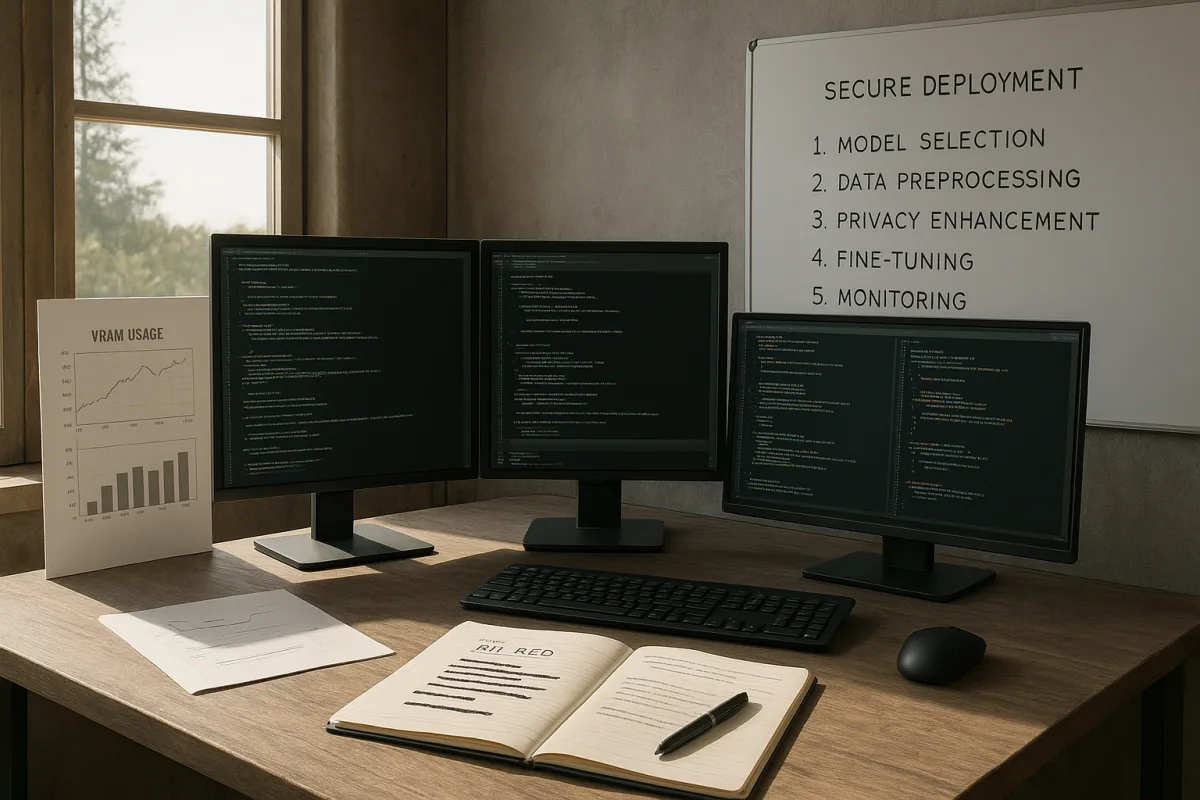
Fine-Tuning and Serving Open LLMs Without Building a GPU Platform First
1. Decide whether fine-tuning is actually the problem
The first failure mode is buying GPUs for a problem that retrieval, better prompting, or ordinary application logic would solve. Fine-tuning changes behavior and output patterns. It does not reliably add fresh, changing facts to a model. [4]
For example, an internal support agent may need current order status, policy text, or account balances. Those belong in a retrieval system or tool call, not in training examples that will become stale after deployment. [4]
Fine-tuning becomes justified when the requirement is behavioral consistency. Typical cases include emitting a strict JSON-like tool-call structure, recognizing specialist document terminology, following a tightly bounded workflow, or selecting among internal actions consistently. [4]
Machine Learning Mastery’s tool-calling example is useful because it is narrow. The target is not “make the model smarter”, but reliably choosing among lookup_order, issue_refund, and escalate_to_human with valid arguments. [4]
That framing also makes evaluation possible. A useful target is not “better answers” but measurable outcomes: valid tool-call rate, correct tool selection, argument completeness, refusal behavior, retrieval-grounded answer quality, and task completion rate.
2. Secure the training data before choosing the model
Open-weight models can help where data residency or closed API restrictions rule out hosted frontier models. But self-hosting does not itself solve privacy. A fine-tuned model can memorize sensitive text, and the extent of that risk remains an active research question. [1]
Krish Naik’s sponsored Crusoe Intelligence Foundry walkthrough uses a sensible non-production demonstration pattern: a synthetic multilingual financial PII dataset with 56,000 documents and 29 labeled PII categories, licensed under Apache 2.0. The dataset avoids using real customer records in a tutorial.
Do not infer from a synthetic benchmark that a redaction system is ready for bank statements or support transcripts. Real data contains typos, multilingual fragments, screenshots converted through OCR, aliases, partial identifiers, and deliberately obfuscated contact details.
Use a layered ingestion pipeline. First detect and redact identifiable data before it reaches a training store. Then preserve a restricted mapping only if a legitimate workflow requires re-identification, with access controls and retention rules outside the model system.
Microsoft Presidio is the established open-source option in this group, and suits teams that need a self-hosted detector and anonymizer integrated into Python services. It is widely used, but research summaries warn it can miss obfuscated PII, so it should not be the sole control. [5]
OpenAI Privacy Filter suits teams already permitted to use an OpenAI API and needing a managed filtering service. Its voice-layer-adjacent API positioning does not make it an on-premises privacy solution, and its service cost is not supplied in the available research. [6]
PRvL, short for PII Redaction via Language Models, suits cases where language-model context may catch PII that pattern matching misses. Its trade-off is that an LLM-based redactor adds inference cost, latency, and another system requiring evaluation. [7]
Distil-PII suits teams seeking smaller specialized models for scalable PII detection and redaction. LLM-Redactor suits teams evaluating another flexible model-based redaction approach, though the research brief provides no reliable price for either product. [5][6]
The practical control is redundancy. Run a detector before training, retain structured records of what was removed, and scan generated outputs before they reach users. Automated detection should route uncertain, high-impact cases to review rather than silently declaring them safe. [5][6]
A minimal ingestion check can be deliberately boring:
text = read_document(path)
findings = analyzer.analyze(text=text, language="en")
clean_text = anonymizer.anonymize(text=text, analyzer_results=findings)
write_training_row(clean_text)
write_audit_record(path, findings)
The missing work is more important than the snippet. Test it against realistic internal examples that include misspellings, account fragments, names embedded in prose, and data the detector should preserve, such as product identifiers.
3. Build examples that teach the exact behavior you need
Many fine-tunes fail before training starts because the examples are fluent but structurally inconsistent. For tool use, every row should follow the production chat format and be validated against the actual tool schema before training. [4]
Machine Learning Mastery argues that a few hundred well-formed examples can outperform thousands of loose examples for tool calling. That is credible because the core failure is often syntax and argument discipline, not lack of general language competence. [4]
Write a validator that rejects unknown functions, missing required arguments, invalid types, and tool calls that do not match the user request. Run it in continuous integration, not only in a notebook before a first experiment.
for example in training_examples:
    validate_roles(example)
    validate_tool_name(example)
    validate_required_arguments(example)
    validate_argument_types(example)
For scale, begin with 150 to 200 hand-authored examples, then consider synthetic expansion from a stronger teacher model, followed by automated judging and human spot checks. Machine Learning Mastery recommends discarding the bottom 10 to 20 percent of generated examples. [4]
That workflow is not a license to scrape an API at volume. Modern synthetic-data distillation is legitimate when the teacher’s license and terms permit it, but the industry disputes concern systematic, unauthorized extraction across organizational boundaries. [3]
Use internal experts to write edge cases. For a refund agent, include ambiguous disputes, missing order identifiers, fraud indicators, repeated requests, and requests where the correct answer is escalation rather than a tool call.
4. Pick QLoRA unless you can justify full fine-tuning
Full fine-tuning updates every model weight, plus optimizer state and gradients. For a 7B model, one hardware guide estimates about 56GB of VRAM for weights alone, with total training memory substantially higher. [2][10]
That is why QLoRA is a practical default. It loads the base model in 4-bit form, freezes its weights, and trains small low-rank adapters. The approach can make 7B-class adaptation feasible on roughly 8GB to 10GB consumer GPUs, depending on sequence length and batch settings. [11]
Do not read that as “a cheap GPU solves training.” It means constrained experiments become possible. Long contexts, larger batches, evaluation workloads, checkpoint storage, failures, and repeated runs still consume time and money.
A compact QLoRA configuration resembles this:
config = LoraConfig(
    r=4,
    lora_alpha=32,
    lora_dropout=0.05,
    target_modules="attention_layers"
)

model = load_model(
    model_id="open_model",
    load_in_4bit=True
)

model = prepare_model_for_kbit_training(model)
model = attach_lora_adapters(model, config)
The values above reflect the tool-agent configuration described by Machine Learning Mastery, not universal optimum settings. Rank controls adapter capacity, while a higher rank can increase adapter size and overfitting risk. [4]
LoRA suits teams with enough memory to hold a higher-precision base model and who want adapter training without modifying all weights. QLoRA suits memory-constrained training, especially for larger open models, because it adds 4-bit quantization to the adapter approach. [10][11]
Claims that parameter-efficient fine-tuning retains 90 to 99 percent of full fine-tuning performance are broad comparisons, not a guarantee for a particular compliance task. [9] Run an ablation on your held-out workload before declaring QLoRA sufficient.
Compute may be the smallest line item. One estimate places a 7B QLoRA cloud run at roughly $1 to $5, while broader projects involving data preparation, iteration, evaluation, and larger models can reach $20,000. [3]
5. Choose managed infrastructure or self-hosting based on traffic
A managed platform is useful when the immediate problem is getting from a dataset to an endpoint without operating Kubernetes, drivers, GPU scheduling, checkpoints, and inference engines. It is not automatically cheaper at sustained volume.
Crusoe Intelligence Foundry, shown in the Krish Naik walkthrough, offers serverless fine-tuning and OpenAI-compatible inference for available open models. It suits rapid experiments, low-volume traffic, and teams without an existing GPU operations practice.
The same walkthrough distinguishes serverless inference from self-serve and tailored deployments. Serverless is aimed at early, usage-based workloads, while dedicated configurations suit applications that need more predictable throughput or latency characteristics.
Hugging Face is relevant here as a model and dataset distribution layer, not as proof that a model is deployable. The Crusoe demonstration exports a resulting checkpoint to a Hugging Face account, which helps versioning and sharing but does not replace deployment evaluation.
Self-hosting open-weight models is usually a scale decision. Research summarized in the brief estimates that it becomes cost-effective above roughly 50 to 100 million tokens per month, when recurring API bills can outweigh infrastructure operations. [8]
A 70B model illustrates why parameter count matters after training. At FP16, it needs about 140GB of VRAM for weights alone, before serving overhead and concurrency capacity. A model that fits in a benchmark script may be uneconomic at production latency targets. [8]
For deployment, package the base model, adapter version, prompt template, tool schemas, redaction policy, and evaluation dataset as separately versioned artifacts. “Model version” alone is not enough to reproduce an agent’s behavior.
6. Tune serving behavior after training
Training is only one of four dials. Data format, adapter configuration, runtime settings, and preference alignment all affect behavior. A model can learn valid tool syntax yet still make poor choices at a high temperature. [4]
Set low temperature for tool selection and structured extraction. Add a bounded retry path that reissues a failed tool-call generation at temperature zero, then escalate if validation still fails rather than allowing unlimited agent loops.
Machine Learning Mastery reports a simulated configuration where one deterministic retry raised success for a temperature 0.7 agent to 98.7 percent. Treat that as an illustration of policy design, not a performance promise for another workload. [4]
Use preference training, such as Direct Preference Optimization, when examples contain two valid-looking actions but one is contextually better. Supervised fine-tuning can teach that issue_refund exists, while preference pairs can teach when escalation is safer. [4]
For a launch gate, require improvement on held-out task accuracy and no meaningful regression on broad capability checks. Machine Learning Mastery gives an example where tool accuracy rose from 61 to 97 percent but general capability fell 7.2 points, a hold rather than a ship decision. [4]
Measure production metrics separately from model metrics: p50 and p95 latency, time to first token, tool-validation failure rate, retry rate, redaction catches, cost per completed task, and human escalation rate. Those are the numbers users experience.
7. Keep voice and large-model claims in perspective
Not every interface needs a self-hosted open model. OpenAI’s GPT-Live-1 is a managed, audio-only API for real-time full-duplex voice conversations, available through the v1/live/sessions endpoint. Its voice layer costs $0.05 per minute, with backend usage billed separately. [12]
GPT-Live-1 suits teams prioritizing natural conversational audio and telephony support over local control. It does not meet a requirement to train and serve an open-weight model inside an organization’s own environment. [12]
That distinction matters because “deployment” bundles incompatible requirements: privacy boundary, model ownership, latency, traffic volume, tuning access, and interface modality. A serverless endpoint, a dedicated GPU deployment, and a voice API solve different operational problems.
Finally, plan for maintenance from day one. Fine-tuned systems drift as policies, tools, user language, and source data change. Re-run redaction checks, regression suites, and cost reviews whenever any of those surrounding components changes.
Frequently Asked Questions
When is fine-tuning necessary versus prompting for LLMs?
Fine-tuning is necessary when you require behavioral consistency that prompting cannot reliably enforce, such as producing a fixed output schema, using a narrow vocabulary, or making repeatable tool calls. For tasks like retrieving current data or answering with up-to-date facts, retrieval or prompting is preferred since fine-tuning does not reliably add fresh or changing information.
How to protect PII during AI model fine-tuning?
Protecting PII requires a layered pipeline approach: first detect and redact identifiable data before it enters training storage, then scan outputs after generation, keep audit logs, and manually review high-risk failures. Tools like Microsoft Presidio, OpenAI Privacy Filter, and PRvL can assist, but no single solution is foolproof, especially against obfuscated or partial identifiers.
What are parameter-efficient fine-tuning methods like QLoRA?
Parameter-efficient methods such as QLoRA drastically reduce hardware requirements compared to full fine-tuning. For example, full fine-tuning of a 7B parameter model requires about 56GB of VRAM plus optimizer overhead, while QLoRA can fine-tune similar models on consumer-grade GPUs with 8–10GB VRAM, maintaining 90–99% of full fine-tuning performance.
How to evaluate a fine-tuned model before deployment?
Do not rely solely on training loss; instead, test the model on held-out tasks measuring accuracy, schema validity, latency, cost, and general capability regression. Evaluation should focus on measurable outcomes relevant to the use case, such as valid tool-call rates, correct tool selection, argument completeness, refusal behavior, and task completion rates.
When does self-hosting AI models become cost-effective?
Self-hosting becomes economically sensible at sustained scale, typically around 50 to 100 million tokens per month. Below this threshold, infrastructure and operational overhead can outweigh GPU cost savings, making cloud or hosted solutions more cost-effective for smaller or intermittent workloads.
How we researched this
This article was assembled from 1 video source, 3 published articles, 12 cited references.
Nothing here is based on hands-on testing. Where a figure or finding appears, it belongs to the source cited beside it, and the writing says so rather than implying otherwise. Every source is listed below so you can check it.
Sources
Fine-Tune, Deploy & Serve Open LLMs with Crusoe Intelligence Foundry — Krish Naik
Build more natural voice experiences with GPT‑Live‑1 in the API — OpenAI News
A Gentle Introduction to Model Distillation — Machine Learning Mastery
Fine-Tuning Agentic AI: A Practical Guide — Machine Learning Mastery
Unintended Memorization of Sensitive Information in Fine-Tuned Language Models
Fine-Tuning Cost Comparison: Open Source vs Closed Source LLM (2026 Edition)
The best PII detection tools in 2026 — an honest guide | Madanpotra Consultancy
Serving Fine-Tuned LLMs in Production: 2026 Guide | Lyceum Technology
LoRA vs Full Fine-Tuning: Which to Choose in 2026 | BearPlex
Parameter-Efficient Fine-Tuning: LoRA, QLoRA, and Adapters Explained
Watch AI Model Fine-Tuning and Deployment Tools on Youtube
Related Articles

Nvidia Acquisition of Hugging Face and Its Impact
Explore Nvidia's acquisition of Hugging Face and its effects on open-source AI platforms, neutrality, and the AI ecosystem.

AI in Data Analytics and Visualization
Explore AI in data analytics and visualization with Slackforce Surfaces, Power BI Copilot, and Tableau AI training options compared.
Open Source AI Agents: TrueForge vs Claude Managed Agents
Explore open source AI agents, comparing TrueForge and Claude Managed Agents to help choose the best runtime for your AI platform needs.

AI-Powered Coding Agents: Best Practices and Risks
Learn best practices, risks, and workflows for AI-powered coding agents to improve software development safely and effectively.