
Open Source AI Agents: TrueForge vs Claude Managed Agents
Explore open source AI agents, comparing TrueForge and Claude Managed Agents to help choose the best runtime for your AI platform needs.
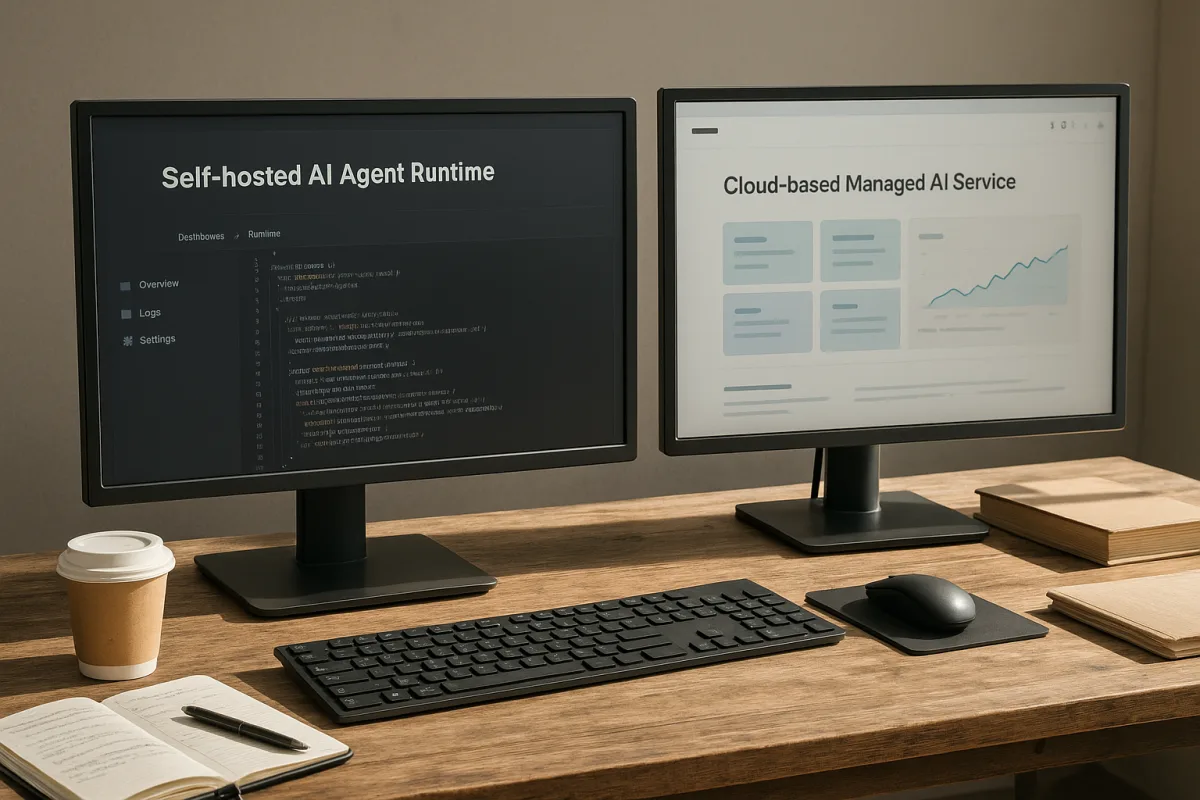
The decision: TrueForge or Claude Managed Agents
The useful comparison in open agent infrastructure is not between every terminal assistant, framework and local model. It is between a self-operated, open runtime and a proprietary managed service: TrueFoundry’s TrueForge versus Anthropic Claude Managed Agents.
That choice determines where the agent loop lives, who controls the model provider, how tools are integrated, and which operational failures become your problem. The language model is only one component. Production agents also need state, tool routing, permissions, retries, approvals, observability and containment.
TrueForge, released by TrueFoundry on August 19, 2026, is an MIT-licensed agent harness. It is intended to provide the runtime around an LLM, including tool use, Model Context Protocol connections, sandboxes and human approval steps. [4]
Anthropic’s Claude Managed Agents, in public beta since April 8, 2026, instead packages that runtime as a service. The appeal is straightforward: a team gets an integrated platform rather than assembling and operating the agent loop itself.
Neither option magically makes an LLM dependable. Both can call an inappropriate tool, misunderstand a business rule, or follow malicious instructions embedded in retrieved content. The relevant question is whether your team wants to own the control plane required to limit those failures.
Head-to-head comparison
| Criterion | TrueForge | Claude Managed Agents |
|---|---|---|
| What it is | An open-source, general-purpose agent harness from TrueFoundry. | Anthropic’s managed runtime for agents built around Claude models. |
| Model choice | Vendor-neutral. It can connect to hosted providers or local endpoints such as Ollama. | Claude-centric managed service. |
| Upfront software price | Free open-source software under the MIT licence, but model, hosting, sandbox, database and monitoring costs remain. [4] | No free software layer. Usage is billed through model tokens plus runtime. |
| Published runtime price | TrueFoundry does not state a comparable per-session public runtime fee in the supplied reporting. | $0.08 per session-hour, in addition to token charges. [14] |
| Model pricing | Depends on the provider selected. Local models remove per-token API billing but not hardware and operations costs. | For example, Opus 4.8 is listed at $5 per million input tokens and $25 per million output tokens, plus the runtime fee. [14] |
| Tooling and agent loop | Handles tools, MCP calls, sandboxes, sub-agents and approval flows, with the operator configuring integrations. | Provides a managed environment, reducing the amount of runtime plumbing a customer needs to run. |
| Deployment control | Can run locally or in infrastructure selected by the user. Useful where data location or model choice is a requirement. | Anthropic operates the managed layer, which reduces infrastructure control but also reduces deployment work. |
| Benchmark evidence | TrueFoundry reports equal accuracy on 14 DevRef Enterprise Bench tasks while claiming 30 percent lower cost using the same Opus model, and 75 percent lower cost with GLM 5.2. [4] | The comparison baseline in TrueFoundry’s reported benchmark, not an independently established universal cost or quality standard. |
| Operational burden | Higher. Someone must secure credentials, tool servers, execution environments, logs and upgrades. | Lower. The managed service absorbs more infrastructure work, though customers still own tool permissions and data governance. |
| Main weakness | Open source does not equal turnkey, secure or cheaper at every scale. The benchmark is narrow and vendor-reported. | Less model portability and a pricing structure that combines token spend with session duration. |
| Best fit | Platform teams building reusable internal agents or products that require model flexibility. | Teams that want to ship Claude-based agents without operating an agent runtime themselves. |
The clear choice for a team building an agent platform is TrueForge. Its real advantage is not that it is open source in the abstract. It lets a team separate the model from the runtime and choose local, open-weight or hosted models by workload.
That matters when an agent does different jobs. A document classifier might justify a small local model, while a complicated research workflow might need a frontier API. A managed Claude-only workflow makes that kind of substitution less natural.
Claude Managed Agents wins a different decision. If a small product team needs a capable Claude-based workflow quickly, the managed approach removes a layer of operational engineering. That can be worth more than a lower inference bill.
Cost claims need more scrutiny than the launch copy
TrueFoundry reports that, across 14 DevRef Enterprise Bench tasks, its harness reached the same accuracy as Claude Managed Agents while lowering costs by 30 percent using the same Opus 4.8 model. It reports a 75 percent reduction using GLM 5.2. [4]
That is promising, but it is not a complete procurement benchmark. Fourteen tasks are too few to establish performance across long-running workflows, error recovery, real permission boundaries, adversarial web content, or the messy tool schemas found in enterprise systems.
The cost reduction may also reflect context handling and agent-loop design rather than an inherent advantage of open source. That is still valuable engineering, but buyers should reproduce representative workloads, then measure task completion, total tokens, wall-clock runtime and human interventions.
Claude’s published model rates make its accounting legible, at least at the token level. Opus 4.8 costs $5 per million input tokens and $25 per million output tokens, while the managed runtime adds $0.08 for every session-hour. [14]
The session fee means an inefficient or stalled workflow has a cost beyond generated tokens. Conversely, TrueForge’s free licence does not mean zero cost. Hosted models, virtual machines, GPU capacity, secure sandboxes, databases, telemetry and on-call engineering all have prices.
Anthropic also tightened the separation between subscriptions and agent tooling in 2026. TechRadar reported that third-party tools including OpenClaw were removed from standard Claude subscriptions, requiring pay-as-you-go, prepaid bundles or API payment instead. [5]
That policy shift reinforces a basic planning rule: do not budget an agent product as though a consumer chat subscription covers production automation. It rarely covers the relevant runtime, volume, audit or integration costs.
The open alternatives are not interchangeable
Cactus Compute’s Needle 2 illustrates a different kind of alternative. It is a 45 million-parameter model packaged as a roughly 14 MB binary and reported to require about 28 MB of RAM. [9]
NeuralNine’s demonstration showed Needle 2 selecting predefined local actions such as checking battery state, changing volume, vibrating a phone and invoking text-to-speech. It can run without an API call or internet connection, which is its central practical distinction.
Needle 2 is free to deploy where its open distribution terms permit, with no quoted per-token price in the supplied material. It suits phones, wearables, microcontrollers and other constrained devices needing narrow, offline tool routing or structured extraction. [15]
It does not suit open-ended support chat, substantial coding, long-horizon research or an autonomous system with broad discretion. Forty-five million parameters is not a clever compression of a frontier agent. It is a deliberate trade: constrained capability for a tiny memory and storage footprint.
BreezeBlue’s BreezeTTS2 occupies another layer of the stack. The 3 billion-parameter open-weights text-to-speech model is designed for local, streaming voice generation, with voice design, voice cloning, directed delivery and multilingual output among its stated features. [10]
Sam Witteveen’s walkthrough demonstrated a local conversational pipeline that paired BreezeTTS2 with a small Gemma model, and highlighted voice direction as more convincing than some vocal-event controls. That is a useful qualitative observation, not an independent latency benchmark.
BreezeBlue has not published concrete consumer-hardware latency, CPU usage or GPU usage data in the supplied research. Local inference can reduce network delay in principle, but it does not establish BreezeTTS2’s actual time-to-first-audio on a typical laptop or phone. [2]
BreezeTTS2’s more immediate limitation is licensing. Sam Witteveen notes that the released model is under a research and non-commercial licence, restricting commercial output and distillation. Its price for hobby or research use is effectively no licence fee, but commercial use requires checking BreezeBlue’s separate terms.
That makes BreezeTTS2 suitable for local prototyping, academic work and non-commercial voice-agent experiments. It falls down as the default speech layer for a commercial assistant, regardless of its apparent quality, until licensing and production performance are made clear.
Managing many agents is a separate problem
Herder is not an agent runtime like TrueForge and not a model like Needle 2. It is a terminal multiplexer aimed at making multiple agent processes visible, persistent and manageable across workspaces, tabs and panes.
Alejandro AO’s setup walkthrough shows Herder tracking agent status, keeping processes alive after the terminal closes, and connecting a local interface to a remote VPS. There is no quoted licence price in the supplied materials, so it should be treated as an operational tool whose hosting costs depend on where it runs.
Herder suits developers coordinating several coding agents, servers and review processes, especially when jobs need to outlive a laptop session. It does not supply evaluation, access control, sandboxing or safe tool policies merely by keeping processes alive.
Running agents on a VPS adds a risk surface that agent demos commonly skip. Industry reporting found more than 175,000 publicly exposed Ollama servers, with roughly half allowing code execution, while more than 1,100 were reportedly visible without authentication. [8]
Those figures do not describe Herder specifically. They do show why a remote terminal containing agents, credentials and executable tools should not be exposed casually. SSH keys, network rules, authentication, least-privilege service accounts and audit logs are baseline requirements.
Prompt injection remains equally relevant. An agent that reads a webpage, issue tracker or document can encounter instructions designed to redirect its tools. Tool abuse and poisoned integrations turn ordinary retrieval into an execution pathway if permissions are broad. [6]
Who each option suits
TrueForge suits platform engineers and organisations building reusable agent systems. Choose it when model portability, local deployment, custom MCP integrations and direct control of the agent loop outweigh the work of securing and operating that stack.
Claude Managed Agents suits teams that have already chosen Claude and prefer a managed operational layer. It is the practical choice when speed of integration and lower infrastructure overhead are more valuable than provider flexibility or the lowest possible workload cost.
Needle 2 suits embedded and mobile builders who need deterministic-enough local tool selection within severe memory limits. It is not the right choice for replacing the reasoning, coding or language breadth of a larger local or hosted model.
BreezeTTS2 suits non-commercial research and prototypes seeking a locally run voice layer with expressive speech controls. Its non-commercial restrictions and unverified consumer-hardware performance make it a poor default for a production voice-agent launch.
Herder suits developers supervising many long-lived local or remote agent processes. It is useful workflow infrastructure, but it should sit behind disciplined server security rather than being mistaken for an agent safety system.
Frequently Asked Questions
What are the main differences between TrueForge and Claude Managed Agents?
TrueForge is an open-source, vendor-neutral agent runtime that can connect to hosted or local models, requiring users to manage the surrounding infrastructure. Claude Managed Agents is a proprietary managed service focused on Claude models, offering an integrated platform that reduces operational overhead but limits model choice and infrastructure control. TrueForge emphasizes flexibility and control, while Claude Managed Agents prioritize ease of deployment and managed execution.
When should I choose an open source AI agent runtime over a managed service?
Choose an open source runtime like TrueForge if you need vendor neutrality, want to run local or alternative models, and have the capacity to operate and secure the infrastructure yourself. Managed services like Claude Managed Agents are better suited for teams that prefer a turnkey solution with less operational responsibility and want to quickly deploy Claude-based agents without managing the runtime.
How do open source AI agents impact operational costs compared to managed agents?
TrueFoundry reports that TrueForge can reduce costs by 30 to 75 percent compared to Claude Managed Agents on certain benchmark tasks, mainly by avoiding per-session fees and token charges associated with managed services. However, these savings depend on the specific workload and do not guarantee lower costs or equal reliability in all cases, as open source requires investment in infrastructure and operations.
What are the benefits of vendor-neutral AI agent runtimes?
Vendor-neutral runtimes like TrueForge allow teams to separate the model from the runtime, enabling the use of local, open-weight, or hosted models depending on workload needs. This flexibility supports diverse tasks, such as using small local models for simple classification and frontier APIs for complex research, which is less natural with vendor-locked managed services.
Can open source AI agents run local or alternative language models?
Yes, TrueForge supports running local or alternative language models by connecting to local endpoints such as Ollama, in addition to hosted providers. This capability allows teams to control data location and model choice, which is important for privacy, compliance, or specialized workloads.
How we researched this
This article was assembled from 4 video sources across 3 channels, 15 cited references.
Nothing here is based on hands-on testing. Where a figure or finding appears, it belongs to the source cited beside it, and the writing says so rather than implying otherwise. Every source is listed below so you can check it.
Sources
BreezeTTS2 - 100% Local Real-Time Voice — Sam Witteveen
Needle 2: The 45M Parameter Model That Runs Everywhere — NeuralNine
TrueForge: Open-Source Alternative To Claude Managed Agents — NeuralNine
Herdr Crash Course — Step-by-Step Setup — Alejandro AO
CPU Benchmarks and Hierarchy 2026: CPU Rankings | Tom's Hardware
Bad news Claude users - Anthropic says you'll need to pay to use OpenClaw now
AI Agent Deployment Security: Protecting Personal AI Assistants | Zylos Research
State of AI Agent Security 2026 — Research Report | Inkog | Inkog
Solved: 9 voice AI challenges every enterprise hits (here’s how)
Amplified 2026: The State of Voice and the Trends Shaping the Voice-First Era | Voices | Voices
Needle 2: Cactus Compute's 14MB On-Device Agent LLM | Oflight Inc.
Watch Open-Source and Alternative AI Agents on Youtube
Also from the sources
Related Articles
TrueForge vs Claude Code Projects
Compare TrueForge and Claude Code Projects to choose the right open source AI agent platform for your deployment and operational needs.
TrueForge vs Hermes Agent
Compare TrueForge and Hermes Agent, two open source AI agent platforms, to find the best fit for deployment, security, and personal assistant use cases.

AI Agents Multi-Agent Systems Platforms
Explore AI agents and multi-agent systems platforms with comparisons, costs, observability, and security insights for effective deployment.
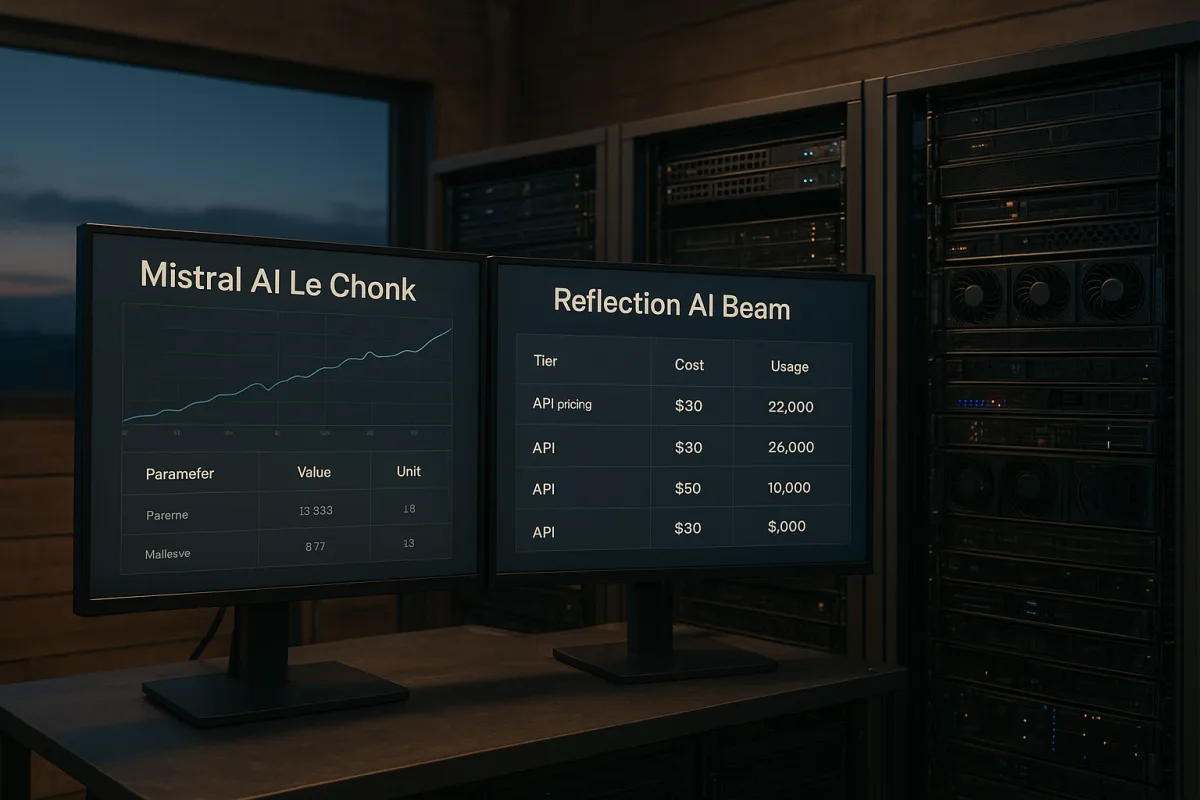
Mistral AI Le Chonk vs Reflection AI Beam
Compare Mistral AI Le Chonk and Reflection AI Beam open-weight models, their specs, benchmarks, pricing, and deployment readiness in 2026.