
TrueForge vs Claude Code Projects
Compare TrueForge and Claude Code Projects to choose the right open source AI agent platform for your deployment and operational needs.

The decision: TrueForge or Claude Code Projects?
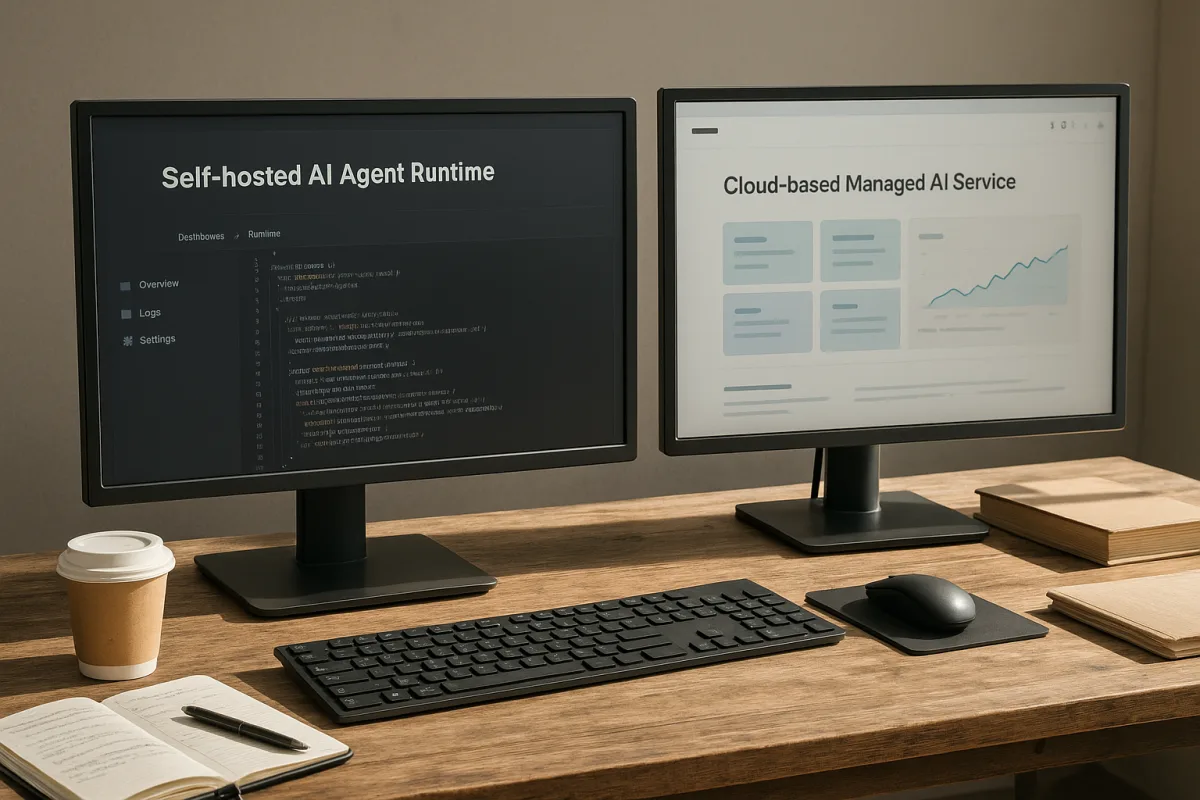
This is a choice between two very different meanings of “agent platform.” TrueFoundry’s TrueForge is an MIT-licensed execution harness for building and running agents under infrastructure you control. Anthropic’s Claude Code Projects is a managed cloud product for coordinating coding agents around a repository.
For a company building internal operational agents, such as support triage, document research, CRM updates, or controlled tool-using workflows, the choice is TrueForge. It exposes the runtime as software, rather than making the runtime itself a hosted product.
For a software team whose work already lives in Git repositories and whose primary goal is to delegate implementation tasks to parallel coding sessions, Claude Code Projects is the more direct option. It is deliberately narrower, and that narrowness is often useful.
That is not a claim that self-hosting is inherently cheaper or safer. It means the systems put responsibility in different places. TrueForge gives the operator control over models, data location, tools, and runtime behavior. Claude Code Projects removes much of that operational work, while requiring trust in Anthropic’s service boundaries and product roadmap.
The same criteria, in the same order
| Criterion | TrueForge | Claude Code Projects |
|---|---|---|
| Primary job | A general-purpose, self-managed agent execution harness for tool-using applications and workflows. | A managed cloud workspace for coordinating multiple Claude Code agents on software projects. |
| Price | MIT-licensed software with no stated runtime fee. Model inference, cloud, hardware, storage, and operations are extra. | Claude Pro starts at $20 per month, with Max 5x at $100 and Max 20x at $200. Usage limits apply, and API use is separately metered. [[9]](https://claudecodeguides.com/claude-code-pricing-every-plan-2026/?utm_source=openai "Claude Code Pricing: Every Plan (2026) |
| Deployment and data control | Can run locally, on private infrastructure, or in an operator-controlled cloud environment. | Cloud threads are the current model in the Projects beta. Anthropic has said local tools and code support are forthcoming. [[10]](https://usingclaude.com/en/news/updates/claude-code-projects-redesigned-beta?utm_source=openai "Claude Code Rolls Out Redesigned Projects in Beta on Desktop and Web |
| Model choice | Model-neutral in principle, including proprietary APIs, compatible hosted models, and local models. | Tied to Claude and the Claude Code environment. |
| Multi-agent coordination | Provides runtime components for sessions, tools, sandboxes, approvals, skills, and MCP integrations, but workflow architecture remains the builder’s responsibility. | A coordinator manages parallel threads, each working in its own cloud session, branch, and repository copy. Merge conflicts remain normal Git merge conflicts. [[10]](https://usingclaude.com/en/news/updates/claude-code-projects-redesigned-beta?utm_source=openai "Claude Code Rolls Out Redesigned Projects in Beta on Desktop and Web |
| Operational burden | Higher. The team owns deployment, updates, observability, secrets, access controls, and capacity planning. | Lower for the user. Anthropic operates the cloud runtime, but users have less control over its internals. |
| Cost evidence | TrueFoundry reports 63 percent fewer tokens than managed agents on its comparison task set, but this is vendor-produced evidence rather than an independent production-cost study. [[3]](https://ai-radar.it/article/trueforge-usa-il-63-di-token-in-meno-dei-managed-agent-a-parita-di-task?utm_source=openai "TrueForge uses 63% fewer tokens than managed agents on the same task set | AI-Radar")[16] |
| Security and compliance | Better fit where data residency or private deployment is mandatory. No public TrueForge-specific vulnerability record is not proof of a stronger security posture. | Managed operations reduce some local administration, but Claude Code has been affected by publicly reported coding-agent and sandbox security issues. [13][15] |
| Main limitation | It is not a turnkey escape from platform engineering. Savings claims do not include the full cost of infrastructure and people. | It is not a general model-neutral agent runtime, and its cloud-first beta model may not fit sensitive or regulated workloads. |
1. Scope: general agent runtime versus coding workspace
TrueForge is best understood as an open implementation of the runtime layer that managed-agent services normally hide. In Sam Witteveen’s sponsored walkthrough, the key distinction is not the prompt editor or chat interface. It is the runtime handling sessions, tool calls, sandboxes, approvals, skills, MCP servers, and APIs.
That makes TrueForge suitable for agents embedded in an internal application or exposed through a service endpoint. A team could use it to make a controlled research assistant, a support-operation workflow, or a business process agent available through Slack, a web application, or another system.
Claude Code Projects has a more focused design. The Verge reports that a project coordinates multiple Claude Code cloud sessions, with each thread operating on its own branch and copy of the repository. A coordinator delegates work, while users can inspect individual threads or steer the project centrally. [10]
That is sensible for codebases. Parallel work on test coverage, documentation, migrations, and isolated features maps reasonably well to branches and pull-request-style review. It maps less well to an agent that must operate across a CRM, a ticketing system, and a document corpus with finely constrained actions.
The important caveat is that neither product creates reliable autonomy just by adding more agents. Agent coordination is a control-flow and verification problem. Multiple model calls can divide context and accelerate independent work, but they can also spread an incorrect assumption through a larger system.
2. Price: free software is not free operation
TrueForge has no listed license charge because it is MIT-licensed. That is meaningful for procurement and vendor lock-in, but it should not be converted into a claim that running it costs nothing.
TrueFoundry’s published comparison reports 63 percent lower token use than managed-agent alternatives on the same task set. [3] Sam Witteveen describes a related vendor benchmark of 14 enterprise tasks, run three times with a blind LLM judge, where harness choices allegedly reduced token use while preserving judged accuracy.
That result is plausible in a narrow sense. Harnesses decide which tools are exposed, how results are summarized, when context is retained, and when work is repeated. Poor tool descriptions and indiscriminate transcript retention can indeed turn tool use into a context-window tax.
But the result is still a vendor benchmark. The NRB reporting cited in the research material correctly characterizes the cost challenge as unverified, because the public comparison does not establish TrueForge’s full production cost across workloads. [16] It is evidence about token consumption under one evaluation setup, not a universal operating-cost guarantee.
Private infrastructure is the missing line item. High-end accelerator ownership can involve hardware priced up to hundreds of thousands of dollars per GPU, while rented capacity adds ongoing consumption charges. [4] Energy, cooling, networking, storage, backups, incident response, and the engineers who maintain the system are additional costs. [5]
Claude Code Projects has more legible starting prices. Claude Pro is listed at $20 monthly, Max 5x at $100, and Max 20x at $200, with usage capacity increasing by tier. [9] Those prices buy convenience, not unlimited autonomous software development. A Pro plan’s approximate usage allowance is not equivalent to a fixed amount of agent work, especially when projects run multiple threads.
The honest cost choice is therefore straightforward. Claude Code Projects is cheaper to start. TrueForge may be cheaper to operate at volume or under model-routing discipline, but only after accounting for the infrastructure and operating team it requires.
3. Deployment, data, and model control
TrueForge wins clearly where an organization needs a private deployment. Its value is not merely that it can call an open-weight model. It allows the organization to decide where session history, prompts, tool configuration, approval policies, and tool outputs live.
This matters in regulated environments, or where data cannot be sent to an external hosted agent runtime. It also matters when teams want to change inference providers without rebuilding an application around a different agent service.
Claude Code Projects currently asks users to accept a cloud execution model. According to The Verge, project threads run as Claude Code cloud sessions, while support for local tools and code was described as coming soon. [10] That could change, but it is not a feature to plan around until shipped.
The model dependency follows from the deployment choice. Claude Code Projects is an Anthropic product designed around Claude. That gives users a more integrated experience, but limits experiments with a cheaper provider, an in-house model, or a jurisdiction-specific deployment.
Watermarking adds a less obvious deployment consideration. Article 50 of the EU AI Act requires machine-readable marking of AI-generated content from August 2, 2026, with transitional arrangements for some systems already on the market. [6] Anthropic documents that Claude marks AI-generated content, while Google has deployed SynthID-related provenance technology in its ecosystem. [17]
This is not a reason to avoid managed services or watermarking. It is a reason to test the actual deployed stack. Research covered by Ars Technica found that watermarking implementations can alter refusal behavior and tool selection in open-weight model experiments, particularly under prompt injection. The research did not test Anthropic’s production implementation, so it should not be generalized beyond that limitation.
4. Coordination and reliability
Claude Code Projects has the more polished coordination abstraction for its intended job. The coordinator, parallel threads, subagents, and branch isolation are understandable to a software team because they mirror established repository workflows. The limitation is equally familiar: two agents changing the same code can still create a merge conflict. [10]
TrueForge provides a runtime substrate rather than prescribing one workflow pattern. That is more flexible, but the builder must decide which tasks may run concurrently, which require approvals, what gets persisted, and how errors are surfaced. Flexibility becomes operational debt when these choices remain implicit.
Google ADK 2.0 belongs in this decision even though it is not the selected head-to-head option. Google Cloud Tech presents ADK workflows as explicit sequential, parallel, and loop primitives, with deterministic function nodes used for gates and checks. Its software price is effectively $0 for the framework, but model, hosting, and cloud-service costs remain extra.
Google ADK suits engineers willing to write orchestration code. In the Google Cloud Tech example, two analyzers run in parallel, then a report agent runs, and a conditional loop refines the result. The tutorial also makes the important admission that loops need hard bounds, showing a maximum of three refinement attempts.
That is the right design instinct. A model grading its own output is not a proof of correctness. Use deterministic checks for format, permissions, policy, data completeness, and budget limits wherever possible. Use human review for consequential actions.
5. Security: control is useful, evidence is incomplete
TrueForge’s private deployment can reduce data exposure to a hosted agent vendor, but it transfers responsibility for secret management, sandboxing, patching, identity controls, logging, and incident response to the adopter. Open source allows inspection, not automatic security.
There are no publicly documented TrueForge-specific vulnerabilities in the supplied research. That absence should not be marketed as a security result. It may reflect a smaller installed base, less public research, less disclosure, or better engineering. Public reporting alone cannot distinguish these possibilities.
Claude Code’s managed environment also does not remove agent risk. Public reports have identified vulnerabilities affecting coding-agent environments, including sandbox escape and approval-bypass-style issues. [13][15] The lesson is not that Claude Code is uniquely unsafe. Tool-using agents expand the consequences of prompt injection and confused authority boundaries.
Security testing should therefore focus on the actual action surface: can an untrusted document influence an agent, can the agent access credentials, can it call external tools, can it modify production systems, and is approval meaningful rather than decorative?
Who each option suits
TrueForge suits platform teams building internal multi-agent applications that need model portability, private-cloud or on-premises deployment, custom tools, and control over agent state. It is the better choice when compliance requirements make a provider-hosted runtime unacceptable, or when inference routing and context efficiency justify a dedicated operational layer.
TrueForge falls down for small teams that mainly want agents to edit a repository this week. The software license is free, but operating a secure and observable runtime is not. Its reported token savings should be treated as a hypothesis to evaluate on a representative workload, not as a procurement guarantee.
Claude Code Projects suits engineering teams already committed to Claude and Git-based development workflows. Its coordinator-and-thread model offers a practical way to parallelize bounded coding tasks without first building an agent platform, and its subscription pricing makes initial adoption simpler. [9][10]
Claude Code Projects falls down for organizations requiring private deployment, model independence, or a general-purpose agent backend for business systems. It also requires normal engineering controls: branch review, tests, least-privilege credentials, constrained tool access, and skepticism toward autonomous completion claims.
Google ADK suits teams that want explicit, code-defined multi-agent workflows without surrendering orchestration decisions to a black-box managed runtime. It is particularly appropriate where deterministic sequencing, parallelism, bounded loops, and quality gates are central requirements.
Google ADK falls down for teams looking for a finished operational harness with deployment, approvals, session management, and observability already assembled. It is a framework, not a substitute for the platform work that TrueForge packages or Claude Code Projects operates for the user.
Frequently Asked Questions
What are the differences between TrueForge and Claude Code Projects?
TrueForge is an open-source, model-neutral agent runtime designed for private cloud or on-premises deployment, giving operators control over models, data, and runtime behavior. Claude Code Projects is a managed cloud workspace focused on coordinating multiple Claude Code agents around software repositories, with less operational burden but tied to Anthropic’s cloud runtime and Claude models. TrueForge suits internal operational agents, while Claude Code Projects targets software teams wanting parallel coding sessions in a cloud environment.
Which AI agent platform is better for private cloud deployment?
TrueForge is better suited for private cloud deployment because it can run locally or in operator-controlled cloud environments, allowing full control over data residency and infrastructure. Claude Code Projects currently operates as a cloud-based service with local tools and code support planned but not yet available, making it less suitable for private or regulated environments at this time.
How does TrueForge reduce token usage compared to managed agents?
TrueFoundry reports that TrueForge uses 63 percent fewer tokens than managed agents on the same task set, based on their internal comparisons. However, this evidence is vendor-produced and has not been independently validated as a comprehensive measure of total cost of ownership, which also includes hardware and operational expenses.
What are the operational trade-offs between self-hosted and managed AI agents?
Self-hosted platforms like TrueForge require teams to manage deployment, updates, observability, secrets, access controls, and capacity planning, resulting in higher operational burden but greater control. Managed platforms like Claude Code Projects reduce local administration and operational complexity by running the runtime in the cloud, but users have less control over the environment and must trust the provider’s service boundaries and roadmap.
Is Claude Code Projects suitable for sensitive or regulated workloads?
Claude Code Projects’ current cloud-first beta model may not fit sensitive or regulated workloads because it requires trusting Anthropic’s cloud runtime and data handling. TrueForge’s ability to run on private infrastructure makes it a better fit where data residency or compliance requirements are mandatory.
How we researched this
This article was assembled from 3 video sources across 2 channels, 3 published articles, 17 cited references.
Nothing here is based on hands-on testing. Where a figure or finding appears, it belongs to the source cited beside it, and the writing says so rather than implying otherwise. Every source is listed below so you can check it.
Sources
The OpenSource Managed Agents — Sam Witteveen
Agent Harnesses Explained: Inside the Stack Behind Antigravity, Claude Code & Cursor — Google Cloud Tech
Google ADK 2.0 workflows tutorial: Building reliable multi-agent systems — Google Cloud Tech
LLMs respond differently to harmful prompts when AI watermarking is used — Ars Technica AI
The AI Superintelligence Slowdown — The Verge AI
Claude Code relaunches Projects to manage multiple AI agents in the cloud — The Verge AI
Watermarks Without Verification: AI Text Watermarking After the EU AI Act
TrueForge uses 63% fewer tokens than managed agents on the same task set | AI-Radar
GPU-as-a-service: Should enterprise IT rent or own AI compute?
Multi-Agent Systems (MAS) in 2026: The Complete Guide | Santage
Claude Code Rolls Out Redesigned Projects in Beta on Desktop and Web | Using Claude
Claude published malicious code to the Internet and attacked 3 real companies - Ars Technica
Bug in top AI coding agents shows that Unix-era security headaches never really die
TrueFoundry challenges Claude costs with unverified software — NRB
Watch Open Source and Managed AI Agent Platforms on Youtube
Also from the sources
Related Articles
TrueForge vs Hermes Agent
Compare TrueForge and Hermes Agent, two open source AI agent platforms, to find the best fit for deployment, security, and personal assistant use cases.
Open Source AI Agents: TrueForge vs Claude Managed Agents
Explore open source AI agents, comparing TrueForge and Claude Managed Agents to help choose the best runtime for your AI platform needs.

Managed AI Agent Platforms
Explore managed AI agent platforms, their runtimes, pricing models, and ecosystem tools for effective AI agent operations in production.
AI Model Fine-Tuning and Deployment Tools Explained
Learn about AI model fine-tuning and deployment tools, including best practices, PII protection, and cost-effective strategies for open LLMs.