
AI for Business Productivity: Enhancing Workflows and ROI
Learn how AI boosts business productivity by optimizing workflows, marketing, and data integration with measurable ROI.
1. Begin with the workflow that is already expensive
The first business problem is usually not choosing a model. It is identifying work that consumes enough skilled time, often enough, that improvement would matter. “Write better marketing copy” is too vague to evaluate.
A better candidate has a clear input, repeatable output, known owner, and measurable downstream result. Account research, campaign-asset variants, weekly inventory planning, first-pass analytics summaries, and software maintenance requests are more workable than an open-ended mandate to “use agents.”
OpenAI’s business-value guidance makes this distinction well. Its suggested sales example starts with account briefs, a task that combines CRM history, industry research, and a recommended point of view before a customer conversation. [2]
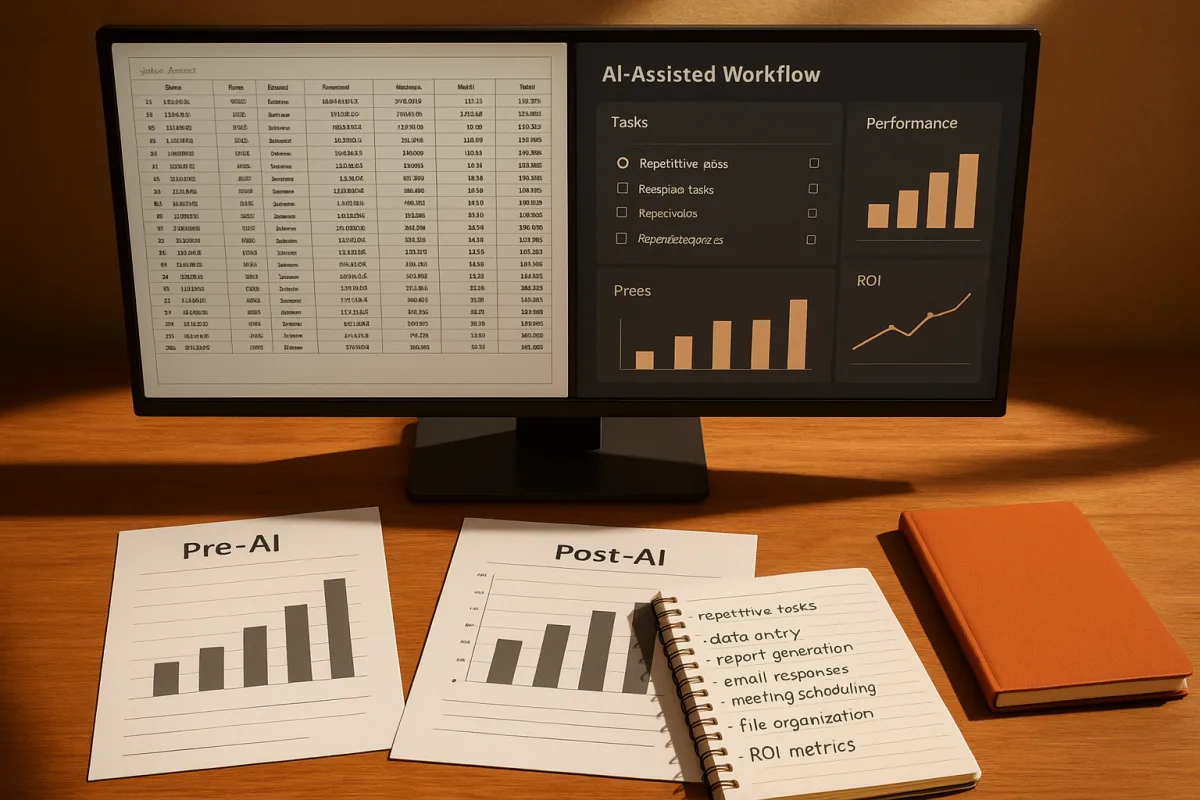
Before adding AI, capture four baseline measures: task volume, elapsed time, quality or error rate, and the business action that follows. For account briefs, that might mean briefs per seller, preparation hours, manager quality scores, and the share of meetings that become qualified opportunities.
That last measure matters because hours saved are not automatically value created. If a seller saves three hours and spends them in internal meetings, the business has gained capacity but not necessarily revenue.
OpenAI illustrates this with a hypothetical 20-person sales team preparing two briefs a week. If AI saves three hours per brief across 46 weeks, that is 5,520 hours, but its example values only half of those hours as productive redeployment. [2]
The calculation produces an illustrative annual capacity value of $207,000 at a fully loaded $75 hourly cost, against assumed first-year AI, setup, training, and support costs of $60,000. That is a hypothetical 245% ROI, not a benchmark a buyer should expect. [2]
2. Use AI to compress campaign production, not to outsource brand judgment
Marketing is an obvious early target because content production is often slow, fragmented, and agency-dependent. Traditional 30-second commercial production can cost $10,000 to $50,000, while generative tools can create draft concepts, copy variants, visual treatments, and localized adaptations in hours rather than weeks.
The useful claim is not that AI makes a full campaign cost $2. Claims of 99% savings usually compare a limited, entry-level AI asset with a much broader agency engagement involving strategy, casting, filming, legal review, media planning, and post-production.
The more defensible range is that AI can reduce production costs by roughly 70% to 90% for suitable assets, especially variant-heavy digital work. The saving shrinks when a campaign requires original footage, regulated claims review, celebrity likeness rights, or careful brand craft.
OpenAI’s advertising announcement points to Sponsored Agents, marketer tools, and integrations with HubSpot and Shopify. Those integrations are potentially useful because they bring campaign work closer to customer and commerce data, rather than leaving it in a disconnected creative chat window.
That is where an AI workflow can replace part of an expensive campaign process. Feed the system approved product information, brand language, audience segments, previous high-performing messages, and prohibited claims. Then generate variants for controlled testing, not a finished national campaign by default.
A practical first deployment is a lifecycle campaign: abandoned-cart emails, regional landing-page copy, product-description refreshes, or paid-social variations. These have relatively structured inputs and short feedback loops through conversion, unsubscribe, return, and customer-service data.
Do not judge the workflow on content volume alone. Marketing teams using AI agents may produce five to six times more content, but more assets can simply create more review work and more opportunities for off-brand material to reach customers.
Measure the cost per approved asset, time from brief to launch, review hours, and incremental conversion against a non-AI control. Report performance by audience and channel, because an improved click-through rate can still produce lower-quality leads or lower-margin sales.
Consumer response is another constraint. Only 45% of Gen Z and Millennial respondents in the research brief felt positive about AI-generated ads. That does not mean audiences reject all AI-assisted production, but it does make authenticity and disclosure questions operational concerns.
Keep a human approval stage for public-facing claims, imagery, and tone. This is especially important in financial services, health, employment, and other areas where plausible generated language can still be misleading, incomplete, or noncompliant.
3. Fix the data layer before connecting an agent to business intelligence
Once teams ask AI to explain revenue, pipeline, inventory, or customer behavior, the limiting factor becomes data definitions. A natural-language interface can make a dashboard easier to query, but it cannot resolve disputes over what counts as an active customer or a qualified lead.
Microsoft Power BI’s Azure OpenAI-backed Copilot can help generate DAX queries and summarize reports. It suits organizations already using Microsoft’s data and identity stack, particularly teams that need analysts and business users working from shared reports.
There is an immediate migration issue: Power BI Q&A is scheduled for retirement in December 2026. Organizations relying on that feature should inventory its use cases and move critical natural-language workflows deliberately, rather than discovering broken reports after retirement.
Salesforce Tableau’s Pulse service takes a different approach. It delivers proactive metric summaries through Slack or email, which suits managers who need exceptions and trend changes surfaced without opening a dashboard every morning.
Tableau has improved governance through features including Tableau Catalog and the Einstein Trust Layer. But the research brief notes that it still trails Google Looker in semantic-layer consistency, so teams should test whether key metrics resolve identically across dashboards and AI-generated summaries.
Google Looker’s Gemini capabilities support natural-language data exploration. Looker is best suited to organizations willing to invest in LookML and analytics engineering, because its governed semantic layer can make answers more consistent when models and definitions are maintained properly.
That requirement is also its drawback. A small team without dedicated analytics engineering may find LookML less accessible than a dashboard-led platform. There are no reliable comparative total-cost or productivity benchmarks for these AI features, so avoid buying on claims of a shortened learning curve.
Start with five business questions that already have accepted answers, such as weekly net revenue, renewal risk, inventory stockout exposure, pipeline coverage, and support backlog. Ask each platform’s assistant those questions and compare its response with a validated report.
Record not just accuracy but lineage. A useful answer should identify the source tables, metric definition, filters, date range, and confidence limitations. If it cannot, it may be fine for exploration but should not drive an operational decision.
4. Instrument usage, then measure outcomes outside the AI tool
The next problem is the temptation to equate adoption with value. A department can consume many tokens, generate thousands of outputs, and still fail to improve profit, quality, cycle time, or customer experience.
OpenAI’s ChatGPT Work and Codex analytics provide usage, credits, token consumption, sampled task classification, plugin usage, and software outcomes such as merged commits and lines of code. [2] These are useful diagnostic signals, but they are not outcome measures by themselves.
For example, OpenAI suggests using task classification to see whether a sales group spends substantial credits on account research and planning. An administrator can then inspect model selection, plugin usage, and training gaps before assuming the workflow deserves wider rollout. [2]
For engineering work, a growing share of AI-assisted merged code is not proof of faster delivery. Pair it with review duration, defect escape rate, rollback frequency, incident load, and rework. OpenAI explicitly recommends comparing Codex contribution trends with review time, defects, and rework. [2]
The vendor’s case studies are useful examples, not independent validation. OpenAI says 1Password estimated 553% ROI and $0.8 million in annual engineering capacity value from Codex, while ATV Big Air Tour reduced listing review from eight hours to one hour weekly. [2]
Those figures should prompt a measurement design, not become a forecast. A capacity-value estimate depends on whether freed time is actually redeployed, whether quality holds, and whether new output changes a commercial outcome.
Set a review date before expanding access. At 30, 60, or 90 days, compare the baseline with AI-assisted results and include training, integration, governance, review, and failure-handling costs. If the effect is only more activity, stop calling it productivity.
5. Put agents behind permissions, audit trails, and human escalation
An assistant drafting a report is one thing. An agent that reads customer data, updates a CRM, changes inventory, sends emails, or triggers a payment is operating inside the business’s control plane.
The governance gap is substantial. ITPro reports that 68% of organizations struggle to distinguish human from AI actions in their identity and access-management systems, leaving weak attribution and potentially excessive permissions. [1]
Use a separate identity for every deployed agent, scoped to the smallest set of systems and actions required. Do not let an agent inherit a broad human administrator account, and do not share credentials between automation workflows.
For every action, log the initiating user, agent identity, source data, tool calls, final action, and approval state. This makes post-incident investigation possible and lets operators distinguish a faulty workflow from an ordinary user mistake.
Require human approval for irreversible or externally visible actions during early deployment. That includes sending customer communications, changing prices, publishing ads, modifying contracts, deleting records, issuing refunds, and merging high-risk production code.
OpenAI’s framework for reporting model misalignment is a reminder that unexpected model behavior should be treated as an operational issue, not merely a prompt-writing problem. Maintain a route for users to report failures, preserve evidence, and disable an automation quickly.
Physical automation deserves a separate standard. Ars Technica reports that Agility Robotics’ Digit 5 humanoid robot is expected to reach early customers in the first half of 2027, with general availability planned by year-end, not as a current plug-in productivity purchase.
Agility says Digit 5 can detect nearby people, stop or move aside, squat when someone approaches closely, lift up to 50 pounds, and operate for 90 minutes before a nine-minute recharge. Those are product claims and planned capabilities, not evidence that humanoids can replace broad warehouse workflows.
The more credible near-term use is a tightly bounded material-handling task in a mapped environment, with safety review and fleet-management integration. Warehouse automation is not equivalent to deploying a text-based agent, and it should not be procured as though it were.
6. Avoid infrastructure decisions based on unreleased hardware
Some businesses are considering local AI infrastructure to control latency, privacy, or ongoing inference costs. That can be sensible for stable, high-volume workloads, but it is not yet possible to make a serious total-cost comparison involving Apple’s rumored enterprise AI server.
Ars Technica reports that Apple is reportedly exploring a server using two or four future M8 Ultra chips, with an expected 2029 release. Apple has not released such an enterprise server, published pricing, or provided performance data.
There is therefore no Apple server TCO to compare with cloud infrastructure. Current NVIDIA H100 on-demand pricing of roughly $6.88 to $10.98 per GPU hour provides only a partial cloud-cost reference, since storage, networking, engineering, utilization, and model-serving overhead also matter.
For now, use cloud capacity for uncertain workloads and measure actual utilization. Consider dedicated infrastructure only when demand is steady enough to justify capital expense, operations staff, hardware refresh risk, and a meaningful security and reliability program.
MIT Technology Review’s account of the wider AI buildout is relevant here. It reports that hyperscalers are spending at extraordinary scale while economy-wide productivity evidence remains limited, a reason buyers should demand local evidence of value rather than assume infrastructure spending proves usefulness.
Frequently Asked Questions
How can AI improve business productivity?
AI can improve productivity by automating repetitive, measurable workflows that consume skilled time, such as sales account preparation or support-ticket triage. By comparing AI-assisted results with a pre-AI baseline—including review and correction time—businesses can identify capacity savings and redeploy productive hours more effectively. However, hours saved do not always translate directly into revenue gains without proper measurement of downstream business impact.
What workflows benefit most from AI automation?
Workflows with clear inputs, repeatable outputs, known ownership, and measurable downstream results benefit most from AI automation. Examples include account research, campaign-asset variants, weekly inventory planning, first-pass analytics summaries, and software maintenance requests. Marketing lifecycle campaigns like abandoned-cart emails and product-description refreshes also suit AI due to their structured inputs and short feedback loops.
How to measure ROI of AI in business processes?
Measure ROI by capturing baseline metrics before AI deployment, such as task volume, elapsed time, quality or error rate, and subsequent business actions. Compare these with AI-assisted outcomes, factoring in review and correction time. For example, AI time savings should be valued based on productive redeployment rather than total hours saved. Cost per approved asset, time from brief to launch, and incremental conversion rates are useful metrics for marketing workflows.
What are best practices for AI in marketing campaigns?
Use AI primarily to reduce campaign production costs and speed, not to replace brand judgment or final approval. Feed AI systems with approved product information, brand language, audience segments, and past high-performing messages to generate controlled variants for testing. Maintain a human approval stage for public-facing claims, imagery, and tone to ensure compliance and authenticity, especially in regulated industries. Measure performance by cost per asset, review hours, and conversion metrics rather than content volume alone.
How to connect AI tools to business intelligence data?
Before connecting AI assistants to BI data, ensure the data layer is well governed with clear semantic models defining key metrics like active customers or qualified leads. Tools like Power BI, Tableau, and Looker can facilitate natural language querying and report summarization but do not replace the need for maintained data definitions. Proper governance and data consistency are essential to avoid disputes and ensure reliable AI-driven insights.
How we researched this
This article was assembled from 6 published articles, 2 cited references.
Nothing here is based on hands-on testing. Where a figure or finding appears, it belongs to the source cited beside it, and the writing says so rather than implying otherwise. Every source is listed below so you can check it.
Sources
Our framework for reporting model misalignment — OpenAI News
What must happen for AI’s trillion-dollar gamble to pay off — MIT Technology Review AI
Apple reportedly building server packed with M-series Ultra chips for AI — Ars Technica AI
Reimagining advertising with AI — OpenAI News
Agility’s new humanoid robot will stop, squat to avoid harming human coworkers — Ars Technica AI
How to connect AI usage to business value — OpenAI News
Related Articles
AI Automation Workflows
Learn best practices for designing AI automation workflows, setting autonomy levels, and safely integrating AI with business tools.

AI Automation in Finance Workflows
Explore AI automation in finance workflows with GPT-6 Astra and Claude Fable, focusing on best practices, risks, and human oversight.

AI Agent Development and Multi-Agent Systems Best Practices
Learn AI agent development essentials, from single-agent workflows to multi-agent systems and tool integration challenges.

AI in Data Analytics and Visualization
Explore AI in data analytics and visualization with Slackforce Surfaces, Power BI Copilot, and Tableau AI training options compared.