
Advances in Autonomous AI Robots and Generalization
Explore how autonomous AI robots improve generalization and transfer learning for real-world tasks in homes and industry.
The shift is real, but it is narrower than the headlines suggest
Humanoid robotics is moving from carefully staged task demonstrations toward a more useful test: whether one trained system can work across variable environments, while sharing space with people. Figure AI’s Helix 2.5 and Agility Robotics’ Digit 5 point in that direction.
The common thread is not that either machine has become generally intelligent. It is that their builders are trying to replace brittle, site-specific robot programming with reusable policies, better perception, and operational systems designed for deployment beyond a single lab.
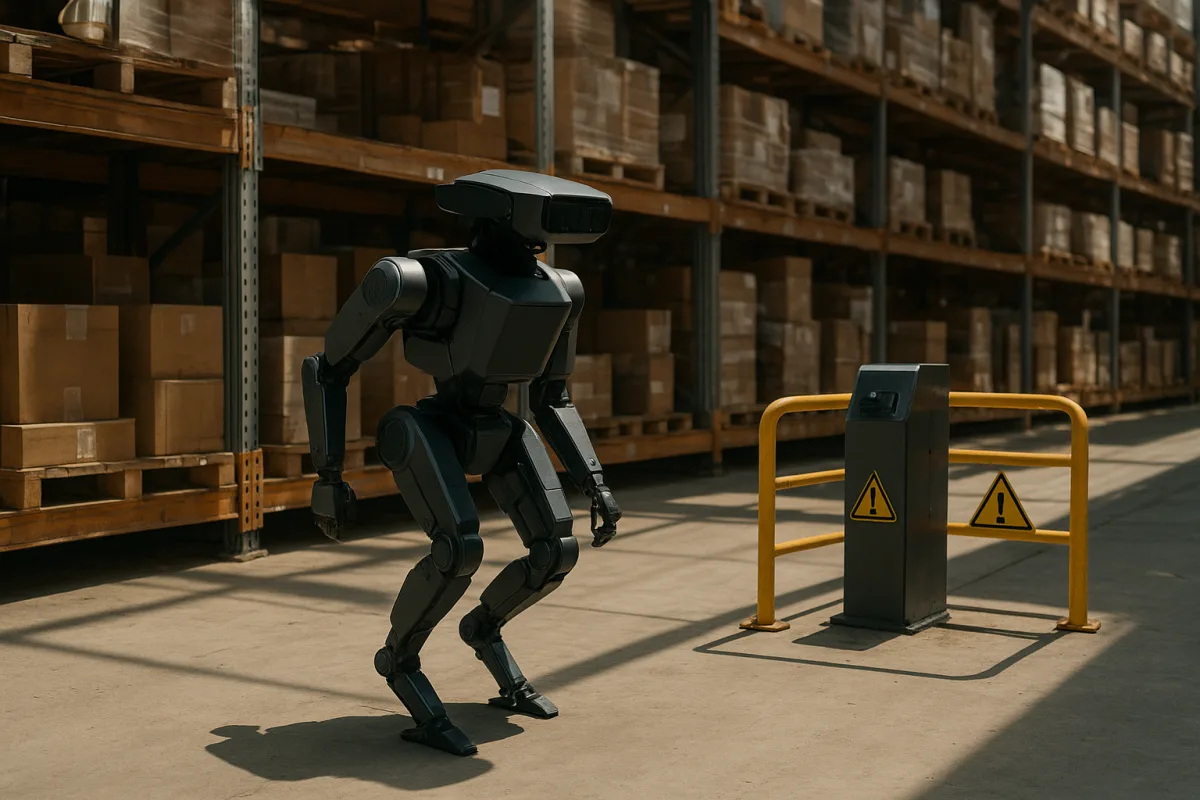
That change matters because conventional industrial automation succeeds by controlling the environment. Humanoids are being sold for the opposite case: environments built for humans, with changing shelves, containers, lighting, walkways, colleagues and exceptions.
The evidence is still largely vendor-generated, and that qualification matters. Figure and Agility have publicised compelling measurements and design claims, but independent field data on failure modes, intervention rates, maintenance burden and worker experience is not yet available.
Figure’s evidence is about transfer, not household autonomy
Figure AI introduced Helix 2.5 in September 2026 with a test across 30 previously unseen Bay Area homes. The company reports a 56 percent success rate on household tasks without collecting data in those evaluation homes beforehand. [3]
That is a meaningful experiment design, if Figure’s description is taken at face value. A robot that only works after mapping a room, tuning its policy, or collecting task-specific local demonstrations has limited practical value outside a controlled deployment.
Figure tested making beds, folding towels and collecting scattered objects into a basket. These are useful task families because they combine navigation, visual recognition, bimanual manipulation, posture changes and recovery from imperfect object placement.
The important result is the comparison Figure reports between models trained from random initial weights and models initialized from its Index pre-training dataset. The pre-trained policy reached 56 percent zero-shot success, versus 9 percent for the randomly initialized version. [3]
That does not prove a humanoid has a general understanding of homes. It does support a narrower and technically credible claim: pre-training on broad human-behaviour data can improve a downstream robot policy’s ability to cope with unfamiliar task instances.
Figure also says Helix 2.5 matched an earlier Helix policy’s performance using half the task-specific training data. [3] If reproducible, that may be commercially more significant than the headline domestic tasks, because robot-data collection is expensive and slow.
There are omissions. A 56 percent task success rate means failure remains common, and Figure has not published a complete breakdown by task, home layout, failure severity, recovery duration, human assistance, or repeated trial performance. [3]
Nor is there public operational feedback from customers using Helix 2.5 in homes or workplaces as of September 19, 2026. That is unsurprising for a recent introduction, but it means reliability claims should remain provisional rather than being extrapolated into a consumer-robot timeline.
Figure has not disclosed a market price, maintenance cost, software-update charge, or total cost of ownership for Helix 2.5. Any claim that a Figure deployment will be cheaper than human labour, or cheaper than fixed automation, is therefore speculation.
Digit 5 is aimed at a more immediate industrial problem
Agility Robotics’ Digit 5 is pursuing a different, more operationally focused form of generalization. Rather than household chores, the new Digit is intended for warehouses and factories where the task is variable but bounded: moving goods, handling containers and reaching human-scale storage.
Ars Technica reports that Digit 5 can repeatedly lift loads up to 50 pounds, or 23 kilograms, and reach as high as 7.2 feet. Those specifications are relevant because they align with the repetitive, single-person lift tasks that generate real warehouse demand.
Agility says the robot can operate for more than 20 hours in a 24-hour period through repeated charging cycles. Its public materials describe a 10-to-1 run-to-charge ratio, but detailed requirements for charger count, electrical supply and station placement remain undisclosed.
This is not a trivial procurement gap. A warehouse project needs to know where robots queue, how charging affects traffic flow, how battery faults are handled, and whether the charger becomes a single point of failure for a fleet.
The product remains a roadmap as well as a machine. Ars Technica reports early customer access is expected in the first half of 2027, followed by general availability by the end of that year, so buyers should distinguish announced capability from field-proven capability.
There is useful evidence behind Agility’s industrial focus. Earlier Digit versions have accumulated more than 65,000 hours in warehouses and factories across North America, according to Agility, with pilots or deployments involving GXO, Schaeffler, Amazon and Toyota Motor Manufacturing Canada.
That history does not validate Digit 5 itself. It does mean Agility is not starting from a blank slate, unlike companies whose evidence consists solely of choreographed clips or simulator-trained demonstrations with no disclosed production experience.
Safety is becoming part of the product, not an afterthought
Digit 5’s most consequential design claim is cooperative safety. According to Ars Technica’s reporting, the robot can identify nearby people and choose mitigation behaviours including moving aside, stopping, or squatting when a person enters close proximity.
That is operationally important because safety cages undermine the economic case for a mobile humanoid. If a robot must be isolated like a conventional industrial arm, facilities lose much of the flexibility that supposedly justifies its higher complexity.
Agility’s chief technology officer told Ars Technica that Digit 5 combines onboard multimodal sensing and AI algorithms to detect people. The company is also integrating Nvidia Thor IGX compute and Nvidia’s Halos for Robotics safety software stack.
Still, “designed to operate near humans” is not the same as a final, universally accepted safety case. The standards landscape remains fragmented, and existing rules for industrial robots, collaborative robots and autonomous mobile robots do not fully fit humanoid machines. [1][2]
ISO 10218, ISO/TS 15066 and ISO 3691-4 provide relevant starting points, but they were not written around a tall, legged machine with human-like reach and changing end-effectors. Site operators must still conduct their own hazard and risk analyses. [1]
Industry groups are working on that gap. ASTM International Committee F48 includes humanoid-robot builders such as Agility Robotics and Boston Dynamics, but formal humanoid-specific standards remain under development rather than completed regulation. [2]
This is why “the robot will stop if a person approaches” is not sufficient procurement language. A credible safety plan needs specified detection zones, stopping behaviour, fallback states, sensor fault handling, emergency-stop procedures, operator training and incident reporting.
Why this is happening now
The technical explanation is less mysterious than the rhetoric around embodied AI. Better visual-language models, more capable accelerators, improved simulation, robot teleoperation data and large-scale policy training are now being assembled into a single development pipeline.
Figure’s result is the clearest public illustration of the data component. Its Index dataset is intended to let Helix 2.5 acquire broad priors about movement, objects and human environments before being trained for a particular task. [3]
The industrial counterpart is operational data. Agility says its Digit programme has drawn on more than 65,000 hours of real-world operation, which is qualitatively different from training entirely in simulation, even though the exact training use of that data is not fully public.
Hardware is also catching up, though not magically. More onboard compute helps run perception and planning with lower latency, while improved batteries, swappable end-effectors and fleet-management software make deployments more plausible for operations teams.
The economic driver is equally straightforward. Warehouses and factories already face repetitive handling work, labour turnover, ergonomic constraints and variable demand. A robot need not replace every worker to justify itself, but it must work reliably enough to fit an existing process.
What project planners should do differently
Start with workflow selection, not the robot catalogue. The best first candidates are repetitive, physically demanding processes with clear handoff points, measurable throughput, limited object variation and a tolerable fallback when the robot requests help.
For Digit 5, that could mean moving totes, staging goods, pallet-related handling or work that requires reaching existing warehouse fixtures. The value proposition weakens when the task requires delicate manipulation, constant judgment calls or unpredictable interactions with the public.
Then measure the current process properly. Capture task cycle time, walking distance, lifting frequency, exception rate, injury exposure, staffing coverage, seasonal variation and the cost of pauses. Without that baseline, claims of labour savings cannot be evaluated.
Budget the full deployment rather than a robot sticker price. One industry estimate places Digit 5 at about $200,000 to purchase, plus a $20,000 one-time deployment fee and roughly $36,000 annually for software and maintenance.
On those assumptions, five-year ownership is approximately $400,000 per robot. The same estimate puts Robots-as-a-Service pricing near $8,500 per month plus a $25,000 deployment fee, or around $535,000 across five years.
Those figures should be treated as an estimate, not an Agility list price. They also do not settle the business case because integration, facility changes, network infrastructure, safety engineering, worker training and process redesign can materially change total cost.
Financing options are widening. Siemens Financial Services became an approved US Small Business Administration 7(a) lender in June 2026, which may matter for eligible automation buyers seeking debt rather than a full capital outlay.
Large pools of capital are also flowing toward automation infrastructure, including JPMorgan Chase’s planned investment of up to $10 billion in advanced manufacturing and robotics. That improves financing availability, but it does not make an unproven deployment low risk.
Finally, specify evidence gates in the contract and project plan. Require task-level success rates, human-intervention rates, downtime categories, recovery time, safety-event reporting, charging performance and a defined acceptance test in your own facility.
The direction of travel is clear: robots are becoming less dependent on one carefully engineered environment, and safer co-presence is becoming a core product requirement. The harder question is whether those gains survive the ordinary disorder of real operations.
Frequently Asked Questions
How does pre-training improve generalization in autonomous AI robots?
Pre-training on broad human-behaviour data enables robots like Figure’s Helix 2.5 to better cope with unfamiliar task instances without environment-specific training. For example, Helix 2.5 achieved a 56 percent zero-shot success rate on household tasks, compared to 9 percent for a randomly initialized model, demonstrating that pre-training can significantly improve transfer across new environments.
What are the challenges of deploying humanoid robots in homes and warehouses?
Deploying humanoid robots faces challenges such as handling variable and dynamic environments designed for humans, rather than controlled industrial settings. In warehouses, projects must plan around bounded workflows, downtime, risk assessment, and integration rather than expecting a general-purpose robot to find tasks on its own. Additionally, safety standards specific to humanoid robots are incomplete, requiring site-specific controls and assessments.
How safe are current humanoid robots around humans?
Current humanoid robots are not yet covered by finalized humanoid-specific safety standards. Existing industrial and collaborative robot standards do not fully address humanoid-specific risks. As a result, deployments still require thorough risk assessments and site-specific safety controls, and “safe around people” should not be equated with certified collaborative work.
What tasks can autonomous AI robots perform without environment-specific training?
Figure’s Helix 2.5 demonstrated the ability to perform household tasks such as making beds, folding towels, and collecting scattered objects into a basket in 30 previously unseen homes without prior environment-specific training. These tasks involve navigation, visual recognition, bimanual manipulation, posture changes, and recovery from imperfect object placement.
What are the cost considerations for industrial humanoid robots like Digit 5?
Digit 5 should be budgeted as part of an industrial automation program rather than a simple hardware purchase. One published estimate places the five-year ownership cost near $400,000 per robot, while a five-year rental arrangement may reach roughly $535,000. Pricing details for Figure’s Helix 2.5 have not been disclosed as of September 2026.
How we researched this
This article was assembled from 2 video sources, 1 published article, 3 cited references.
Nothing here is based on hands-on testing. Where a figure or finding appears, it belongs to the source cited beside it, and the writing says so rather than implying otherwise. Every source is listed below so you can check it.
Sources
Figure AI Robot HELIX 2.5 Autonomous Generalization In 30 New Homes — AI News
New Digit 5 Humanoid Robot AI Upgrades, Gemini 3.8 Live, Claude Docs + Slides — AI News
Agility’s new humanoid robot will stop, squat to avoid harming human coworkers — Ars Technica AI
Watch Advances in Autonomous AI Robots and Generalization on Youtube
Also from the sources
Related Articles

AI Model Fine-Tuning and Deployment Tools Explained
Learn about AI model fine-tuning and deployment tools, including best practices, PII protection, and cost-effective strategies for open LLMs.
AI in Robotics and Real-Time Applications
Explore how AI integrates with robotics for real-time control, challenges in deployment, and practical lessons from recent demos and projects.

Revolutionizing Robotics: Nvidia Upgrades Neo, Atlas, and Unitree G1
Nvidia upgrades humanoid robots Neo, Atlas, and Unitree G1 with cutting-edge technology, enhancing movement, manipulation, communication, and autonomy. The future envisions personal robots for household tasks, sustainability, and space exploration.

TrueForge vs Claude Code Projects
Compare TrueForge and Claude Code Projects to choose the right open source AI agent platform for your deployment and operational needs.