
AI Robotics Platforms Comparison and Physical AGI
Compare leading AI robotics platforms and physical AGI progress, including Gemini Robotics 2, Dex5-S hand, HomeBody, and teleoperated robots.
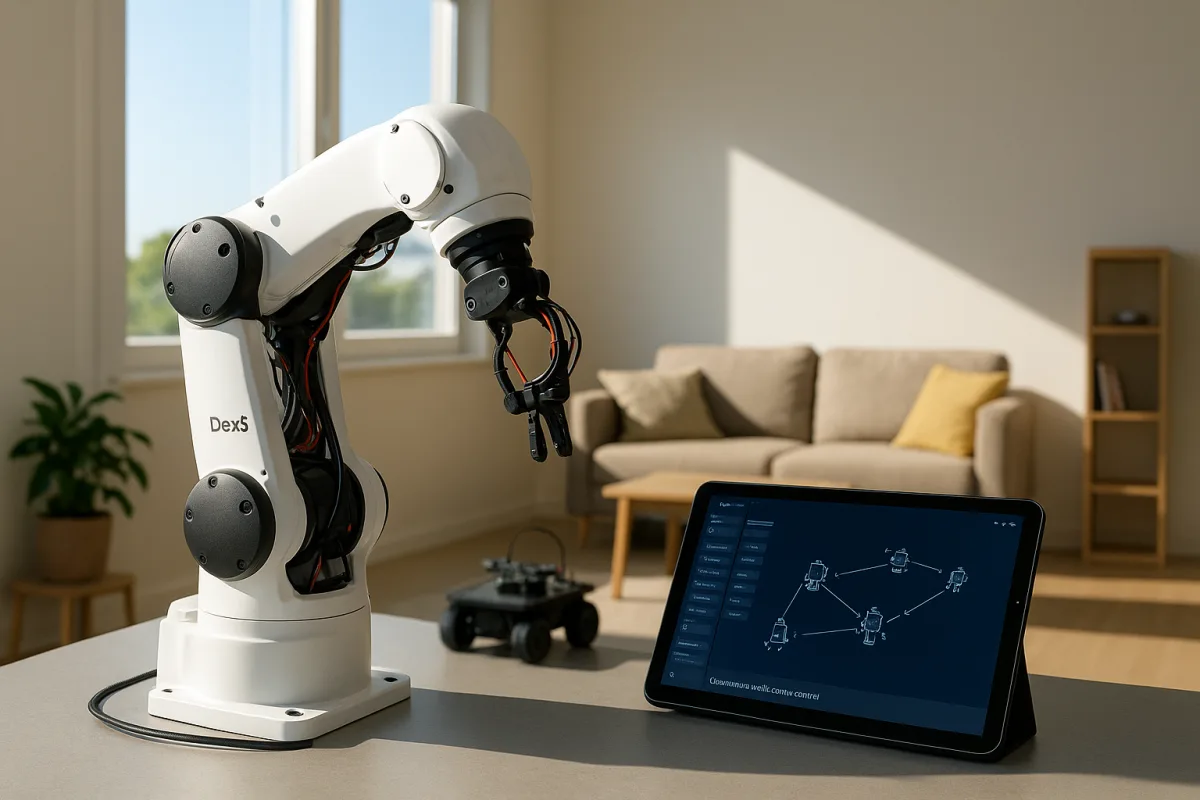
The quick list
- Best overall: Google DeepMind’s Gemini Robotics 2, for robotics teams that need a generalist control and planning layer across multiple robot bodies.
- Best value: Unitree Robotics’ Dex5-S hand, for researchers already operating compatible humanoids and willing to accept incomplete performance data.
- Best for small spaces: Stanford and Caltech’s HomeBody, for researchers studying robots that explore and remember indoor environments rather than another full-size humanoid.
- Best for teleoperation research: REK’s EngineAI T800 fighting robot, for controlled VR robotics demonstrations, not autonomous security or industrial work.
The practical question is not which robot looks most human in a viral clip. It is which approach reduces the engineering bottleneck you actually have: planning, locomotion, manipulation, remote operation, or operation in a cluttered home.
That distinction matters because “physical AGI” is currently more of a framing device than a product category. Google’s work concerns general-purpose robot policy and reasoning software. Unitree sells a mechanical end effector. REK stages teleoperated combat. HomeBody appears to be early academic embodied-AI work.
Comparison table
| Option | What it is | Price disclosed | Size or layout | What it is suited to | Main trade-off |
|---|---|---|---|---|---|
| Google DeepMind Gemini Robotics 2 | Robot action, reasoning and on-device model family | No public product price | Works across Apollo 2 humanoids and Franka F3 Duo arms | Multi-step manipulation, whole-body control and multi-robot coordination | Software capability is not the same as reliable physical task completion |
| Unitree Robotics Dex5-S | Five-finger robotic hand | From about $6,500 per hand, excluding shipping and tax | Human-scale hand, 22 active degrees of freedom | Adding more articulated manipulation to a compatible humanoid | No independent durability or dexterity comparison is public |
| Stanford and Caltech HomeBody | Research humanoid focused on exploration and memory | No public price | Designed around home-scale indoor operation | Research into navigation, memory and domestic embodied intelligence | No public ownership, maintenance or deployment data |
| REK / EngineAI T800 | VR-piloted humanoid fighting platform | No public price | About 1.73 m tall and 75 to 85 kg | Teleoperation, spectacle and controlled human-machine interaction experiments | Not autonomous, and no public actuator, sensor or joint specifications |
Sticker prices are especially misleading in robotics. Unitree’s quoted Dex5-S figure covers the hand, not integration, shipping, tax, a compatible robot, engineering time, safety equipment, maintenance, or regulatory work. No comparable public pricing exists for the other three options.
Google DeepMind Gemini Robotics 2: strongest software case, weakest basis for AGI claims
Google DeepMind’s Gemini Robotics 2 is the closest item here to a general-purpose robotics platform, but it is not a humanoid that a buyer can order. It is a model family intended to connect perception, language instructions, spatial reasoning, planning and motor control. [3][4]
Google separates the stack into roles. Gemini Robotics 2 produces actions, Gemini Robotics ER 2 handles higher-level reasoning and planning, and Gemini Robotics On-Device 2 is intended for lower-latency execution on the machine itself. [3][5]
That architecture is sensible. A robot needs a process that can identify an object, infer the task sequence, monitor progress and revise a plan when a grasp fails. It also needs a control layer that converts those decisions into safe, physically feasible movements.
Google has demonstrated the same model checkpoint across Apptronik’s Apollo 2 humanoid with different hands and a Franka F3 Duo arm with a gripper. That is a more useful direction than building intelligence tightly around one showroom robot body. [4][5]
Still, cross-embodiment transfer is not the same as plug-and-play deployment. Different hands change reachable grasps, force limits, sensing, contact dynamics and failure modes. A policy that can plan a task across platforms may still need substantial platform-specific validation before operating around people.
The published dexterity results are the important corrective to polished demos. Google reported approximately 92% success for unscrewing a light bulb, but only around 36% for screwing one back in, 44% for tying a trash-bag knot, 40% for sealing a Ziploc bag, and 32% for sweeping into a dustpan. [3][4]
Those figures do not mean the research is weak. They show what the benchmark measures: repeated success on defined physical tasks. They also show what a launch montage omits, namely that a system can have credible high-level reasoning and still fail routine contact-rich work too often for unsupervised deployment.
The AI Uncovered channel describes Google’s effort as “physical AGI.” That phrase overstates the evidence. The more defensible description is a generalist robotics software program that is beginning to combine language-grounded planning with whole-body control, under constrained demonstrations and incomplete reliability data.
For a lab or manufacturer, Gemini Robotics 2 suits teams attempting to reduce per-task programming effort. For an operations manager, it is not yet enough information to estimate throughput, safety cases, intervention rates, hardware cost, or return on investment.
Unitree Robotics Dex5-S: a relatively cheap hand, not a proven manipulation system
Unitree Robotics’ Dex5-S is easier to place commercially because it has a published starting price: approximately $6,500 per hand, excluding shipping and tax. The AI News channel notes that fitting two hands would therefore cost roughly $13,000 before those extras.
That figure is notable because Unitree’s G1 humanoid has been advertised around $13,500. In other words, a pair of Dex5-S hands can cost about as much as the entry-level humanoid body they are intended to upgrade, before integration and support costs.
The Dex5-S has 22 active degrees of freedom, backdrivable joints and impact-torque protection, according to Unitree’s published specification. It is human-hand scale, which matters for interaction with tools, handles, packaging and appliances designed around human dimensions.
Degrees of freedom are useful, but they are not a score for real-world dexterity. They tell you how many independently controlled motions are available, not whether the hand can identify a stable grasp, sense slip, regulate force or repeat a task after minor environmental changes.
The missing information is substantial. There are no public independent benchmarks comparing Dex5-S dexterity or durability against alternatives such as AGILINK’s OmniHand 3 Ultra-M or the Shadow Dexterous Hand. Reported grip force, hand weight, tactile sensing details and lifecycle data are also incomplete.
The POMDAR benchmark, introduced in 2026, is the kind of common evaluation framework this category needs. Until robotic hands are measured on repeatable grasping and manipulation tasks, a 22-degree-of-freedom specification should be read as a design description, not a capability ranking.
The AI News channel speculates about future tactile sensor arrays. That is reasonable engineering speculation, but buyers should not treat it as a delivered feature. Unitree has not publicly established fingertip tactile sensing as part of the Dex5-S specification.
For deployment, the safety question is ordinary industrial robotics rather than a new hand-specific regulatory category. OSHA requirements, along with standards such as ANSI/RIA R15.06 and ISO 10218, still govern machine guarding, lockout procedures and industrial robot safety. [2]
Dex5-S therefore suits research groups and integrators who need an articulated hand at a comparatively accessible component price. It does not yet suit buyers needing a documented service interval, quantified reliability, independently validated manipulation performance or a certified collaborative-workstation package.
HomeBody: promising research framing, almost no purchasing information
The Stanford and Caltech HomeBody project is the least commercially legible option in this roundup. Dr Alan D. Thompson’s September 2026 video identifies it as a humanoid that explores and remembers, which points toward long-horizon indoor navigation and embodied memory rather than a specific manipulation product.
That focus addresses a real gap. A useful home robot cannot merely recognize an object in front of its cameras. It needs to remember room layouts, find objects after they move, reason about routes and cope with homes that are neither standardized nor tidy.
But HomeBody is currently a research reference, not a buying decision in the ordinary sense. No public price, dimensions, runtime, maintenance plan, warranty, payload, supported task set or independent operational evaluation is available for the Stanford and Caltech system.
That absence should temper claims about household humanoids generally. Industry estimates cited by RoboZaps put typical humanoid operation at two to four hours per charge, with continuous uptime often requiring intervention after 30 to 90 minutes. [6]
The same broader industry estimates put post-warranty annual maintenance around 8% to 15% of purchase price, while batteries and actuators are finite-life components. [6] Those are not HomeBody-specific figures, but they are relevant context when someone presents home robotics as an imminent consumer appliance category.
HomeBody suits university researchers studying embodied memory, navigation and home-scale interaction. It does not suit a homeowner, facility manager or procurement team, because there is no public product offering against which to assess price, support or safety.
REK’s EngineAI T800: a teleoperation demo, not robot combat autonomy
REK’s viral September 18 fight in San Francisco is the clearest example of how a compelling clip can create the wrong technical impression. AI Revolution describes a six-foot Terminator-styled robot defeating entertainer Frankie LaPenna in a short MMA-style match.
The independently reported account is less dramatic and more informative. The robot was an EngineAI T800, approximately 1.73 metres tall and weighing 75 to 85 kg. A human pilot controlled it through VR equipment, while onboard AI handled balance and posture.
That makes REK’s system a telepresence and teleoperation platform. It does not show a humanoid independently choosing tactics, reading an opponent or making combat decisions. The human operator remained responsible for the meaningful decision loop.
Teleoperation is still technically significant. Maintaining balance while delivering kicks, receiving contact and following a remote operator’s movements requires capable hardware and control. But it is a fundamentally different engineering problem from building an autonomous general-purpose robot.
The staged nature of the event also limits what can be inferred. The opponent wore substantial padding, the fight was brief, and the footage cannot establish kick force, latency, control robustness or how the robot behaves after an unexpected fall or collision.
No public data establishes the T800’s joint degrees of freedom, actuator design, sensor suite or maintenance requirements. Without those details, it cannot be compared meaningfully with an industrial humanoid on payload, safety, uptime or repairability.
REK’s EngineAI T800 suits entertainment, VR-control research and carefully bounded demonstrations. It is unsuitable as evidence for autonomous security, practical sports competition, or a near-term robot able to operate safely among untrained members of the public.
Who each option suits
Google DeepMind Gemini Robotics 2 suits robotics developers, research labs and robot manufacturers building generalist manipulation systems. Its value lies in a potentially reusable intelligence layer, especially where language instructions and changing tasks matter more than a single optimized automation cell.
Unitree Robotics Dex5-S suits teams with a compatible robot platform and a concrete need for more articulated grasping. At roughly $6,500 per hand before shipping and tax, it is comparatively accessible hardware, but the integration burden and evidence gap remain buyer risks.
Stanford and Caltech’s HomeBody suits academic work on embodied memory and domestic navigation. It is not currently a sensible procurement option because public information does not support even a basic ownership-cost or operating-reliability estimate.
REK’s EngineAI T800 suits organizations exploring VR piloting, public demonstrations or controlled human-machine interaction. It should be evaluated as remotely operated robotics hardware, not as an autonomous fighting system or a proof that humanoids have crossed a general-intelligence threshold.
Frequently Asked Questions
What are the leading AI robotics platforms in 2026?
The leading platforms include Google DeepMind’s Gemini Robotics 2 for generalist control and planning across multiple robot bodies, Unitree Robotics’ Dex5-S as a robotic hand for manipulation research, Stanford and Caltech’s HomeBody for domestic embodied AI research, and REK’s EngineAI T800 for teleoperation demonstrations. Each serves different roles in the robotics stack, from software and manipulation to teleoperation and indoor exploration.
How does Google DeepMind's Gemini Robotics 2 compare to other robotic systems?
Gemini Robotics 2 is a software stack focused on multi-step manipulation, whole-body control, and multi-robot coordination, demonstrated on different robot bodies like Apptronik’s Apollo 2 and Franka F3 Duo. Its task success rates vary widely (32% to 92%), and it is not a purchasable robot but rather a model family for robotics teams needing generalist control. Unlike hardware-focused systems, it emphasizes cross-embodiment transfer and planning rather than reliable physical task completion.
What are the current limitations of physical AGI in robotics?
None of the reviewed systems qualify as near-term physical AGI products. They represent layers such as planning software, robot hands, teleoperated humanoids, or early domestic embodied AI research. Physical AGI remains more a conceptual framing than a deployable technology, with current platforms showing limited task success, incomplete hardware integration, or reliance on human teleoperation.
Which robotic hands offer the best value for manipulation research?
Unitree Robotics’ Dex5-S hand is the best value option, priced from about $6,500 per hand before shipping and taxes. It features 22 active degrees of freedom and is designed for high-dexterity tasks, but lacks publicly available durability, tactile sensing, or grip force benchmarks. It suits researchers with compatible humanoids willing to accept incomplete performance data.
What research is being done on domestic embodied AI robots?
Stanford and Caltech’s HomeBody project focuses on robots designed for exploration and memory within constrained home environments. It is intended for research into navigation, memory, and domestic embodied intelligence rather than as a purchasable household product. There is no public pricing, operational record, or evidence of deployment as of 2026.
How we researched this
This article was assembled from 4 video sources across 4 channels, 6 cited references.
Nothing here is based on hands-on testing. Where a figure or finding appears, it belongs to the source cited beside it, and the writing says so rather than implying otherwise. Every source is listed below so you can check it.
Sources
AI Robots Are Beating Humans Now — AI Revolution
Google Is Now Building Physical AGI — AI Uncovered
First look: HomeBody: A Humanoid That Explores, Remembers... by Stanford, Caltech (Sep/2026) — Dr Alan D. Thompson
Xpeng IRON, Unitree DEX5-S AI Robot Hand, JEV Beats Claude, Opus 5.5 — AI News
Robotics - Standards | Occupational Safety and Health Administration
Watch AI Robotics and Physical AGI Developments on Youtube
Also from the sources
Related Articles
AI in Robotics and Real-Time Applications
Explore how AI integrates with robotics for real-time control, challenges in deployment, and practical lessons from recent demos and projects.

AI Agents Multi-Agent Systems Platforms
Explore AI agents and multi-agent systems platforms with comparisons, costs, observability, and security insights for effective deployment.
Advances in Autonomous AI Robots and Generalization
Explore how autonomous AI robots improve generalization and transfer learning for real-world tasks in homes and industry.
AI Agents in Real-Time Applications
Explore how AI agents work in real-time sports, robotics, and voice AI, focusing on latency, specialized tooling, and practical deployment challenges.