
Industrial Humanoid Robots Comparison
Compare industrial humanoid robots like Figure 4, Unitree models, and Google’s orbital AI hardware for insights on pricing, specs, and use cases.
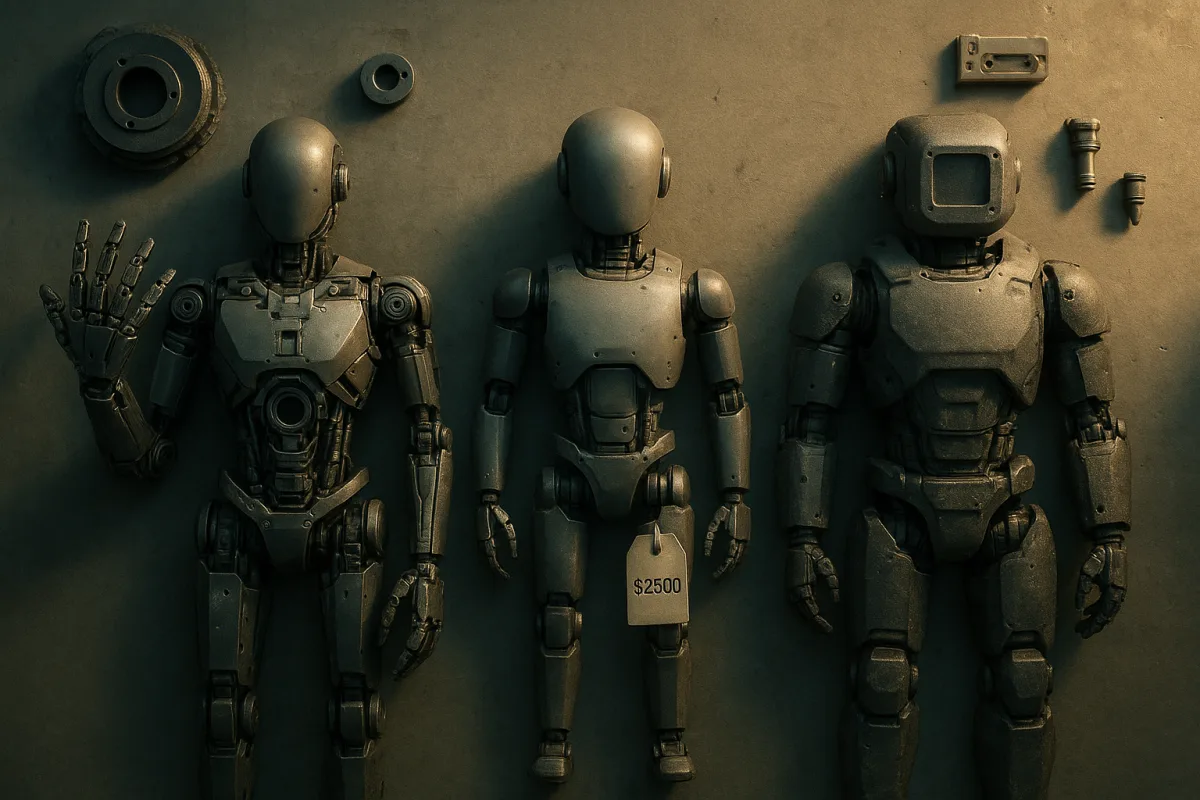
AI Hardware and Robotics Advances: What Figure 4 and Google’s Orbital TPUs Actually Change
The quick list
Best overall industrial humanoid to watch: Figure 4 , for robotics teams that can work with an unreleased platform and want Figure AI’s redesigned actuators, battery system, and high-actuator-count hands.
Best value commercial humanoid reference: Unitree G1 , for developers who need a published entry price of $13,500 instead of waiting for Figure AI to disclose commercial terms.
Best for higher-spec humanoid deployments: Unitree H2 , for buyers who want a priced platform at $29,900 and need a comparison point above entry-level developer hardware.
Best subscription-oriented option: 1X NEO , for organizations that prefer a reported $499 monthly plan over an upfront purchase, alongside a reported $20,000 purchase price.
Best for in-orbit inference experiments: Google Project Suncatcher , for satellite and Earth-observation operators studying onboard analysis, not for teams seeking conventional AI infrastructure.
You are deciding between very different kinds of hardware bets. One puts motors, hands, and batteries into a human-shaped machine that must survive a work shift. The other puts AI accelerators into a vacuum, where power, cooling, networking, and repair all work differently.
Figure AI’s Figure 4 is the nearer-term product story, although it remains incomplete for a buyer. Google’s Project Suncatcher is the stranger technical story, a satellite carrying four Trillium-generation TPUs and a preloaded Gemma 4 model.
| Option | What it is | Published price | Key hardware or layout detail | Main trade-off | Best fit |
|---|---|---|---|---|---|
| Figure AI Figure 4 | Upcoming humanoid robot | Not disclosed | New in-house actuators, new battery packs, redesigned hands with more actuators than earlier whole robots | No published uptime, capacity, payload, speed, precision, or reliability data | Enterprise teams evaluating future humanoid automation |
| Unitree G1 | Commercial humanoid reference | $13,500 | Entry-level priced humanoid | Published price does not make it equivalent to Figure 4 | Developers needing a lower-cost comparison point |
| Unitree H2 | Higher-priced commercial humanoid reference | $29,900 | Commercial humanoid positioned above G1 pricing | No Figure 4 performance comparison is available | Buyers wanting a disclosed higher-tier option |
| 1X NEO | Humanoid robot with purchase and subscription paths | $20,000 or $499 per month | Purchase or recurring-payment model | Terms and included services were not specified in the available pricing | Organizations preferring subscription economics |
| Google Project Suncatcher prototype | Low Earth orbit AI-compute satellite | Not disclosed | Four Trillium TPUs, 1,000-watt solar array, one TPU active at a time for about 15 minutes | Thermal limits, radiation, downlink, launch costs, and regulation | Onboard satellite inference research |
| Starcloud 1 | AI satellite using Nvidia hardware | Not disclosed | Nvidia H100 GPU, reported LLM inference and small-model training | Individual-satellite design does not solve cluster-scale interconnects | Companies exploring standalone orbital compute |
Figure 4’s upgrades are important, but the buying case is still unpriced
Figure AI says Figure 4 has reached design lock and that it has begun shipping parts. That is a meaningful manufacturing milestone, but it is not the same as a published deployment specification or evidence of reliable operation in a customer facility.
The company is bringing Figure 4 actuators in house and characterizing each unique actuator design. It has also assembled 10 battery packs for initial testing, with load, thermal, and broader battery characterization planned over the following months.
Those details point to Figure AI focusing on the hard parts of humanoid production. Actuators determine force, movement quality, heat, maintenance burden, and cost. Battery packaging shapes runtime, balance, charging workflow, and how much useful work a robot can do between interruptions.
The most ambitious claim concerns the hands. Figure AI says its new hand system has more actuators than an entire prior robot and is approaching human-hand parity. That could matter substantially for manipulation, but the company has not published finger force, tactile sensing, cycle life, grasp success rates, or repair procedures.
This is where the launch rhetoric runs ahead of the available numbers. Figure founder Brett Adcock called the platform the company’s largest generational step and likened it to an “iPhone 1” moment for humanoids, but buyers still lack the metrics needed to compare it with deployed industrial machines.
No retail or commercial price for Figure 4 has been disclosed. That leaves Unitree G1 at $13,500, Unitree H2 at $29,900, and 1X NEO at a reported $20,000 purchase price or $499 monthly subscription as market context, not like-for-like substitutes.
Those competitor prices tell you where visible humanoid pricing begins, not what a Figure 4 deployment will cost. The available information does not specify what the quoted Unitree or 1X prices include, such as support, fleet-management software, shipping, integration, charging infrastructure, or service contracts.
Runtime and maintenance are still the humanoid bottleneck
The core hardware question is not whether a humanoid can complete a polished demonstration. You need to know how many useful task hours it delivers per day, how often it needs help, what breaks, and whether a technician can return it to service quickly.
Figure AI has not published failure rates or maintenance results from Figure 4 field testing. That absence is significant because actuators experience repeated mechanical stress, while batteries constrain shift coverage and can impose charging, cooling, and replacement costs.
Across the sector, humanoid battery operation commonly falls in the two-to-four-hour range, well below an eight-to-12-hour human shift. McKinsey identifies battery limits and actuator supply as major constraints as humanoid makers move from prototypes toward commercial deployments.[1]
Tesla’s Optimus Gen 2, for comparison, reportedly uses a 2.3 kWh battery and targets roughly two hours of operation under dynamic conditions. There is no public performance dataset that lets you compare its motors, precision, energy consumption, or battery behavior directly with Figure 4.[1]
Figure AI has shown prior operating evidence with Figure 03, reporting more than 30,000 packages processed over 24 or more hours at roughly three seconds per package. That result describes an earlier robot and a particular task setup, so it cannot establish Figure 4 uptime or throughput.
We would not buy on the phrase “baby AGI,” which Figure AI used to describe a newly trained robotics model. Its claim rests on undisclosed pretraining scale, GPU count, tasks, evaluation design, and baseline comparisons, all of which determine whether progress transfers beyond a controlled environment.
Genie 4 may matter to robotics, but it is not Figure 4
Google DeepMind’s Genie 4 is a separate product category: an interactive world model, not a humanoid robot. It generates navigable environments in real time, responds to keyboard controls and text prompts, and can generate ambient audio and interactive character dialogue.
DeepMind says Genie 4 can alter environments while they run, including weather, camera position, objects, and characters. It also says the system models interactions such as collisions and aerodynamics, with Gemini models helping maintain scene coherence and manage multi-step goals.
For robotics developers, the appeal is training data and task rehearsal. A model can try structured actions in simulated environments before consuming time on physical robots, batteries, parts, and human supervision. The limitation is transfer: simulation behavior can differ from real-world contacts, friction, lighting, and sensor noise.
DeepMind has demonstrated a setup in which Gemini 4 Argon decomposes a checker-playing task and sends text instructions into Genie 4, which simulates an Apptronik Apollo humanoid. That is a promising training workflow, but it is not a published benchmark of real robot task success.
Google’s TPU satellite proves execution, not orbital data centers
Google’s Project Suncatcher prototype launched on October 1, 2026, as part of SpaceX’s Transporter 18 rideshare mission. Built with satellite company Planet, it carries four Trillium TPUs, Google’s sixth-generation tensor-processing units, along with a 1,000-watt solar array.
The satellite has now generated a response using Gemma 4 and returned it to Earth during a pass near Svalbard, Norway. Sundar Pichai described the event as Project Suncatcher’s “hello world” moment, which is the right framing for this demonstration.
It proves that a data-center-class TPU can run a generative AI task in orbit and send back an answer. It does not prove economically competitive training, reliable continuous operation, cluster-scale networking, or a service that developers can rent.
Power and cooling explain why. The prototype has four TPUs, but only one runs at a time for about 15 minutes before requiring cooldown due to thermal constraints. The mission is designed to run for one year, testing whether the hardware can survive and operate in orbit over time.
A 1,000-watt solar array is substantial for a small satellite but tiny beside terrestrial AI infrastructure. In space, excess heat cannot be dumped into air or water. It must move through conductive structures and radiate away through radiator area, adding mass and design complexity.
Google has tested Trillium hardware under a 67-million-electron-volt proton beam. The company found high-speed memory particularly sensitive, while testing suggested a roughly two-kilorad exposure was near three times the anticipated five-year shielded-mission dose and produced no identified permanent dose-related failures.
That result is encouraging, but it is a controlled radiation test. Orbital hardware must also handle thermal cycling, micrometeoroids, maneuvering, communications failures, and the difficulty of detecting silent calculation errors from radiation-induced bit flips.
The cluster design is the real Suncatcher bet
Google’s longer-term proposal is not one smart satellite. It is a tightly coordinated cluster of many satellites, each with solar panels and TPUs, joined by high-speed laser links so they can process a shared workload.
Google’s Joule paper describes an illustrative 81-satellite cluster at roughly 400 miles altitude. The cluster spans a radius slightly greater than half a mile, while neighboring satellites could sit only 330 to 660 feet apart to reduce communication latency.
For distributed model training, that interconnect is the central issue. Google estimates that an orbital cluster would need 10 terabits per second between satellites to match data-center-style workloads. Ground tests reached 800 gigabits per second in one direction, or 1.6 terabits per second bidirectionally.
Those links are impressive laboratory results, yet they remain far below the cited 10-terabit target. Maintaining optical links between satellites flying in close formation introduces pointing, control, and orbital-dynamics problems that do not exist between racks on a data-center floor.
Google argues that solar generation in the right orbit can reach up to eight times ground-panel output. Dawn-dusk sun-synchronous orbits offer nearly continuous sunlight, potentially reducing battery needs, but that energy advantage must cover launch, heat rejection, networking, and replacement constraints.
The company’s economic model assumes launch costs of about $90 per pound and estimates an annualized cost near $810 per kilowatt. It compares that figure with reported U.S. data-center energy spending of about $570 to $3,000 per kilowatt per year, but the launch assumption carries much of the conclusion.
Orbital compute also now faces licensing work alongside engineering work. U.S. low-Earth-orbit deployments must operate within the FCC’s Part 100 satellite licensing framework, effective from July 2026, while radio use intersects with International Telecommunication Union rules for non-geostationary satellite frequencies.
Who each option suits
Figure 4 suits enterprise robotics teams with patient capital and a direct relationship with Figure AI. You should want early access to a platform whose actuator, hand, and battery designs are still being characterized, and you should be prepared for undisclosed pricing and operating data.
Unitree G1 suits developers seeking a visible low-cost entry point. Its reported $13,500 price gives you a clearer starting number than Figure 4, though you still need to establish what hardware configuration, support, and deployment services that figure includes.
Unitree H2 suits buyers comparing commercial humanoids above the entry tier. The reported $29,900 price makes it a useful budget reference, but you should not infer that it matches Figure 4’s intended manipulation hardware or software capabilities.
1X NEO suits organizations that value payment flexibility. A reported $20,000 purchase path and $499 monthly subscription offer a different procurement model, although the available pricing does not spell out service levels, integration work, or contract requirements.
Google Project Suncatcher suits satellite operators and AI-infrastructure researchers. If you process large volumes of Earth-observation data, onboard inference could reduce raw-data downlink needs. If you need dependable training capacity or interactive cloud inference now, terrestrial infrastructure remains the option with known power, cooling, repair, and networking paths.
Frequently Asked Questions
What are the key differences between Figure AI Figure 4 and Unitree humanoid robots?
Figure 4 features newly designed in-house actuators, battery packs, and hands with more actuators than previous whole robots, aiming for near human-hand parity. In contrast, Unitree’s robots like the G1 and H2 are commercially available with published prices but lack the disclosed advanced hardware redesigns of Figure 4. Figure 4 remains unreleased with no published uptime, payload, or reliability data, while Unitree’s models provide clearer commercial reference points.
How does Figure 4 compare to commercial humanoid robots in price and specs?
Figure AI has not disclosed any pricing or detailed performance specifications for Figure 4. By comparison, Unitree’s G1 is priced at $13,500, the H2 at $29,900, and 1X’s NEO is available for $20,000 or a $499 monthly subscription. These competitor prices serve as market context but are not direct substitutes or equivalents since Figure 4’s capabilities and costs remain unreported.
What are the current limitations of industrial humanoid robots like Figure 4?
A major limitation is the lack of published data on runtime, maintenance, failure rates, and operational reliability. Actuators face mechanical stress that affects durability, and battery capacity typically limits continuous operation to a few hours, falling short of a full human work shift. Without detailed field testing results, it is unclear how Figure 4 addresses these common bottlenecks.
What is Google’s Project Suncatcher and how does it relate to AI hardware in space?
Project Suncatcher is a satellite experiment carrying four Trillium-generation TPUs powered by a 1,000-watt solar array, designed to run AI inference workloads in low Earth orbit. Each TPU operates sequentially for about 15 minutes due to thermal constraints, and the mission is intended as a one-year test of TPU viability in space rather than a deployable cloud service. This project explores onboard satellite AI processing rather than replacing terrestrial data centers.
Are there affordable humanoid robots available for developers today?
Yes, there are commercially available humanoid robots with published prices suitable for developers. Unitree offers the G1 at $13,500 and the H2 at $29,900, while 1X provides the NEO robot for $20,000 or a $499 monthly subscription. These platforms offer clearer pricing and availability compared to unreleased options like Figure 4.
How we researched this
This article was assembled from 2 video sources across 2 channels, 1 cited reference.
Nothing here is based on hands-on testing. Where a figure or finding appears, it belongs to the source cited beside it, and the writing says so rather than implying otherwise. Every source is listed below so you can check it.
Sources
Google Just Sent Gemma 4 Into Space and It Answered Back, AI Revolution
Figure AI Reveals New 04 Humanoid Robot Hardware Upgrades (GENIE 4), AI News
Scaling the humanoid robotics supply chain into billion-dollar wins | McKinsey
Watch AI Hardware and Robotics Advances on Youtube
Also from the sources
Related Articles
AI Robotics Platforms Comparison and Physical AGI
Compare leading AI robotics platforms and physical AGI progress, including Gemini Robotics 2, Dex5-S hand, HomeBody, and teleoperated robots.
Advances in Autonomous AI Robots and Generalization
Explore how autonomous AI robots improve generalization and transfer learning for real-world tasks in homes and industry.
AI Models and Chips Comparison in 2026: Jalapeño vs Gemini
Compare AI models and chips in 2026, including OpenAI's Jalapeño and Google's Gemini 3.7 Flash, with insights on performance, cost, and deployment.
AI Model Efficiency and Cloud Integration Advances Explained
Explore AI model efficiency and cloud integration advances, including GPT-6.1 Terra and TorchTPU cost and performance insights for AI workloads.