
AI Models and Chips Comparison in 2026: Jalapeño vs Gemini
Compare AI models and chips in 2026, including OpenAI's Jalapeño and Google's Gemini 3.7 Flash, with insights on performance, cost, and deployment.
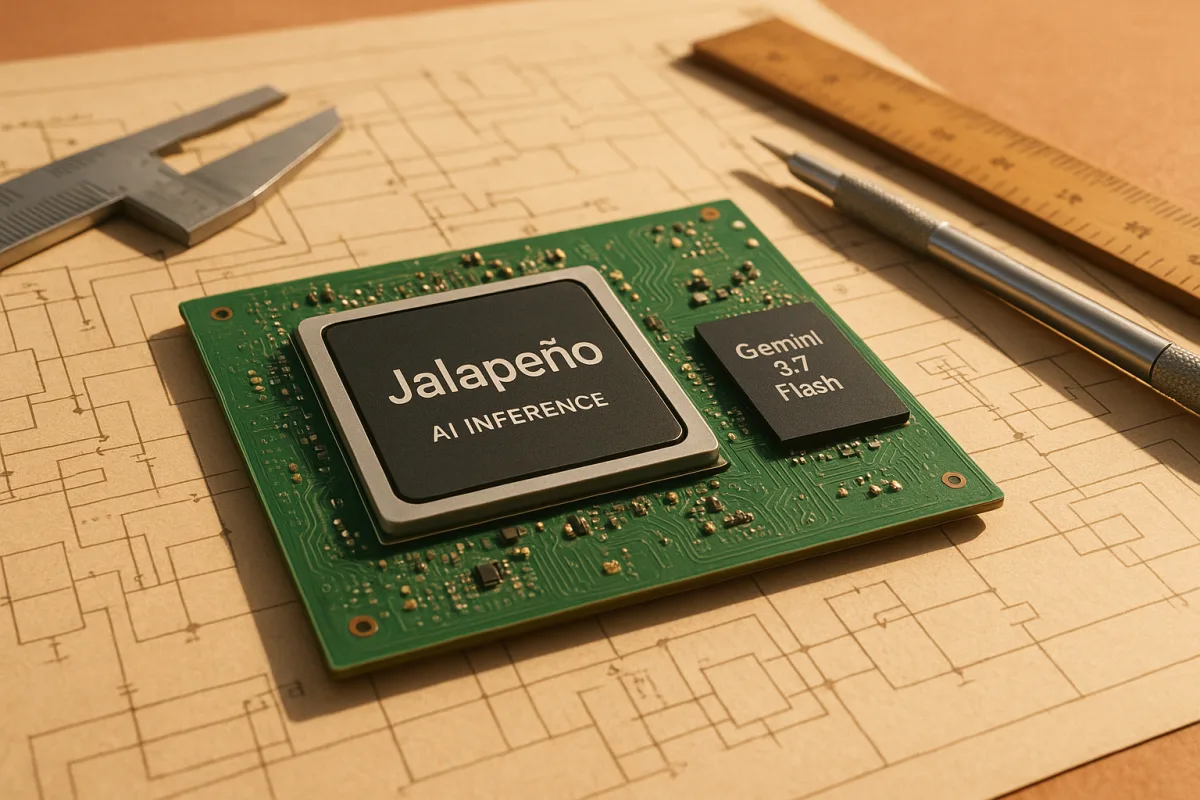
Comparing Frontier AI Models and Chips in 2026: OpenAI’s Jalapeño vs Google’s Gemini 3.7 Flash and the Ox Alpha Enigma
The AI landscape in 2026 continues to evolve rapidly with new model releases and custom hardware pushing the envelope on performance, cost, and deployment scale. Three of the most talked-about entrants this year are OpenAI’s Jalapeño inference chip powering GPT models, Google DeepMind’s Gemini 3.7 Flash model, and the mysterious Ox Alpha, an unclaimed frontier-class multimodal model distributed openly but shrouded in anonymity. Each boasts impressive capabilities in coding, agentic workflows, and multimodal reasoning, yet their differences in architecture, cost, and production readiness paint a nuanced picture for AI practitioners and enterprises deciding where to invest.
This article offers a focused head-to-head comparison of OpenAI’s Jalapeño-powered models and Google’s Gemini 3.7 Flash, with contextual remarks on Ox Alpha’s disruptive but uncertain arrival. The goal is to clarify what these technologies actually deliver beyond headline scores, the benchmarks used and their limits, and practical considerations around deployment, cost, and compliance in 2026.
Model and Chip Overview: What They Are and What They Aim to Do
OpenAI’s Jalapeño chip is a custom-designed inference accelerator introduced in mid-2026, intended to run large language models (LLMs) with greater energy efficiency and lower latency than previous commercial AI hardware, particularly Nvidia’s GB200 and GB300 series. It supports a range of OpenAI’s own models and external open-weight models like DeepSeek R1 and Kimi K2.5 1T, showing consistent throughput gains of 1.5 to 1.9 times per watt and latency reductions of up to 3.6 times in benchmarks that simulate real inference tasks. Jalapeño is designed as part of a full-stack system where software, chip, memory, and network are co-optimized for interactive and agentic workloads, which involve many sequential steps with tool calls and complex reasoning .
Google DeepMind’s Gemini 3.7 Flash is the latest iteration of their Flash series models, explicitly targeted at coding, agentic applications, and web development tasks. Released just three weeks after Gemini 3.6 Flash, version 3.7 shows notable improvements in multiple benchmarks relevant to software engineering workflows, such as FrontierCode 1.1 Main (43.6% success rate), DeepSWE v1.1 (65.3%), and AutomationBench (30.4%), all representing realistic, production-level coding tasks rather than simplified puzzles. Google positions Gemini 3.7 Flash as a cost-effective, reliable workhorse for enterprises deploying AI agents that must “finish the job” with minimal retries and manual intervention [1][2].
Ox Alpha emerged suddenly on the open internet as a frontier-class multimodal model supporting text, image, and video input with an unprecedented ~1 million token context window. It boasts a mixture-of-experts architecture with an estimated 744 billion parameters total and around 40 billion active during decoding, enabling it to process complex coding workflows and sustained agentic tasks. Ox Alpha’s unknown origin and lack of official documentation have spurred speculation that it is either a fine-tuned Google Gemini variant or a Chinese-developed model. While it achieves an 80% pass rate on subsets of the DeepSeek-SWE benchmark, outperforming GPT 5.6 Soul and Claude Fable, it suffers from stability issues such as mid-sentence halts and requires manual intervention to continue in certain cases. These operational caveats and its unclaimed provenance raise questions about production readiness and enterprise security compliance [3].
Benchmarking and What They Measure (and Omit)
Benchmarks are the common currency for comparing AI models but come with significant caveats:
FrontierCode and DeepSWE benchmarks measure models’ ability to read, diagnose, modify, and test real software repositories iteratively, approximating true developer workflows more closely than single-shot coding problems. DeepSWE v1.1 is particularly valued for assessing long-horizon engineering tasks and agentic performance.
WebDev Arena and AutomationBench test web application generation and enterprise workflow automation, respectively, focusing on completeness, accuracy, and multi-step task execution.
InferenceX is a hardware-focused benchmark measuring AI work per watt and latency across prefill and decode phases for inference chips, crucial for assessing the economic viability of deploying models in production at scale.
Artificial Analysis Intelligence Index and Agentic Index aggregate multiple benchmarks to provide composite measures of intelligence and agentic ability.
These benchmarks omit or underrepresent areas such as:
Real-world user experience, including how models handle ambiguous instructions or require manual prompt engineering.
Safety, ethical guardrails, and the ability to resist adversarial inputs or jailbreaks.
Regulatory compliance, including privacy and data residency requirements.
Cost transparency, especially around operational expenses for inference tokens and hardware maintenance.
Stability and reliability in continuous, long-duration agentic workflows.
Pricing and Cost Efficiency: What You Pay and What You Get
Jalapeño chip’s efficiency promises substantial throughput and latency improvements, but OpenAI has not disclosed verified power consumption costs per inference token or total cost of ownership. The chip operates with a thermal design power (TDP) rated at 700 watts but sustains about 550 watts during workloads tested publicly. Despite claims of 1.5 to 1.9× more AI work per watt compared to Nvidia GB200/GB300, the lack of transparent pricing makes it difficult to assess end-user economics accurately .
Gemini 3.7 Flash is priced aggressively to capture market share, with an introductory rate of $0.75 per million input tokens and $3.75 per million output tokens, valid through the end of 2026 before doubling in 2027. This is half the original 3.6 Flash pricing and positioned to undercut some competitors. However, OpenAI’s Flash-like Luna model is reported at $0.20 input and $1.20 output per million tokens, indicating Google’s price is competitive but not the cheapest. Despite aggressive pricing, no concrete adoption rates or customer usage volumes have been released so far, though the rapid release cadence of Gemini models suggests strong internal demand and development pressures [2].
Ox Alpha is currently offered free on open platforms with near-unlimited token throughput, allowing experimentation at scale without cost barriers. However, the absence of a commercial model card and the unknown origin complicate evaluation of its cost-effectiveness and risk profile in enterprise contexts [3].
Performance and Application Domains: Who Benefits Most?
OpenAI Jalapeño + GPT Models
Strengths: Best suited for customers prioritizing low-latency, high-throughput inference for interactive agents requiring many sequential reasoning steps. The chip's balanced architecture minimizes data movement bottlenecks, enabling more efficient prefill and decode cycles critical for agent workloads. This is especially valuable for enterprises running large-scale cloud inference with strict latency SLAs or deploying real-time applications in financial services, customer support, or voice assistance .
Limitations: Without disclosed token-costs, smaller organizations may find it hard to forecast expenses. Jalapeño deployment remains limited to select data centers and is not yet available for local or edge use. Its advantage depends heavily on optimized software stacks and integration with OpenAI’s ecosystem, potentially limiting flexibility.
Google Gemini 3.7 Flash
Strengths: A cost-effective workhorse model focused on practical coding and agentic tasks, suitable for enterprises needing production-grade software engineering AI at scale but at lower cost than flagship models. Strong improvements in multi-step planning, tool use, and execution fidelity reduce manual oversight and retries, which translates to lower operational overhead. Its integration with Google’s AI Studio, Gemini API, and Google Workspace tools broadens its appeal for businesses invested in Google’s ecosystem [1].
Limitations: Despite improvements, Gemini 3.7 Flash does not lead in all benchmarks; for example, it lags behind GPT 5.6 Terra in some coding tasks and has gaps in expert-level knowledge domains like chemical, biological, radiological, and nuclear safety, requiring additional safeguards for sensitive applications. The rapid succession of releases (3.6 Flash to 3.7 Flash in three weeks) suggests incremental rather than transformative improvements. Its availability is somewhat gated, with consumer access limited to subscribers of Google AI Pro and Ultra tiers [2].
Ox Alpha
Strengths: Offers a uniquely large context window (~1 million tokens) and multimodal input capabilities (text, image, video), enabling complex agentic workflows that exceed most competitors. Its open availability and free usage model encourage experimentation and rapid iteration. Early benchmarks show competitive coding accuracy on real-world tasks.
Limitations: Stability issues manifest as halting mid-sentence and the need for manual continuation, limiting reliability in production. Its unknown vendor and lack of official safety controls or compliance documentation pose significant risks for enterprise deployment. Privacy concerns arise since the model’s provenance and training data are not disclosed, complicating risk assessment under tightening regulations. The model’s actual superiority remains unproven given the limited and varied benchmark samples [3].
Regulatory and Compliance Considerations
Entering 2026, deploying frontier AI models is increasingly fraught with regulatory challenges:
The EU AI Act, effective August 2, 2026, imposes strict transparency, documentation, and risk management requirements on “high-risk” AI systems, including those used in cybersecurity, finance, and critical infrastructure, with penalties up to €15 million or 3% of global turnover for noncompliance [2].
Licensing and IP terms for open-weight large models restrict commercial use and redistribution, complicating deployment for many organizations.
Privacy and data residency concerns are heightened for models developed or hosted outside of the user’s jurisdiction, especially with geopolitical tensions affecting supply chains.
Google’s Gemini 3.7 Flash integrates updated safeguards against misuse in chemical, biological, radiological, nuclear (CBRN), and cyber offense domains but still lacks expert-level knowledge, necessitating additional human oversight [1].
Ox Alpha’s anonymity and absence of safety documentation raise serious compliance risks that likely preclude its use in regulated contexts without extensive vetting [3].
OpenAI’s Jalapeño, as part of a tightly controlled stack with in-house silicon and software, may offer better governance over data flows and security, though no public compliance certifications have been disclosed.
Deployment Costs and Infrastructure Realities
Running frontier models locally remains challenging.
The Qwen 3.8-27B open-weight model (~27.8 billion parameters, 262k token context) can run on consumer-grade hardware with ≥24GB GPU memory or Macs with 32GB unified memory, making local deployments feasible at hardware costs of approximately $1,500 to $3,000 plus electricity and maintenance [1].
The Qwen 3.8-Max, a massive 2.4 trillion parameter mixture-of-experts model with 95 billion active parameters per task, requires roughly 1.2 TB of VRAM at 4-bit quantization, demanding at least eight Nvidia H200 GPUs priced around $50,000 each. Total hardware costs exceed $400,000, with significant operational overhead, rendering local deployment impractical outside of large data centers [1].
Neither Jalapeño nor Gemini 3.7 Flash are currently positioned for local use; both rely on cloud or controlled infrastructure deployments. Jalapeño’s production ramp is planned for late 2026 and beyond, with no announced plans for broad availability outside OpenAI’s networks .
Final Assessment and Recommendations
Choosing between Jalapeño-powered OpenAI models and Google’s Gemini 3.7 Flash depends heavily on your priorities and constraints:
If your focus is on maximizing inference efficiency, minimizing latency for agentic workflows, and benefiting from a vertically integrated system with custom silicon, OpenAI’s Jalapeño stack offers a compelling, if currently exclusive, solution. The lack of transparent pricing and limited availability may restrict access, but its architectural advances suggest it is best suited for large-scale, latency-sensitive deployments requiring tight control.
If your priority is cost-effective, production-ready coding and agentic AI within a familiar ecosystem, with relatively mature tooling and a lower barrier to entry, Gemini 3.7 Flash is a strong candidate. It offers proven benchmark improvements over its predecessor, reasonable pricing, and integration with Google’s workspace and developer platforms. However, it falls short of matching the absolute frontier capabilities of flagship models and demands scrutiny around compliance and domain-specific safety.
Ox Alpha represents a tantalizing glimpse of next-generation multimodal, large-context AI but comes with operational instability and significant unknowns around provenance and compliance. Its open availability at no cost invites experimentation but cautions against immediate production use. Enterprises should treat it as a research curiosity rather than a reliable product.
In the current AI landscape, model capability gains are increasingly incremental, while deployment economics, latency, and compliance are taking center stage. Both Jalapeño and Gemini 3.7 Flash reflect this shift, focusing on serving smarter, faster, and cheaper AI agents rather than raw benchmark dominance. Ox Alpha challenges these assumptions but highlights the risks of opacity and instability.
In summary, neither OpenAI’s Jalapeño nor Google’s Gemini 3.7 Flash is a clear winner across all dimensions. Jalapeño excels in efficiency and latency for large-scale inference but is less accessible, while Gemini 3.7 Flash offers a competitively priced, practical model tuned for coding and agentic tasks but with some capability and safety trade-offs. Ox Alpha’s disruptive arrival underscores both the potential and perils of frontier AI models emerging from less transparent sources. Organizations must weigh these factors carefully, balancing performance requirements, cost constraints, deployment scale, and regulatory compliance when selecting AI infrastructure in 2026.
This analysis is based on publicly available benchmarks, model cards, and independent research briefings as of August 2026. Specific performance and cost metrics remain subject to verification and may evolve as vendors release further data and models mature.
Frequently Asked Questions
How do OpenAI Jalapeño and Google Gemini 3.7 Flash compare in 2026?
OpenAI’s Jalapeño chip focuses on inference acceleration with improved energy efficiency and latency, showing 1.5 to 1.9 times throughput gains per watt and up to 3.6 times lower latency than Nvidia GB200/GB300. Google’s Gemini 3.7 Flash model emphasizes coding and agentic workflows with competitive benchmark success rates and aggressive pricing. Jalapeño is part of a co-optimized hardware-software stack, while Gemini 3.7 Flash targets cost-effective, reliable enterprise deployment.
What are the performance benchmarks for AI models and chips in 2026?
Benchmarks like FrontierCode, DeepSWE v1.1, AutomationBench, and InferenceX measure coding ability, long-horizon engineering tasks, workflow automation, and hardware efficiency respectively. Gemini 3.7 Flash scores 43.6% on FrontierCode 1.1 Main and 65.3% on DeepSWE v1.1, while Ox Alpha achieves an 80% pass rate on DeepSeek-SWE subsets. InferenceX benchmarks show Jalapeño’s throughput and latency improvements but lack verified cost-per-inference data.
What are the cost and deployment considerations for AI chips in 2026?
Jalapeño’s exact power consumption costs per inference token remain undisclosed despite efficiency claims, with sustained power draw around 550 watts. Gemini 3.7 Flash is priced at $0.75 per million input tokens and $3.75 per million output tokens through 2026, doubling in 2027, reflecting aggressive market positioning. Deployment challenges include regulatory compliance under the EU AI Act, licensing restrictions, privacy risks, and operational oversight gaps, especially for open-weight and unclaimed models like Ox Alpha.
What are the strengths and limitations of Ox Alpha AI model?
Ox Alpha offers a large multimodal context window (~1 million tokens) and a mixture-of-experts architecture enabling complex coding and agentic workflows. However, it suffers from stability issues such as mid-sentence halts requiring manual intervention, and its anonymous origin raises enterprise security and compliance concerns. These factors limit its production readiness despite strong benchmark performance.
Which AI chip offers better efficiency for inference in 2026?
OpenAI’s Jalapeño chip demonstrates superior energy efficiency and latency improvements compared to Nvidia’s GB200/GB300 series, with throughput gains of up to 1.9 times per watt and latency reductions up to 3.6 times in inference tasks. However, the absence of publicly verified power consumption costs per token prevents a full economic comparison. Google’s Gemini 3.7 Flash pricing is transparent but focuses on model cost rather than chip-level efficiency metrics.
Sources
Qwen3.8-27B & How to Serve it Fast, Sam Witteveen
Google Just Dropped Gemini 3.7 Flash and It's Shockingly Impressive, AI Revolution
This New AI Beats the Best Models... But No One Knows Who Built It, AI Revolution
This New AI Beats the Best Models... But No One Knows Who Built It, AI Revolution
Save your token cost with Gemini 3.7 Flash!!!, 1littlecoder
The full stack behind abundant intelligence, OpenAI News
Introducing Gemini 3.7 Flash, Google DeepMind Blog
Grok exfiltrates user data when malicious instructions are encrypted, Ars Technica AI
OpenAI says its Jalapeño chip can power faster AI responses than the competition, The Verge AI
Jalapeño’s first results show industry-leading speed and efficiency in AI inference, OpenAI News
Flight attendants freaked out that Google is buying tons of Spirit employee data, Ars Technica AI
Introducing the Admin plugin for ChatGPT Work and Codex, OpenAI News
Google announces Gemini 3.7 Flash just three weeks after previous release, Ars Technica AI
Watch Breakthrough AI Models and Chips in 2026 on Youtube
Also from the sources
Related Articles

Gemini 3.5 and 3.8 Voice AI Technologies Explained
Explore Gemini 3.5 and 3.8 voice AI technologies, including transcription, TTS models, and best practices for accurate speech applications.

AI Model Infrastructure Optimization Techniques Explained
Learn AI model infrastructure optimization techniques to improve inference latency, local deployment, tokenization, and GPU utilization effectively.

GPT-6 Astra Frontier AI Model
Explore GPT-6 Astra frontier AI model's features, pricing, context window, benchmarks, and practical applications in long-task workflows.

Stealth AI Model Releases and Emerging Frontier AI Models
Explore stealth AI model releases, including Ox Alpha, pricing, risks, and how emerging frontier AI models impact coding and development.