
Google Gemini Robotics 2.5 vs Bionic Robots: AI in Robotics
Explore Google Gemini Robotics 2.5 and bionic robots, comparing AI models for physical tasks and humanoid communication in robotics.
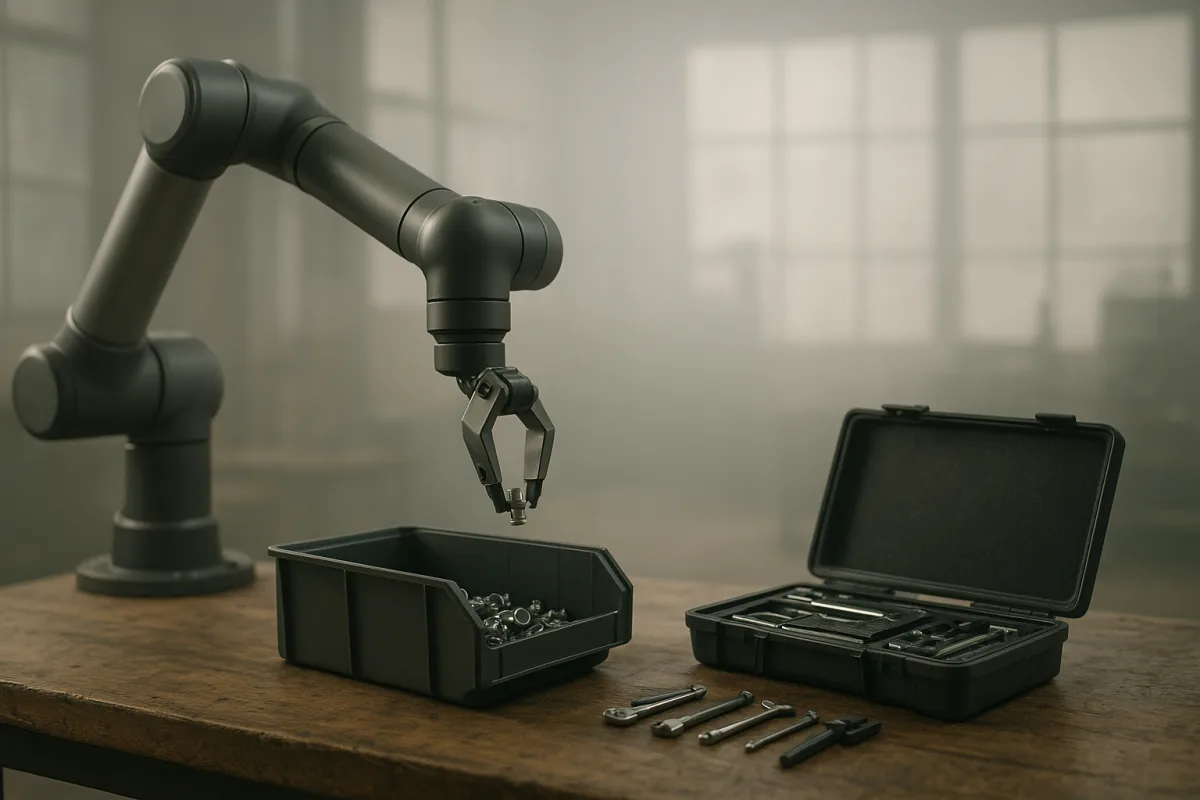
A robot arm misses the toolbox lid, then closes it 93 percent of the time
That is the kind of change Google DeepMind is highlighting with Gemini Robotics 2.5, its latest vision-language-action model for robots. It is a software system aimed at making robotic arms and humanoid hands complete multi-step physical tasks.
Across more than 200 tasks, Google says Gemini Robotics 2.5 improved success rates by 30 percent to 100 percent over earlier baselines, while reducing completion time by 20 percent to 30 percent. The tasks include using tongs to serve food, tying bows, and pipetting liquid. [1]
China’s latest bionic humanoids target a very different moment: a person standing in front of a life-size robot with a face, eyes, artificial skin, and a prepared answer. Xinhua’s Shinyan and Xinyu news-anchor robots were presented at the World Media Summit in Beijing.
These are not close substitutes in the conventional product sense. Gemini Robotics 2.5 is an AI control layer for physical work, while the Xinhua robots are public-facing humanoid presenters built around visual presence and controlled communication.
Still, they answer the same broader question: what kind of embodied AI should you invest attention, engineering time, and budget into? We would pick Gemini Robotics 2.5 for operational automation. The bionic anchors suit organizations whose job is to host, guide, explain, or perform.
The two options at a glance
| Criteria | Google Gemini Robotics 2.5 | Xinhua and UBTECH bionic humanoid anchors |
|---|---|---|
| What it is | A vision-language-action model that controls robot actions | Life-size humanoid news presenters with artificial skin and camera-based eyes |
| Primary job | Multi-step manipulation, kitting, packing, tool use, and object handling | Reading news, answering from approved information, and interacting with audiences |
| Physical platform | Works with platforms including Apptronik’s Apollo 2 and Franka Duo | Built by UBTECH for Xinhua’s Shinyan and Xinyu characters |
| Evidence of dexterity | Google reports gains across more than 200 tasks and a 96 percent Mercedes parts-kitting result | No published manipulation benchmark or work-rate data |
| Deployment status | Limited to select robotics partners, with no public API or pricing | Demonstrated publicly, but cost, languages, autonomy level, and sales availability are unpublished |
| Information control | Can pair action models with embodied reasoning and task workflows | Draws from Xinhua’s vetted current-affairs library |
| Safety evidence | Google reports inference-time hazard guidance, but full test conditions are unpublished | No published safety certification, intervention rate, or public-operation reliability data |
| Main weakness | Results are internally reported and access is limited | Realistic appearance does not establish operational capability or broad usefulness |
1. What you are actually buying
Gemini Robotics 2.5 is not a robot you can place on an order form. It is a proprietary AI model that Google DeepMind is rolling out to selected robotics partners, not a public API or a commercially priced product. [4]
Google pairs the action model with Gemini Robotics ER, an embodied-reasoning system that tracks the workflow while the action model controls hands and arms. The intent is to let one system understand a goal and another execute physical steps.
The bionic alternative is much more visibly complete. Shinyan and Xinyu stand at human scale, use artificial skin intended to resemble human skin, and appear to make eye contact through cameras positioned where pupils would be.
But these robots are not sold as general workplace platforms. Their reported purpose is presenting vetted news, speaking with visitors, and appearing in settings such as schools, museums, visitor centers, or media events.
That makes the first choice straightforward. If you need a robot to sort components, put objects in trays, or handle variable packaging, the Google stack is the relevant option. If you need an animated spokesperson, the bionic anchors fit better.
2. What each system is built to do
Google’s strongest examples are contact-rich tasks, where a robot has to adjust to object position, grip force, shape, and sequencing. These are tasks that fail quickly if the robot sees correctly but cannot translate perception into precise movement.
Google says the model raised toolbox-lid closing from 0 percent with Gemini Robotics 2 to 93 percent. It reported gains from 0 percent to 70 percent for untying ribbon bows and from 5 percent to 100 percent for packing pastries with tongs.
Those examples also show where the system remains incomplete. Folding pants rose from 0 percent to 40 percent in Google’s reported tests, a reminder that soft, deformable objects still create difficult perception and control problems.
The Xinhua robots operate in a narrower loop. They read prepared news, respond to questions from a library of current-affairs material checked by Xinhua, and use facial movement, gaze, and speech to make the interaction feel less like a kiosk.
AI Revolution reported that the robots’ apparent eye contact comes from camera lenses in their pupils. Australia’s AAP found their movements still looked mechanically regular, with repeated head turns, darting eyes, and blinking patterns.
The skin and face create an immediate human reference point. They do not, on the available evidence, give these robots tactile sensing, dependable grasping, or the kind of manipulation capability Google is benchmarking.
3. Benchmarks and evidence
Google’s reported results are the stronger evidence package, though readers should not mistake a polished benchmark chart for independent validation. The company and its partners produced the task figures, and no third-party evaluation has been published.
On Mercedes-Benz production lines in Hungary and Germany, Gemini Robotics 2.5 reportedly reached 96 percent success at parts kitting. The work included picking automotive parts from bulk bins and arranging them into vehicle-specific trays. [2]
That is a promising production-shaped task. Yet TechTimes reports that Google did not publish the trial count, detailed success criteria, or rate of human intervention behind the 96 percent result. [3]
Those missing details change how you should interpret the number. A system that succeeds on repeated runs with stable lighting, known parts, and quick operator recovery can still require substantial engineering before it handles a live factory’s exceptions.
The bionic anchors have less measurable evidence. Xinhua has described the system as traceable, secure, and controllable because it retrieves from approved content, but no error rate, response latency, language coverage, or remote-supervision arrangement has been published.
Limiting the answer source can reduce open-ended fabrication. It can also make the system’s boundaries very clear: the organization that curates the library determines what the robot can retrieve, summarize, and present to the audience.
For customer-facing work, that controlled boundary may be a feature. For a general information assistant, it is a constraint. You would need to test how it retrieves the right document and preserves meaning when answering unscripted questions.
4. Deployment and real-world work
Gemini Robotics 2.5 has a more credible path into existing industrial automation because it can run on different embodiments. Google has shown it with Apptronik’s Apollo 2 humanoid and Franka Duo, a dual-arm gripper platform.
That hardware flexibility is valuable if your facility already has a robot-cell strategy. You can evaluate the model against your workpiece mix, grippers, safety setup, and conveyor arrangement instead of rebuilding a workflow around a news-presenter body.
It is also early access technology. Google has not published pricing for Gemini Robotics 2.5, Apollo 2, or Franka Duo, and has not opened the model for general purchase. [4]
The bionic anchors are farther along as a staged, public artifact. They have a body, appearance, and defined dialogue role. What remains unclear is whether they can operate for long periods without a technician, scripted support, or a controlled venue.
China’s broader humanoid field offers a useful caution. AI Revolution reported that six wheeled Agibot G2 robots worked a streamed 24-hour convenience-store event in Shanghai, completing 1,730 tasks and serving 683 customers according to Agibot.
Two robots reportedly failed their “probation” after the event. One restocking robot did not keep pace, while a table-cleaning robot wandered off course and rolled out of the store. The company did not publish charging frequency or human intervention data.
That demonstration involved different robots from Xinhua’s anchors, but it illustrates the deployment gap across humanoid robotics. A continuous event does not necessarily mean each robot autonomously completed a full shift under normal commercial operating conditions.
5. Safety, upkeep, and the missing costs
Google says inference-time guidance improved safe task completion by 33 percent around obstacles and 43 percent around nearby people. Those are internal figures, and the testing setup behind them has not been fully disclosed.
For factory use, you would still need the standard work: physical guarding where required, speed and force limits, risk assessment, stop procedures, operator training, and a plan for failures involving people, tools, or moving inventory.
The bionic robots add a different concern. A highly humanlike face can draw people closer, especially in museums or public venues, while their camera-based perception and behavior boundaries remain opaque to visitors.
Artificial skin also creates maintenance questions that a metal-bodied industrial arm avoids. Neither UBTECH nor Xinhua has published durability, replacement intervals, cleaning requirements, sensor performance, or field maintenance costs for Shinyan and Xinyu.
Pricing is equally thin. No public price, financing plan, or total-cost figure is available for Google’s model or its partner robots. Public figures for the bionic anchors are also unavailable, so do not build a business case around assumed humanoid labor savings.
Some Chinese humanoids are purchasable at the lower end of the market. Humanoza reports Unitree’s R1 AIR at around $4,900, but that is a separate product, not a price proxy for an artificial-skin news robot. [5]
Who each option suits
Gemini Robotics 2.5 suits robotics teams with a real manipulation problem. If your operation involves parts kitting, packaging, sorting, food handling, or repetitive tasks that defeat fixed automation when objects shift slightly, this is the option we would pursue first.
Start with a bounded workflow and measure your own outcomes: task success, cycle time, intervention rate, recovery time, and the percentage of edge cases handed back to people. Google’s results justify evaluation, not blind deployment.
It falls down if you need a generally available product, predictable licensing, or published total cost. Access remains limited, and the best reported figures come from Google and its partners under conditions that are not fully described.
Xinhua’s UBTECH bionic anchors suit institutions selling presence and interaction. Museums, visitor centers, media organizations, and educational venues may find value in a human-scale presenter that can deliver approved material with more theater than a screen or speaker.
Use them where content is tightly governed, the questions are narrow, and staff can monitor the experience. The controlled news library may appeal to organizations that prioritize message consistency and traceability over wide-open conversation.
They fall down as workers. Their artificial skin, expressive faces, and camera eyes establish a public persona, but the available reporting does not show robust manipulation, autonomous facility work, published safety performance, or a commercial operating record.
Frequently Asked Questions
What is Google Gemini Robotics 2.5 and how does it improve robot dexterity?
Google Gemini Robotics 2.5 is a vision-language-action AI model designed to control robotic arms and humanoid hands to complete multi-step physical tasks. It improves dexterity by raising success rates by 30 to 100 percent over earlier baselines and reducing task completion times by 20 to 30 percent across more than 200 tasks, including using tongs, tying bows, and pipetting liquids. The system integrates with an embodied-reasoning layer to track workflows while executing physical steps.
How does Gemini Robotics 2.5 compare to Xinhua's bionic humanoid robots?
Gemini Robotics 2.5 focuses on physical task automation with contact-rich manipulation such as kitting parts and handling tools. In contrast, Xinhua’s bionic humanoid robots are life-size presenters designed for scripted public communication, using artificial skin and camera-based eyes to simulate eye contact. The bionic robots lack published manipulation benchmarks and are intended for media, museum, or visitor center roles rather than general-purpose work.
What types of tasks can Gemini Robotics 2.5 automate?
Gemini Robotics 2.5 automates complex, contact-heavy tasks including kitting parts, packing items, using tools, serving food with tongs, tying bows, and pipetting liquids. It excels in tasks requiring precise adjustment to object position, grip force, and sequencing. However, it shows limitations with deformable objects, such as folding pants, where success rates remain lower.
Are Google Gemini Robotics 2.5 and bionic robots commercially available?
Neither Google Gemini Robotics 2.5 nor Xinhua’s bionic humanoid robots are commercially available to the general public. Gemini Robotics 2.5 is currently limited to select robotics partners without a public API or pricing, while the bionic robots have been demonstrated publicly but have unpublished sales availability, cost, and autonomy details.
What are the strengths and limitations of Gemini Robotics 2.5 in industrial use?
Gemini Robotics 2.5 demonstrates strong performance improvements in multi-step manipulation and contact-rich tasks, with reported success rates up to 96 percent in industrial parts kitting. Its main strength lies in operational automation for physical work. Limitations include the lack of independent third-party validation, undisclosed trial details, and challenges with tasks involving soft, deformable objects.
How we researched this
This article was assembled from 2 video sources across 2 channels, 5 cited references.
Nothing here is based on hands-on testing. Where a figure or finding appears, it belongs to the source cited beside it, and the writing says so rather than implying otherwise. Every source is listed below so you can check it.
Sources
China’s New Bionic AI Robots Look Too Human With Artificial Skin, AI Revolution
Tesla Optimus Killer? Gemini Robotics 2.5 AI Robot Aces 200 Tasks (CLAUDE FINANCE), AI News
Google says Gemini Robotics 2.5 raises task success 30% to 100% over earlier baselines | AI.info
Gemini Robotics 2.5 Reports 96% Success Sorting Mercedes Car Parts but Publishes No Trial Count
Watch AI in Robotics: Google Gemini Robotics and Bionic Robots on Youtube
Also from the sources
Related Articles
AI Robotics Platforms Comparison and Physical AGI
Compare leading AI robotics platforms and physical AGI progress, including Gemini Robotics 2, Dex5-S hand, HomeBody, and teleoperated robots.
Google Gemini 4 Argon AI Model: Token Limits and Agentic AI
Explore Google Gemini 4 Argon AI model's token limits, pricing, and agentic AI features for complex workflows and robotics simulations.
Industrial Humanoid Robots Comparison
Compare industrial humanoid robots like Figure 4, Unitree models, and Google’s orbital AI hardware for insights on pricing, specs, and use cases.
AI Robotics Demonstrations
Explore AI robotics demonstrations covering research platforms, simulations, humanoid designs, and automation tools for robotics R&D and deployment.