
AI Content Creation: Infinite Streaming and Agentic Avatars
Explore AI content creation with infinite streaming and agentic avatars for continuous, scalable video production and brand workflows.
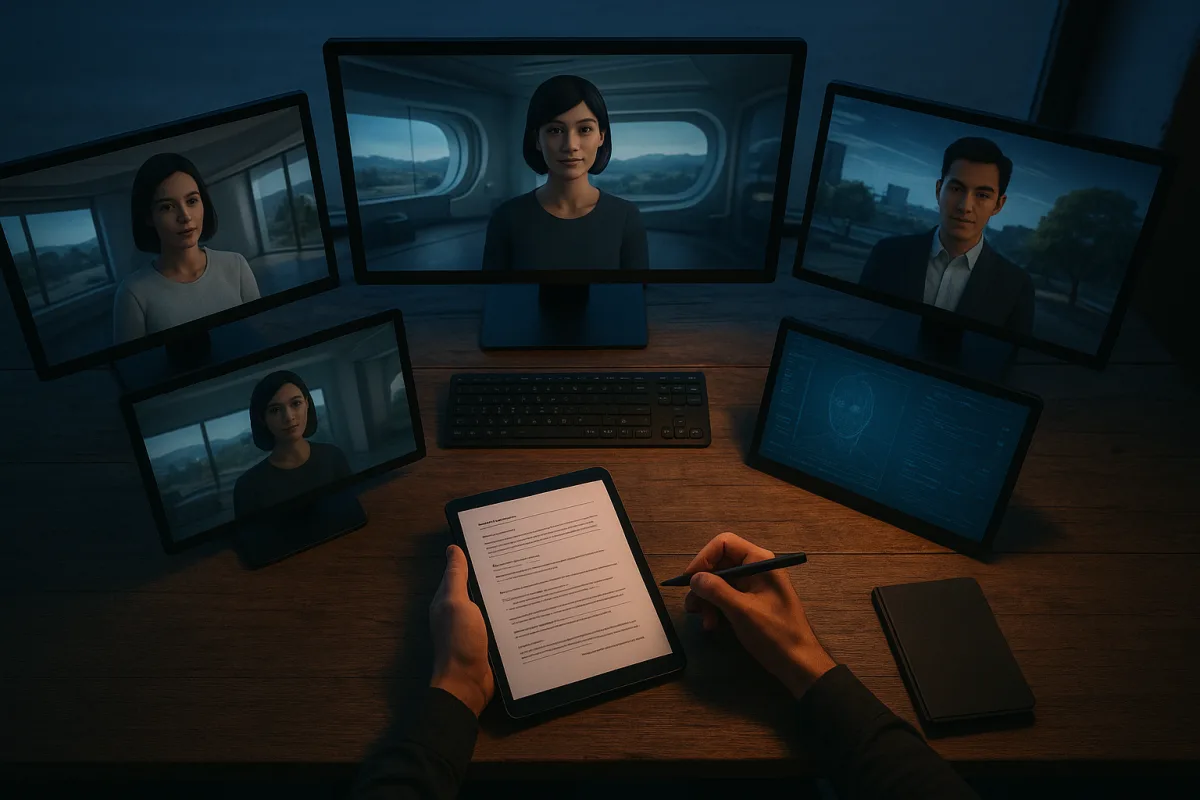
AI Content Creation Is Moving From Generation to Continuous Production
The shift is from making clips to operating a content system
AI video tools are becoming less like isolated generators and more like compact production pipelines. The important change is not that a model can create another glossy shot, but that software can choose, sequence, revise, and distribute many such shots.
Two recent demonstrations point in the same direction, despite serving very different use cases. AI Revolution’s coverage of Abacus AI Studio focuses on commercial production through reusable digital presenters, while All About AI builds a continuously generated Twitch stream around a fast video model.
Neither example proves that automated media has solved storytelling or advertising. Both do show that the technical bottleneck is moving upward, from generating a video frame to deciding what should happen next and maintaining enough throughput to keep publishing.
That matters because most commercial content is not a single hero film. It is a volume problem: multiple hooks, localised versions, product variants, creator-style ads, aspect ratios, seasonal revisions, and new placements after the first creative fails.
Agentic avatars automate the production brief, not just the face
In AI Revolution’s demonstration, Abacus AI Studio’s Agentic Avatars system creates a reusable identity from a stock persona, a text description, or supplied reference images. The system can also produce or clone a voice, then retain the resulting character for later videos.
The notable implementation detail is the planning layer. Rather than sending a prompt straight to a video model, Studio reportedly researches supplied product material, generates a numbered shot list, and asks the user to approve it before rendering.
That is a meaningful workflow improvement if it works reliably. A shot list is where a brand can catch the wrong audience, tone, product claim, or sequence before spending compute on imagery that was never usable.
The AI Revolution example uses a fragrance campaign brief built from product images, and describes shots such as macro glass imagery, camera orbits, slow-motion liquid, and a final product frame. This is conventional commercial grammar, assembled automatically rather than invented by a director.
The system appears to combine an LLM-driven planning layer with video generation from Seedance 2.5, according to AI Revolution. It also draws on a library of camera and editorial presets, which likely constrains outputs into familiar social and advertising formats.
That constraint is useful, not a failure of creativity. A short-form product review, an unboxing clip, and a luxury brand film require different pacing, shot density, dialogue, and opening hooks, so templates can encode practical production knowledge.
AI Revolution describes product-focused templates for virtual try-ons, creator-style reviews, unboxings, beauty routines, and polished commercials. The commercial opportunity is not a fully autonomous brand voice, it is faster creation of structured variations around an approved message.
Identity persistence is promising, but not evidence of perfect consistency
The other core claim is identity persistence: create a synthetic presenter once, then place the same person in different outfits, locations, lighting conditions, and formats. For a commercial team, that is more useful than generating an attractive but different person every time.
This is a real technical problem. Image and video generators have improved at single clips, but retaining a face, body proportions, hairstyle, wardrobe details, and voice across cuts remains difficult, especially when camera angle and lighting change.
AI Revolution itself notes the limitation in its Abacus AI Studio demonstration: faces can drift and product details can break. The prompt’s instruction not to alter the subject’s appearance is not a guarantee, it is a mitigation strategy.
That distinction should shape project planning. A synthetic spokesperson might be acceptable for internal concept testing, low-risk social experimentation, or clearly fictional campaigns, while a regulated product demonstration needs substantially more human review and source footage.
Product accuracy is an especially sharp boundary. A system may preserve the rough silhouette and colour of a perfume bottle or handbag, yet alter the logo, cap, fabric construction, interface, ingredient label, or safety information in ways that make the asset unusable.
The same applies to apparent product use. A generated skincare review can depict an avatar applying something to an arm, but it does not establish that the person used the product, that the product performed as claimed, or that an advertised outcome is substantiated.
The economics are favourable, but the viral cost comparisons are too clean
The strongest argument for these tools is iteration. A conventional 30-second brand commercial can cost roughly $25,000 to $100,000 and take three to five weeks through traditional production processes, according to figures compiled in the research brief.
Those figures are plausible as broad market ranges, but they are not a fair like-for-like comparison with an AI-generated asset. A traditional campaign price can include creative development, casting, location work, crews, post-production, insurance, rights management, and deliverables across channels.
Third-party estimates cited in the research brief place an AI-generated 30-second commercial around $500 to $2,000, with turnaround potentially as fast as 24 hours. Those are indicative service-market estimates, not official Abacus AI guarantees or published per-project rates.
Abacus AI’s public pricing is subscription-based rather than per commercial: Basic costs $10 per month, while unrestricted Pro access adds $10 per month, according to the research brief. Basic suits occasional experimentation, while Pro suits teams generating enough variants to value fewer access limits.
That sticker price is not the all-in cost of commercial production. A project still needs someone to write an accurate brief, clear product imagery, approve legal claims, assess brand safety, review edits, maintain archives, and determine whether performance data supports scaling.
The sensible comparison is therefore not AI versus a six-figure shoot in every case. It is AI-assisted previsualisation and creative testing versus making expensive decisions before any audience has seen the idea.
A retailer could generate ten opening hooks for a product page, test them as clearly labelled social ads, and reserve a physical shoot for the concepts that demonstrate useful engagement or conversion. That is a narrower and more defensible use case.
Infinite streaming is a throughput trick, not an endlessly coherent show
All About AI demonstrates another version of automated production: a Twitch pipeline that continually queues short generated scenes. It uses a FastH3 variant of MiniMax H3, an LLM to extend the story, FFmpeg for streaming, and chat commands to redirect events.
The basic arithmetic is straightforward. If a 15-second clip renders in less than 15 seconds, the system can play one clip while preparing the next, making a technically continuous stream possible as long as the queue does not run dry.
All About AI reports generating 15-second clips in around 10 to 13 seconds at 480p using two Nvidia B200 GPUs rented through RunPod. That is a useful builder demonstration, but it is not an official benchmark or a reproducible cost specification.
The research brief says MiniMax has not published detailed FastH3 infrastructure requirements or a fixed cloud-cost breakdown. It identifies 12GB of VRAM as a plausible minimum for related deployments, while stressing that the exact requirements for this streaming configuration remain uncertain.
The demonstration’s economics also illustrate why “infinite” needs qualification. All About AI cites cloud rental around $13 to $14 an hour for the B200 setup, and reports loading roughly 132GB of GPU memory before the stream can begin.
That is not a consumer-grade always-on media operation. It may be viable for a prototype, a scheduled event, or an experimental channel, but persistent streaming adds monitoring, moderation, retry logic, storage, bandwidth, platform operations, and GPU idle-time costs.
FastH3’s speed also comes from compromises. The research brief says FastH3 Preview v1 reduces transformer calls from 49 to four and uses 90 percent sparse attention, enabling up to a claimed 14-times speedup but with expected quality degradation.
No published user study quantifies how much viewers notice that degradation. The model is chiefly optimised for 480p, so it is better understood as a system for maintaining temporal supply than a route to broadcast-quality visual production.
Interaction improves novelty more than narrative
The interactive part of infinite streaming is attractive because chat participants can introduce a new setting, joke, or goal. In the All About AI prototype, viewer prompts are prioritised over the automatic queue and become inputs to the next generated scene.
Yet the sample dialogue makes the central limitation obvious. It contains garbled language, inconsistent references, and joke structures that do not resolve cleanly, even when individual clips remain watchable enough to sustain momentary novelty.
The system has memory in the narrow operational sense that it stores earlier story context. That is not the same as durable narrative state, coherent character motivation, continuity editing, or a showrunner’s ability to decide that an audience suggestion should be rejected.
For a project planner, that suggests a specific fit: ambient, absurdist, game-like, or community-driven streams where unpredictable output is part of the proposition. It is a poor fit for premium scripted entertainment, regulated advertising, or a trusted news format.
There is also a less technical issue in the prototype. Its cartoon prompt evokes recognisable commercial animation styles, which may draw viewers but creates avoidable intellectual-property risk when a format is visibly trading on another rights holder’s characters or visual identity.
Legal compliance is becoming a production requirement
The technology encourages teams to treat faces and voices as configurable media assets. The law and labour agreements increasingly treat them as protected likenesses, which is the correct lens for anyone planning commercial use.
The research brief notes that SAG-AFTRA requires clear, specific written consent and separate compensation for digital replicas. It also identifies platforms such as Semblance that position licensing and revocation controls as core features, rather than afterthoughts.
A permission checkbox is not enough for a serious workflow. Consent should identify the source material, the allowed purposes, territories, media channels, duration, whether training or voice cloning is permitted, and what happens when a performer withdraws permission.
This is particularly important where a real employee, customer, creator, or actor supplies a few photographs or seconds of audio. Technical ease lowers the cost of replication, but it does not create the right to make that person endorse a product or appear in a new scenario.
Disclosure requirements are also becoming more concrete. StreamingMeme reports that EU AI transparency rules require labels for AI-generated or manipulated streaming video ads that resemble real entities, with penalties potentially reaching €15 million or 3 percent of global turnover. [1]
The research brief also flags New York’s Synthetic Performer Disclosure Law, effective July 2026, as requiring visible disclosure in advertising. Enforcement practices are still evolving, but waiting for a dispute is not a useful compliance strategy.
Copyright remains unsettled in another direction. Under the current US position described in the research brief, fully AI-generated output generally lacks copyright protection without sufficient human authorship, reducing the certainty around ownership of an autonomous content library.
At the same time, training-data disputes have not disappeared. The research brief cites 2026 litigation involving Sony Music and Warner Music against Anthropic, plus Round Hill Music’s claims against Suno and Anthropic, as evidence that source-data risk can reach far beyond the final render.
How to plan an AI content project without mistaking volume for strategy
Start with a content system that has clear inputs and measurable outcomes. Provide approved product facts, visual reference material, prohibited claims, audience definitions, required disclosures, brand language, and a list of details that must not change between versions.
Use an agentic workflow to generate concepts, shot lists, scripts, and low-cost visual treatments. Keep a human owner responsible for factual accuracy, creative approval, rights clearance, and the decision to move from synthetic prototype to paid media.
Choose synthetic avatars when the value lies in repeatable format execution, language adaptation, or quick comparative testing. Choose licensed human talent and conventional production when trust, product fidelity, emotional performance, or long-term brand distinctiveness is central to the result.
For infinite streaming, define graceful failure before defining scale. The stream needs a safe fallback loop, filtered audience prompts, moderation, queue monitoring, logs of generation decisions, and a mechanism to stop publishing when the model begins producing unsafe or incoherent material.
The trend is real because independent builders are already assembling both sides of the stack: agents that plan commercial video and pipelines that generate clips fast enough to fill a live channel. The evidence is still thin on durable audience demand, reliable cost curves, and quality at scale.
Frequently Asked Questions
What is infinite streaming in AI content creation?
Infinite streaming refers to the continuous generation of video content in real time, typically at low resolution such as 480p. It is technically feasible when the AI generation process stays ahead of playback, but current implementations show weak continuity, unreliable dialogue, and unclear operating costs.
How do agentic avatars improve AI video production?
Agentic avatars create reusable digital identities from stock personas or reference images, including cloned voices, that can be retained for multiple videos. They incorporate a planning layer that generates and seeks approval for a shot list before rendering, helping brands catch errors early and produce structured variations efficiently.
What are the limitations of AI-generated continuous video?
AI-generated continuous video struggles with maintaining consistent identity features like face, body proportions, and wardrobe across scenes. Product details can be inaccurate or altered, and generated content does not guarantee that depicted product use or claims are authentic or substantiated.
How can brands use AI for scalable content creation?
Brands can leverage AI to rapidly create multiple content variants such as localized versions, product variants, and different formats by automating shot planning and avatar reuse. This approach addresses the volume challenge in commercial content, enabling faster iteration around approved messages.
What workflows ensure quality in AI-generated video content?
Effective workflows include human approval at every stage, especially for shot lists and branding accuracy, to reduce wasted renders and ensure compliance. Using synthetic personas only with explicit permission and incorporating visible disclosures for AI-generated likenesses help maintain legal and ethical standards.
How we researched this
This article was assembled from 2 video sources across 2 channels, 1 cited reference.
Nothing here is based on hands-on testing. Where a figure or finding appears, it belongs to the source cited beside it, and the writing says so rather than implying otherwise. Every source is listed below so you can check it.
Sources
Abacus AI’s New AGENTIC AVATARS Is an Infinite Content Machine — AI Revolution
Infinite AI Streaming Will Change Content Forever (Minimax FastH3) — All About AI
EU AI transparency rules mandate deepfake labels for streaming video ads | StreamingMeme
Watch AI in Content Creation: Infinite Streaming and Agentic Avatars on Youtube
Also from the sources
Related Articles
AI-Powered Multimedia Workflows for Content Creation
Explore AI-powered multimedia workflows that enhance video editing, coordination, and content creation with practical tool comparisons.
AI Automation in Video Editing: Tools, Workflows, and Limits
Explore AI automation in video editing, including tools like Claude Opus 5.5 and Hyperframes, workflows, and practical limitations for content creators.
Generative AI Content Creation
Learn how generative AI content creation tools and workflows boost marketing efficiency and ensure compliance with best practices.

AI Tools for Marketing Workflow Optimization and Asset
Explore AI tools that optimize marketing workflows by generating ads, managing assets, and creating virtual influencers for efficient campaigns.