
Mistral AI Le Chonk vs Reflection AI Beam
Compare Mistral AI Le Chonk and Reflection AI Beam open-weight models, their specs, benchmarks, pricing, and deployment readiness in 2026.
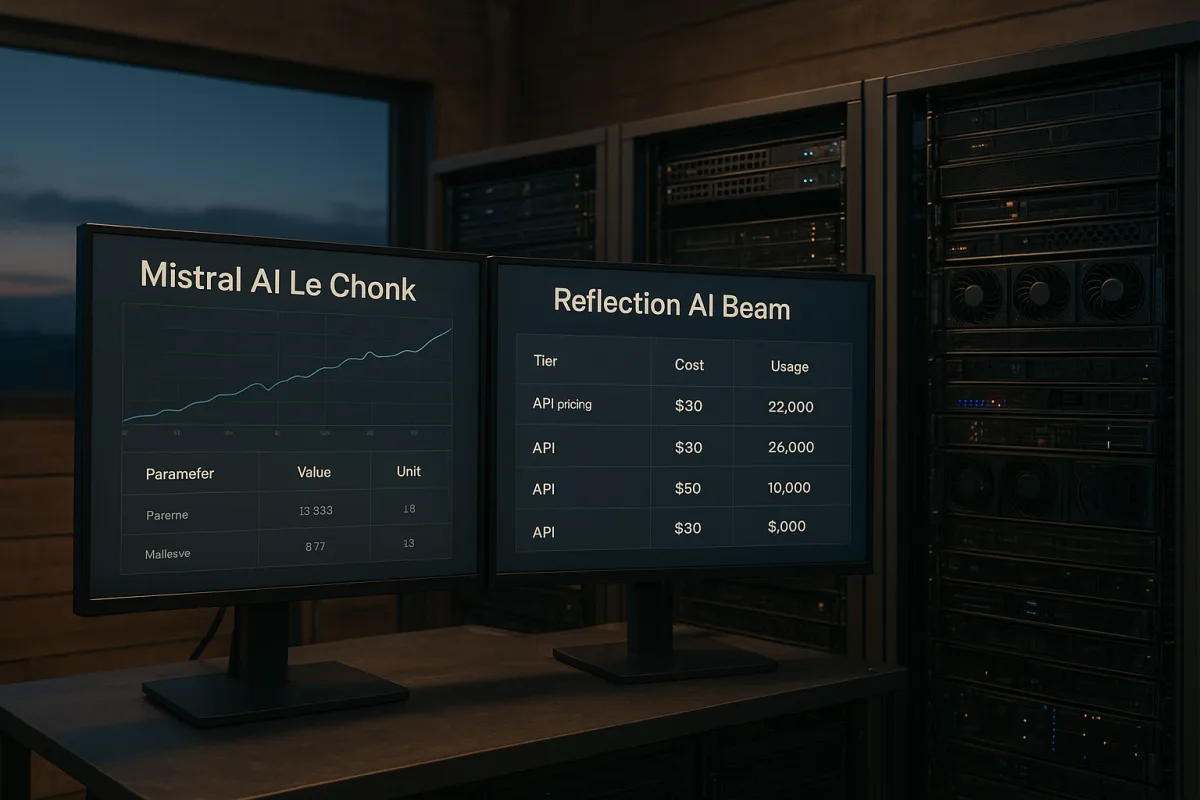
The decision: Mistral Large 4, also called Le Chonk, versus Beam
The choice here is between two western open-weight contenders pitched as alternatives to Chinese model families: Mistral AI’s Le Chonk and Reflection AI’s Beam. For an organisation choosing a model now, Le Chonk is the more defensible pick.
That is not a claim that France-based Mistral AI has overtaken Chinese open-weight leaders, let alone closed models from Anthropic or OpenAI. It has not. It is a narrower procurement judgement: documented capability, available commercial access and jurisdictional fit beat an opaque promise.
Beam is the more interesting story in strategic terms. Axios reports that Reflection AI has backing connected to Nvidia and prominent US investors, and is pursuing an American answer to China’s open-model ecosystem. [1] But an investment narrative is not an evaluation report.
The channel AI Revolution describes Beam as a 501-billion-parameter mixture-of-experts model, with 23 billion parameters active for each token, aimed at coding, reasoning and agent workflows. It also reports a planned Apache 2.0 release. Those are useful architectural claims, but they remain insufficient for a production decision.
By contrast, Mistral AI announced Mistral Large 4, informally called Le Chonk, on October 6, 2026. The company describes a one-trillion-parameter mixture-of-experts model with 49 billion active parameters, multimodal input and European training infrastructure. [3]
“Open source” also needs careful handling here. These models are generally better described as open-weight, meaning the weights may be available under a licence while training data, full recipes and the broader development process remain unavailable. That distinction matters for auditability and reproducibility.
Head-to-head comparison
| Criterion | Beam, from Reflection AI | Mistral Large 4, Le Chonk, from Mistral AI |
|---|---|---|
| What it is | A reported 501B-parameter mixture-of-experts text model, focused on coding, reasoning and agents | A 1T-parameter mixture-of-experts multimodal model with 49B active parameters |
| Evidence available | Public capability claims are not supported by detailed independently assessable benchmarks or deployment data | Published model specifications, API access and benchmark reporting provide a more concrete evaluation starting point |
| Capability position | Cannot be ranked confidently against peers from public evidence | A strong western open-weight model, but not clearly ahead of leading Chinese open-weight models |
| Coding and agents | Positioned for coding and autonomous task execution, but claims cannot yet be verified externally | Broad coding and agent benchmarks are published, though vendor-selected benchmarks require caution |
| Multimodality | Reported as text-only | Supports image input as well as text [3] |
| Context window | Reflection AI has claimed a one-million-token context window through launch coverage | One-million-token context is part of Mistral AI’s published positioning [3] |
| Price | No stable public API price or verified self-hosting cost is available | API pricing reported at $1.36 per million input tokens and $4.18 per million output tokens, excluding any customer-side integration, storage or governance costs [3] |
| Infrastructure burden | Likely substantial, given 501B total parameters, but specific serving requirements are not public | Substantial. One trillion total parameters means serious memory and serving requirements even though only 49B parameters activate per token |
| Regulatory fit | A US-origin model entering a fragmented state-led regulatory environment | The clearer choice for organisations prioritising European deployment, data residency and EU AI Act alignment |
| Best suited to | Teams willing to join an early-access ecosystem and independently validate every claimed capability | European enterprises, public-sector buyers and platform teams that need a documented western open-weight option now |
| Main weakness | Insufficient public evidence to establish performance, cost or operational reliability | Not the best value or best coding performer globally, especially against Chinese open-weight competitors |
Criterion one: evidence beats launch rhetoric
The most important difference is not parameter count. It is evidence. Reflection AI may eventually make Beam a credible US open-weight challenger, but the independent research brief is clear: no detailed public performance results or real-world usage statistics are available as of October 2026.
That directly qualifies the more confident claims made by the AI Revolution channel. Its reported figures for SWE-style software tasks, long-context use and agent demonstrations may reflect Reflection AI’s internal materials, but outside readers cannot inspect enough methodology to treat them as settled comparisons.
This is a familiar model-launch problem. A benchmark number means little without the exact model version, prompting protocol, tool permissions, test contamination controls, pass@k setting and compute budget. Agent benchmarks particularly measure the surrounding harness as much as the language model.
Mistral AI has more visible documentation, but that does not mean taking its benchmark charts literally. The NeuralNine channel correctly notes that vendor release pages choose comparisons that make their model legible at its strengths. That is marketing practice, not necessarily misconduct.
The sensible reading of Le Chonk’s results is therefore modest. Mistral AI has returned to serious contention among western open-weight developers. It has not demonstrated that a European model now leads the overall open-weight field.
Criterion two: capability, and what the benchmarks omit
Le Chonk’s one-trillion total parameters should not be mistaken for one trillion parameters of computation on every generated token. Its mixture-of-experts architecture activates 49 billion parameters, reducing inference work relative to a dense trillion-parameter system. [3]
That helps throughput, but it does not remove the need to store and serve a large model. Weight storage, memory bandwidth, expert routing, batching behaviour and high-speed interconnects all remain practical constraints. A model can be computationally sparse and still operationally expensive.
Mistral AI has emphasised cybersecurity performance, coding and business-agent tasks. Those are useful capabilities for a model used to triage alerts, inspect code or gather information, but they deserve workload-specific validation before use in a security operations workflow.
A cyber benchmark can measure whether a model identifies a known vulnerability, reproduces a controlled exploit or solves a capture-the-flag challenge. It does not measure whether an organisation has safe access controls, reliable audit trails or a human process for handling dangerous outputs.
For coding, the most relevant comparison is not a polished demo that generates a web application. It is whether the model resolves issues in the organisation’s repositories, obeys test suites, limits unnecessary file changes and knows when a request is underspecified.
Chinese competitors remain the uncomfortable reference point. DeepSeek V4-Pro reportedly reaches 83.7 percent on SWE-Bench coding evaluation, while Moonshot AI’s Kimi K2.6 is reported as the strongest open coder on SWE-Bench Pro at 58.6. [4] Those scores are not identical tests, so they should not be compared as a single ranking.
Still, the wider direction is clear. Mozilla’s reporting found Chinese open-weight models roughly four months behind frontier US offerings, while often costing up to 80 percent less to operate. Some benchmarks still show gaps, but that is a more serious competitive position than western launch commentary sometimes admits. [5]
Criterion three: price is more than token billing
Le Chonk has a quoted API rate of $1.36 per million input tokens and $4.18 per million output tokens. [3] That is a usable starting price, not an all-in deployment cost. It excludes application development, retrieval systems, data pipelines, monitoring, evaluation and human review.
Beam does not yet offer a similarly stable public price that permits an honest head-to-head cost calculation. Its supposed efficiency may prove meaningful, especially if its active parameter count keeps inference manageable. Until serving terms and independent throughput figures are available, that remains a hypothesis.
Self-hosting changes the calculation again. Research on open-model deployment places annual costs anywhere from roughly $125,000 to more than $12 million, depending on scale, hardware purchasing, utilisation and support requirements. [9] The broad range is not evasive, it reflects the architecture of the workload.
A text proof of concept may have modest memory needs, while a multi-agent system compounds them. TechRadar’s reporting cites an illustrative rise from about $40 monthly for a text proof of concept to $840 monthly for a multi-agent setup, before considering the broader infrastructure stack. [11]
That is why open weights do not automatically mean cheaper AI. They offer control and optionality. They can also create a responsibility to run GPU clusters, manage capacity, patch inference servers, secure model endpoints and retain engineers who understand distributed serving.
Criterion four: sovereignty and regulation
For European organisations, Le Chonk’s strongest argument may be less about raw benchmark rank than operational geography. Mistral AI trained the model in Europe on approximately 4,000 Nvidia Grace Blackwell GPUs over two months. [3]
Training location does not itself guarantee legal compliance. The EU AI Act is phased in through 2027, and open-source or open-weight developers receive limited exemptions rather than a blanket pass. High-risk uses still bring data governance, transparency and risk-management obligations. [16] [17]
The distinction becomes sharper in healthcare and public services. GDPR and the European Health Data Space framework add constraints around sensitive data, access and secondary use. A European-hosted model may simplify a governance conversation, but it cannot substitute for a lawful data-processing basis or system-level controls. [18]
Beam may appeal to US government and enterprise buyers looking for an alternative to Chinese models. Yet the United States remains a fragmented regulatory environment, with state-level rules rather than a single comprehensive federal AI law. [16] That can be flexible, but it is not automatically simpler.
A separate contender: Jev is not a substitute for either
Typesafe AI’s Jev belongs in this discussion because it challenges an assumption behind the Beam-versus-Le-Chonk contest: not every production AI task needs a generative language model. Jev is a proprietary decision model that returns typed probabilities rather than prose. [15]
According to Typesafe AI’s published framing and coverage of its release, Jev is intended for classification, routing, guardrails and predefined choices. It cannot replace Le Chonk or Beam for drafting text, writing code or open-ended research. It may replace part of their surrounding orchestration stack.
The James Briggs channel highlights Jev’s calibrated-probability design. In principle, a prediction of 0.8 should correspond to roughly 80 percent correctness over comparable cases. That property is valuable for automated escalation rules, provided a buyer validates calibration on its own data.
Jev’s reported cost is $0.042 per million input tokens, with claimed latency from 70 to 500 milliseconds. [12] It suits high-volume, bounded decisions such as content routing, tool selection and policy checks. It falls down when a task needs explanation, synthesis or novel text generation.
The reported adoption story should also be treated carefully. Coverage says one-third of Fortune 500 companies adopted Jev within weeks. [12] Without a public definition of “adopted,” that could mean experimentation, a gateway integration or genuine production deployment. Those are not interchangeable measures.
Open-weight momentum is real, dominance is not
Open-weight models now route the majority of production tokens through OpenRouter, according to Mozilla reporting. [6] That suggests developers value choice, price competition and the ability to change providers without rebuilding applications.
It does not establish that open models have won enterprise AI. Enterprise adoption of open models reportedly fell from 19 percent to 11 percent over the past year, while closed models retain much of the high-stakes spending. [7] Production token share and enterprise revenue measure different behaviour.
Claude Opus 4.6 and OpenAI GPT-5.4 still lead on several demanding enterprise evaluations and procurement categories. Their advantage is not only model capability. Buyers also pay for support, hosted reliability, liability terms, security reviews and fewer internal infrastructure obligations. [8]
That makes the present market less dramatic than the slogans suggest. Open-weight models are credible, strategically important and increasingly useful. They have not made proprietary frontier models obsolete, and a single western release has not ended China’s lead in cost-efficient open-weight development.
Who each option suits
Mistral Large 4, Le Chonk, suits European enterprises, regulated organisations and platform teams that need a currently documented open-weight model with multimodal input, published API pricing and a plausible European data-governance story. Its $1.36 per million input-token and $4.18 per million output-token API rates exclude integration and governance costs. [3]
Mistral Large 4, Le Chonk, falls down for buyers seeking the best global coding value, the smallest infrastructure footprint or indisputable frontier performance. Chinese open-weight models may offer stronger coding results and lower operating costs, while closed US models remain safer choices for some high-stakes workloads.
Reflection AI’s Beam suits research teams and early adopters that specifically want to track a US-developed open-weight alternative, can tolerate release uncertainty and have the capability to run independent evaluations before any production commitment. No reliable public API price is available, and self-hosting would add major infrastructure costs.
Reflection AI’s Beam falls down for procurement teams needing a model now. Until detailed benchmarks, licence terms, serving requirements and external usage evidence are public, its claimed efficiency and agent performance cannot be compared responsibly with Le Chonk or Chinese rivals.
Typesafe AI’s Jev suits teams with high-volume, predefined decision tasks, especially routing, guardrails and tool selection. Its reported $0.042 per million input-token price is attractive for that narrow role, but it is API-only and not an open-weight model. [12]
Typesafe AI’s Jev falls down for any workflow requiring generated language, code synthesis, document drafting or open-ended analysis. It is not a smaller replacement for Beam or Le Chonk. It is a specialised component that may make an LLM system cheaper and more predictable.
Frequently Asked Questions
What are the differences between Mistral AI Le Chonk and Reflection AI Beam?
Le Chonk is a 1 trillion-parameter mixture-of-experts multimodal model with 49 billion active parameters and published specifications, API pricing, and European training infrastructure. Beam is a 501-billion-parameter mixture-of-experts text-only model with 23 billion active parameters aimed at coding and reasoning, but lacks detailed public benchmarks or verified deployment data. Le Chonk supports image input and has clearer regulatory alignment for Europe, while Beam’s claims remain unverified and it is better treated as a model to watch.
Which open-weight AI model is better for deployment in 2026?
Mistral AI’s Le Chonk is the more defensible choice for deployment today due to its documented capabilities, published API pricing, and clearer compliance with European regulations. Reflection AI’s Beam lacks independent public benchmark details and real-world usage data, making it unsuitable for immediate procurement. However, neither western model currently outperforms the best Chinese open-weight models in coding value.
How does Mistral Large 4 compare to Chinese open-weight AI models?
Mistral Large 4 (Le Chonk) is a strong western open-weight model but does not clearly surpass leading Chinese open-weight models such as DeepSeek V4-Pro and Moonshot AI’s Kimi K2.6. Chinese models often deliver stronger coding benchmark results at lower operating costs. Therefore, while Le Chonk is a documented and viable option for European organizations, Chinese models remain competitive in terms of performance and cost.
What are the infrastructure requirements for running Le Chonk?
Running Le Chonk requires substantial infrastructure due to its one trillion total parameters, even though only 49 billion parameters activate per token. This entails significant GPU memory, networking, storage, and engineering resources, potentially resulting in a seven-figure annual cost. Self-hosting such large models is not “free AI” and demands considerable operational investment.
Is Reflection AI Beam ready for production use?
No, Beam is not currently ready for production use. There are no detailed independent benchmarks or real-world deployment data publicly available as of October 2026. Its performance claims remain unverified, and it is recommended to monitor Beam’s development rather than adopt it immediately.
How we researched this
This article was assembled from 3 video sources across 3 channels, 20 cited references.
Nothing here is based on hands-on testing. Where a figure or finding appears, it belongs to the source cited beside it, and the writing says so rather than implying otherwise. Every source is listed below so you can check it.
Sources
American DeepSeek is HERE: The New KING of Open Source AI — AI Revolution
Mistral's LeChonk Brought Europe Back... — NeuralNine
Jev AI vs Open Source: Can GLiNER Replace It? — James Briggs
Meet Le Chonk: Everything you need to know about Mistral's new open-weight AI model
Chinese Open-Source LLM Companies Leaderboard 2026 | Presenc AI
Mozilla Report: Open-Weight Models Now Route the Majority of AI Tokens — Ground Truth
Open vs Closed AI Models in 2026: Who's Actually Winning | GetCoreTech
The maker of non-text AI model Jev valued at $7.5B just weeks after launch | TechCrunch
Jev becomes Vercel AI Gateway’s fastest-adopted model in its first 24 hours | Beyond the News
Open-Source AI and the EU AI Act: Where the Exemptions Stop | Confir
Navigating the European Union’s AI and health data framework - Atlantic Council
AI and Data Privacy: Legal Requirements (2026) | Recording Law
Watch New AI Model Releases and Open Source Competitors on Youtube
Also from the sources
Related Articles
TrueForge vs Hermes Agent
Compare TrueForge and Hermes Agent, two open source AI agent platforms, to find the best fit for deployment, security, and personal assistant use cases.

TrueForge vs Claude Code Projects
Compare TrueForge and Claude Code Projects to choose the right open source AI agent platform for your deployment and operational needs.
AI Model Fine-Tuning and Deployment Tools Explained
Learn about AI model fine-tuning and deployment tools, including best practices, PII protection, and cost-effective strategies for open LLMs.
AI Models and Chips Comparison in 2026: Jalapeño vs Gemini
Compare AI models and chips in 2026, including OpenAI's Jalapeño and Google's Gemini 3.7 Flash, with insights on performance, cost, and deployment.