AI Robotics Hardware Innovations for 2027
Explore AI robotics hardware innovations for 2027, including integrated joints, tactile sensors, and subsystem trends shaping practical robot design.
The shift is toward robot subsystems, not a single general-purpose machine
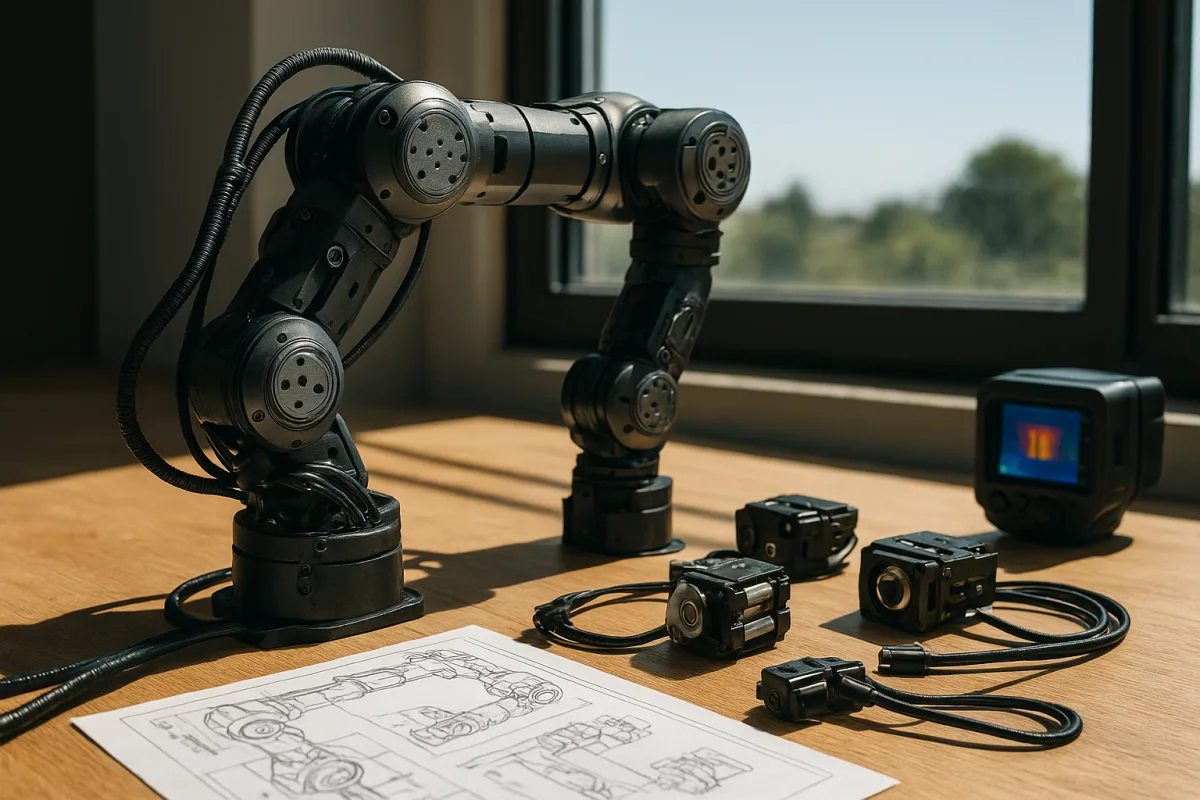
The clearest robotics hardware trend for 2027 is not that humanoids have suddenly become broadly useful. It is that component suppliers and robot builders are concentrating on the unglamorous constraints that determine whether a system can work outside a staged demonstration.
Panasonic’s component roadmap, as described by AI News, emphasises tactile sensing, compact joint modules, flexible electronics, wiring, energy recovery and lightweight structures. The individual claims require caution, but the direction is credible: better embodied AI needs better physical interfaces, not merely larger language models.
That same pattern appears independently in robot-builder practice. In a sentdex demonstration, a wheeled mobile manipulator from Vulcan Robotics, called the Sourcy robot, succeeds at a floor-cleaning-style pickup task through camera placement, arm travel and accessible mechanics rather than humanlike form.
ZHR Robotics’ commercially described actuator families make the trend still more concrete. Its ZHR-H harmonic-drive and ZHR-P planetary-drive modules integrate functions that previously demanded separate mechanical, electrical and control integration, reducing packaging overhead and assembly work. [3]
This is an incremental change with practical consequences. The robot industry is moving from “can the model issue an action?” toward “can the machine sense contact, place an end effector, survive repeated motion, recover from faults and be repaired?”
Panasonic’s proposed upgrades are plausible, but much remains unproven
The Panasonic list presented by AI News includes pressure sensors intended to support object-shape estimation and slip prediction. Those are meaningful tactile goals, especially for hands that need to distinguish a stable grasp from one that is about to fail.
But there is no public Panasonic pressure-sensor model for AI robotics with a published benchmark, price or field result as of October 2026. That matters because tactile sensing is often discussed as a capability category while omitting calibration drift, mounting compliance, sampling rate and contact localisation.
Panasonic does sell industrial pressure sensors, but these are not evidence that it has solved dexterous robotic touch. The Panasonic ADP5100 costs about $41.16 at the median reported price and suits industrial pressure measurement from 0 to 100 kPa, with 1.25% accuracy.
The Panasonic ADP5111 has a reported median price near $64.95 and accepts up to a 5.25 V supply, while the Panasonic ADP5161 costs roughly $64.89 and measures up to 500 kPa. Both suit industrial sensing applications, not demonstrated humanoid fingertip perception.
The contrast with an established robotics instrument is revealing. The ATI Nano17 six-axis force-torque sensor is a 17 mm, 9.1 g sensor priced at $4,600, suited to high-precision robotic contact measurement, with force ranges of plus or minus 50 N in x and y and plus or minus 70 N in z. [1]
ATI lists a resolution of 0.318 gram-force for the Nano17. [1] That does not make it automatically appropriate for every robot hand, but it illustrates the gap between inexpensive industrial pressure transducers and specialist multi-axis contact sensing.
Panasonic’s proposed tungsten drive wire deserves similar restraint. Tungsten’s material properties make it a credible choice where actuator tendons need strength, fatigue resistance and corrosion resistance, particularly in compact or medical-robotics-like mechanisms. [2]
Available material reporting describes tungsten as having roughly 30% higher tensile strength than stainless steel in the relevant comparison, alongside favourable fatigue properties. [2] There is, however, little public robotics-specific evidence on lifetime, field maintenance or failure rates in tendon-driven hands.
That is an evidence gap, not proof that tungsten wire is trouble-free. A team considering it should demand cycle-life data under its actual bend radii, loading profile, cable routing and contamination conditions, then design replacement access before selecting the material.
Integrated joints are the best-supported hardware trend
Integrated joints have firmer evidence behind them than Panasonic’s tactile roadmap. Combining the motor, driver and gearbox in one module reduces the amount of custom bracketry, wiring, enclosure design and alignment that a robot builder must solve repeatedly.
ZHR Robotics states that its integrated-joint approach can reduce assembly complexity by up to 60% and improve space efficiency. [3] Suppliers naturally present their systems favourably, but the engineering logic is sound: fewer interfaces generally mean fewer integration opportunities to get wrong.
The ZHR-H14 harmonic-drive module is specified at 5 to 14 Nm in a 70 mm package weighing 0.52 kg. [3] It suits lighter arms, wrists, compact mobile manipulators and joints where low package volume outweighs absolute output torque.
The larger ZHR-H25 is specified at 27 to 91 Nm, measures 110 mm and weighs 3 kg. [3] It suits larger limb joints or heavier manipulation tasks, although a project should model its mass distribution before assuming more torque improves whole-body performance.
For applications prioritising efficiency, ZHR’s planetary ZHR-P family is specified above 96% efficiency, with torque configured by application. [3] Its CyberGear model is listed at 98 mm diameter and 0.317 kg, suited to designs needing compact rotational actuation without the mass of a larger harmonic module. [3]
These specifications measure components, not robot capability. They do not report sustained torque under thermal load, backlash after use, controller latency, acoustic noise, impact survival, repair time or performance when a mobile base and arm are controlled together.
That distinction is important because robotics benchmarks often hide the integration burden. A torque rating tells a designer whether a module may be viable, but not whether the resulting arm can safely manipulate a carton for eight hours near people.
Sensor placement and morphology remain model multipliers
The sentdex work with Vulcan Robotics’ Sourcy robot makes a useful counterpoint to humanoid-first messaging. The robot has two gripper cameras, two upper cameras, a lower-facing camera and 2D lidar, giving the controller overlapping views of the floor and pickup area.
The demonstrated task is modest but relevant: identifying a small object, approaching it, gripping it and placing it in a bin. The footage is accelerated tenfold, and individual successes do not establish a task success rate, operating speed or unattended reliability.
Still, the hardware configuration explains why the demonstration is more interesting than a polished humanoid clip. The arms move vertically on the body, allowing the robot to reach floor-level objects and then lift them over a bin without demanding extreme whole-body bending.
The sentdex creator also points to the value of large wheels that traverse clothing and small floor obstacles, while acknowledging that the platform cannot use stairs. That is a sensible trade: many indoor tasks do not require legs, but do require dependable recovery from clutter.
The Sourcy robot appears deliberately accessible, with substantial 3D-printed construction and an enclosure that can be opened for repair. For a research project, that serviceability can be more valuable than an industrial finish, especially where sensors and actuators will be changed repeatedly.
The creator’s main mechanical criticism is the arm’s five degrees of freedom, with a sixth rotational degree of freedom desired. That is a concrete design constraint, not a vague request for “more intelligence,” and it illustrates how manipulation limits often originate in kinematics.
Autonomous operating systems are not robot operating systems
AI News also presents Hark Pro, an AI assistant offering web and mobile computer-use automation, as a step toward an autonomous AI operating system. Hark Pro is reportedly priced from $20 or $100 per month, suited to personal administrative tasks such as online purchasing, scheduling and account-connected workflows.
Those functions should not be confused with a safety-rated robot operating system. The transcript’s examples concern browser tasks, messaging, payment and cloud services, not deterministic motor control, collision monitoring, real-time sensing or functional safety.
A system that can autonomously book transport or reorder consumer goods may still be useful in a robotics stack, for instance as a supervisor-facing workflow layer. It is not evidence that an agent should decide joint trajectories or override force limits.
There is also no basis in the supplied evidence to describe Hark as Panasonic’s operating system. Panasonic’s reported component work and Hark Pro’s consumer assistant product are separate claims in the AI News coverage, and should remain analytically separate unless the companies establish a relationship.
For commercial robots, autonomous software creates a compliance problem as well as a capability question. ISO 10218 covers industrial robots, ISO/TS 15066 addresses collaborative robots, and ISO 13482 applies to personal care and service robots, though humanoid-specific coverage remains incomplete.
The pending replacement for ISO 13482 and the draft ISO/CD 25785-1 for dynamically stable industrial mobile robots show that standards are still catching up. In the European Union, the Machinery Regulation becomes mandatory on January 20, 2027, while Cyber Resilience Act obligations expand later that year.
A project deployed in the United States has less humanoid-specific federal regulation, but existing occupational safety requirements still apply. The absence of a special humanoid approval process is not a safety case, and it does not remove liability for foreseeable failures.
What this means for a 2027 robotics project
Start with task geometry before choosing a body plan. If the work means retrieving items from a floor, shelves and bins, map reach envelopes, camera occlusion, wrist orientation, base clearance and recovery paths before committing to legs or a humanoid silhouette.
Specify sensing at the contact level. A low-cost Panasonic industrial pressure sensor may suit pneumatic monitoring or process instrumentation, while an ATI Nano17 suits precise force-torque measurement, but neither selection alone constitutes a full tactile-hand architecture. [1]
Use integrated joints where the project benefits from repeatable packaging, but keep thermal and mechanical validation in-house. Obtain continuous and peak torque curves, encoder resolution, gear reduction, controller interfaces, ingress protection, fault behaviour and realistic replacement costs before designing a limb around a supplier module.
Budget beyond the robot’s sticker price. Entry-level humanoids such as Unitree systems reportedly start near $13,500 and high-end systems such as Boston Dynamics’ Atlas are cited around $150,000 to $250,000, but these figures do not include integration, facilities changes, maintenance, software or safety work.
Available estimates place five-year total ownership at 2.5 to 3.5 times purchase price, while a RobixOne study characterises consumer humanoid resale values as near zero. Those figures are not forecasts for every 2027 platform, but they argue against treating a robot as a recoverable capital asset.
The evidence supports a real hardware shift, especially toward integrated actuation, better sensing coverage and repairable platforms. It does not yet support claims that Panasonic’s proposed sensor stack, tungsten actuation or autonomous assistant software will independently deliver reliable general-purpose humanoids.
Frequently Asked Questions
What are the key AI robotics hardware innovations expected in 2027?
Key innovations include improved tactile sensing, compact and integrated joint modules, flexible electronics, wiring improvements, energy recovery systems, and lightweight structural components. These advances focus on enhancing physical interfaces and robot subsystems rather than breakthroughs in humanoid intelligence or form.
How are integrated joint modules improving robot design in 2027?
Integrated joint modules combine the motor, driver, and gearbox into a single unit, reducing the need for custom brackets, wiring, and alignment. This integration can cut assembly complexity by up to 60% and improve space efficiency, making robot construction faster and more reliable. However, validation of thermal limits, backlash, control interfaces, and repair procedures on the actual joint remains essential.
What role do tactile sensors play in AI robotics hardware advancements?
Tactile sensors aim to support object-shape estimation and slip prediction, which are critical for dexterous manipulation and stable grasping. While Panasonic proposes new pressure sensors for these purposes, no robotics-specific models or performance benchmarks are publicly available as of late 2026, and existing industrial sensors differ significantly from specialized multi-axis contact sensors used in robotics.
Why is the focus shifting to robot subsystems rather than humanoid robots in 2027?
The robotics industry is prioritizing practical constraints like sensing coverage, actuator packaging, serviceability, and mechanical robustness over developing a single general-purpose humanoid. This shift reflects the need for systems that can reliably operate outside staged demonstrations by focusing on effective subsystems rather than humanlike form or intelligence.
What are the challenges in adopting new robotics hardware components in 2027?
Challenges include the lack of publicly available performance data and benchmarks for new components like tactile sensors, uncertainties about durability and maintenance (e.g., tungsten drive wires), and the need for thorough validation of integrated modules beyond advertised specifications. Additionally, integrating autonomous operating systems requires careful separation from safety-critical control loops until failure modes and regulatory compliance are fully understood.
How we researched this
This article was assembled from 2 video sources across 2 channels, 3 cited references.
Nothing here is based on hands-on testing. Where a figure or finding appears, it belongs to the source cited beside it, and the writing says so rather than implying otherwise. Every source is listed below so you can check it.
Sources
Robot Chonk Cleans the Floor — sentdex
Panasonic's 8 AI Robot Upgrades (2027 TECH) + Hark Autonomous AI OS — AI News
ATI Nano17 6-Axis F/T Sensor — Price & Availability | Robotics Center
Humanoid Robot Motor Selection Guide: Sizing Specs & Formulas [2026]
Watch AI Robotics Hardware Innovations for 2027 on Youtube
Also from the sources
Related Articles
AI Robotics Platforms Comparison and Physical AGI
Compare leading AI robotics platforms and physical AGI progress, including Gemini Robotics 2, Dex5-S hand, HomeBody, and teleoperated robots.
AI in Robotics and Real-Time Applications
Explore how AI integrates with robotics for real-time control, challenges in deployment, and practical lessons from recent demos and projects.
AI Agents in Real-Time Applications
Explore how AI agents work in real-time sports, robotics, and voice AI, focusing on latency, specialized tooling, and practical deployment challenges.
Advances in Autonomous AI Robots and Generalization
Explore how autonomous AI robots improve generalization and transfer learning for real-world tasks in homes and industry.