Robot Learning from Human Demonstrations with OM-1 Model
Explore how robot learning from human demonstrations enables training robots using wearable sensors without direct robot operation.
The pitch: teach the robot without operating the robot
Reward AI unveiled OM-1 on September 14, 2026, as the decision-making policy in its Omnibody robotics stack. The company’s central claim is attractive: collect human demonstrations without a robot present, then use that data to teach industrial arms, mobile manipulators, and humanoids. [1]
That proposal targets an expensive bottleneck. Most robot-learning programs need someone to operate the physical machine, either directly or remotely, while it performs a task. The operator creates examples, but each example occupies valuable robot time and carries some risk of collision, breakage, or poor execution.
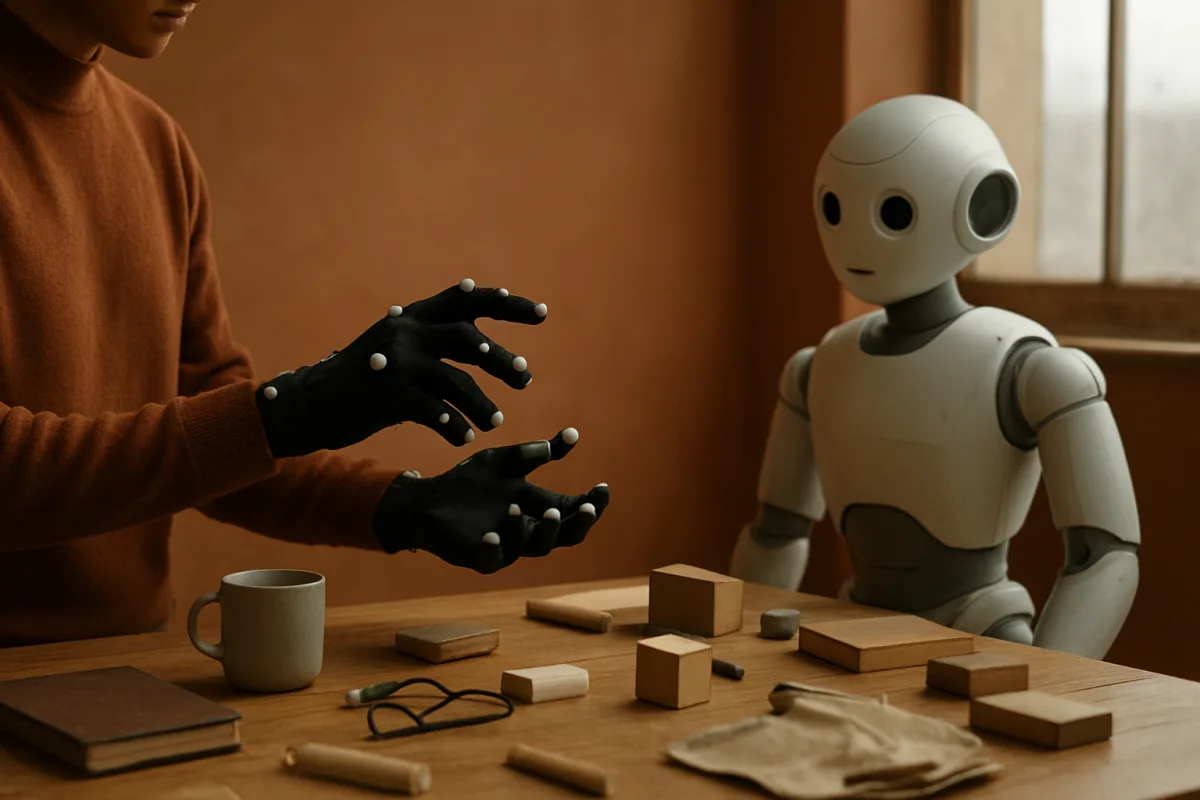
OM-1 tries to separate skill collection from robot operation. A person wears Reward AI’s sensorized Omnibody Hand glove, performs a task normally, and records the movements. The company calls these robot-free demonstrations because no robot needs to be in the room during data capture. [1]
The glove records images, touch signals, hand pose, finger proximity, and force along the demonstrated trajectory. Those modalities matter because picking up a box and opening a refrigerator door are not only geometric problems. A robot must know where to move, how quickly to move, how hard to push, and when to close or release its grip.
A conventional video dataset can show that a hand rotated a knob. It cannot necessarily show whether the operator felt resistance, eased off force, or tightened their grip as the knob moved. Reward AI’s case is that a richer wearable record can preserve more of the information a physical robot needs. [1]
What the robot brain must turn that data into
The phrase “learn from human data” can obscure the mechanical translation involved. A person has joints, muscles, skin, and a hand shape unlike those of an industrial gripper or a humanoid hand. A policy must turn the demonstrated action into commands that a particular machine can execute.
Reward AI says OM-1 processes each sensor stream at its native sampling rate, instead of converting all streams to one shared frequency. Cameras, electromagnetic trackers, tactile sensors, and force measurements produce data at different speeds, and forcing them into one clock can discard timing information. [1]
The system also uses a short history of sensor readings. That gives the model context for motions that look similar frame by frame but differ in intent, such as reaching toward an object, pulling against resistance, or beginning to release a grasp.
Its output is not a high-level instruction like “put the package on the shelf.” Reward AI says the policy produces movement direction, speed, force, and grasp or release decisions. A separate control layer then translates those predictions into continuously updated motor commands. [1]
That lower layer is a large part of whether the idea works outside a demo. Reward AI says it trains the controller with simulation and reinforcement learning to account for acceleration-dependent dynamics, external disturbances, and delays. It runs on its own fast clock, so model inference should not pause a robot’s motion. [1]
In other words, OM-1 has two jobs. The learned policy chooses an action from the sensory context. The controller makes that action physically feasible, smoothing the transitions as motors, joints, payloads, and unexpected contact push the robot away from the ideal trajectory.
Why the glove’s error numbers matter
Data quality begins before model training. If the recorded hand path is inaccurate, the robot receives noisy examples of what a successful grasp, throw, or insertion was supposed to look like. This is especially costly when the claimed advantage is collecting relatively small amounts of data.
Reward AI compared visual-inertial tracking with electromagnetic tracking over eight movement speeds from 3 to 67 centimeters per second. At the fastest speed, it reported mean overshoot error of 24.9 millimeters for visual-inertial tracking and 9.5 millimeters for its electromagnetic approach. [1]
Across the measured speed range, the company reported electromagnetic-tracking error rising from roughly 0.4 millimeters to 9.5 millimeters. Visual-inertial error rose from about 2.1 millimeters to 24.9 millimeters, averaged across 10 runs at each speed. [1]
Reward AI says the electromagnetic system cut high-speed tracking error by 60%. [1] That is a meaningful engineering result if it holds in broad use, because a 15-millimeter discrepancy can separate a secure grasp from a missed handle or an awkward collision.
But motion-tracking accuracy is not a task-success benchmark. It does not reveal how often a robot completes a job, how well it handles unfamiliar objects, whether it recovers from failure, or how it compares with a teleoperated dataset collected on the target hardware.
Reward AI has not published independent comparisons between OM-1 and teleoperation-based training, nor detailed success rates for the tasks it shows. Its claim that a new, difficult, long-horizon task can be learned from under 30 minutes of data remains the company’s assertion. [1]
The missing cost is the human doing the demonstration
Robot-free demonstration changes who does the work. Instead of hiring an operator to control a costly robot, a company can potentially ask a worker to perform familiar tasks wearing an instrumented glove. That may allow data collection in offices, warehouses, kitchens, or mock workspaces.
It can also make diversity cheaper to capture. Different people can demonstrate different object sizes, approaches, grips, work surfaces, and speeds without waiting for access to the same robot fleet. Reward AI says additional demonstrations can be added to the training process without recollecting previous data. [1]
Yet the labor has not disappeared. Someone still performs the task, verifies the recording, organizes task definitions, handles edge cases, and decides whether a recorded attempt was good enough to train on. The robot-free approach changes the workflow, not the need for human judgment.
The other cost is adaptation to the deployed machine. A demonstration of a person opening a fridge supplies useful intent and motion cues. The target robot still needs calibrated cameras, reliable perception, a reachable arm path, sufficient grip strength, and a controller that can cope with the door’s actual resistance.
That is why a policy trained on broad human activity can look capable before it encounters a new handle, shiny packaging, a moving pet, a poorly placed cable, or a staircase. Generalization is the expensive part, particularly when errors can damage property or injure someone nearby.
Tau Robotics shows the data loop in a real apartment
Tau Robotics, a San Francisco startup offering humanoid cleaning visits, illustrates the current alternative. Its robots clean real homes, but humans remotely pilot them for many tasks through cameras on the robots’ heads and wrists, while the resulting sessions create training data. [3]
MIT Technology Review observed one of Tau’s four-and-a-half-foot humanoids cleaning an apartment with remote assistance. Tasks including bed making and laundry folding relied on kinematic guidance, where a human operator performs motions and the robot mirrors them through sensors.
That arrangement is closer to collecting robot-specific demonstrations than Reward AI’s glove-first method. The benefit is that the data reflects the robot’s own cameras, body, tools, and control limits. The cost is that every example needs a working robot, connectivity, supervision, and an operator.
Tau cofounder Cornelia Weinzierl told MIT Technology Review that the robot could already vacuum and mop autonomously. Other household actions still needed human help, and the company had completed only a couple hundred cleanings, a small base for the varied work inside real apartments.
The deployment also exposed the unglamorous failure modes that short manipulation clips omit. The robot struggled on outdoor steps, could not climb a carpeted staircase, and stalled when hot weather disrupted the equipment used by its remote operator, according to MIT Technology Review.
Those incidents are not evidence about OM-1 specifically. Reward AI has not disclosed OM-1 failure modes in comparable household deployments. They do show that a robot brain cannot compensate for a weak communications link, overheated support equipment, inadequate locomotion, or tools that detach mid-task.
The business case still includes a human in the loop
Tau’s early pricing has changed as the service developed. MIT Technology Review reported an initial offer of $30 for an hour with one robot, then $60 for a weekly cleaning with two robots or $100 for a one-time visit.
Other reporting put Tau’s standard rate at $50 per robot per hour, with two robots commonly used, and recurring bookings discounted to $60 hourly for weekly service, $80 for biweekly, and $90 for monthly sessions. [3] The invite-only service remains limited to San Francisco. [3]
At those rates, the service sits around or above the reported $35 to $45 hourly range for human cleaners in San Francisco. [3] The price buys robot novelty and data collection along with cleaning, not an established autonomous alternative to hiring a person.
Tau’s modified Unitree G1 hardware is reported to cost roughly $55,000 per robot before ongoing maintenance, transport, staffing, remote operations, and replacement parts. [3] A household robot’s sticker price, if sold directly, would similarly omit the service infrastructure that currently makes it function.
Data privacy is another part of the bill. Tau’s system uses continuous video recording, with storage retained unless a customer requests deletion. [5] If you invite a teleoperated machine into your home, you are buying a service involving cameras, network access, and human oversight.
Autonomy needs evidence beyond a shift or a clip
Xiaomi has reported that two humanoids worked eight-hour shifts at its electric-car factory, sorting center-console side-cover components and coordinating with production systems and autonomous mobile robots. The company called this an early validation, not a general-purpose factory result.
Xiaomi also reported up to 98% success on threaded component fitting in July, but it has not published a full-shift success rate across all work performed. The task occurred in a controlled production setting, where object placement, lighting, floors, and workflow can be tightly managed.
Agibot’s A3 Ultra makes a different case, emphasizing uneven terrain. The humanoid is listed at 174 centimeters and 60 kilograms, with lidar, chest and knee cameras, claimed three-meter risk prediction, and up to eight hours of battery life split between walking and standing.
Those specifications describe an ambitious platform, but Agibot has not published speed, maximum step-height, or slope ratings for the A3 Ultra. Its quoted 10-second dual-battery swap may reduce downtime, yet it says little about whether the robot can perform a job reliably over that shift.
For home deployment, the standards picture is incomplete. ISO 13482 covers personal-care robots, while ANSI/A3 R15.06-2025 adopts updated industrial robot safety standards that were not written specifically for humanoids in residences. [2]
The United States has no single residential-humanoid safety framework. Developers must combine task-specific risk assessment with overlapping safety, communications, and product requirements, while the FCC’s 2026 Covered List restrictions can also affect imports of some foreign-produced advanced robots. [2]
What to watch next
The strongest version of Reward AI’s proposition is not that teleoperation disappears. It is that a company can reserve robot time for validation and difficult cases, while gathering large volumes of human skill data away from expensive hardware.
We would look for three results before treating OM-1 as a major change in robot learning: task-level success rates, comparisons against robot-collected and teleoperated data, and performance after environmental changes. A claim about under 30 minutes is meaningful only alongside those numbers.
The near-term winners may use both approaches. Wearable demonstrations can provide breadth, while remote operation supplies examples from the deployed robot in its actual setting. Tau’s cleaners show why the second loop remains necessary, even when the machine can already mop a floor or clean a toilet.
For now, humanoid autonomy is best understood as a data-production system with a robot attached. The model matters, but your outcome depends on how faithfully the data captures human skill, how well controls transfer it to hardware, and how safely the machine handles everything that was not in the demonstration.
Frequently Asked Questions
How does robot learning from human demonstrations work?
Robot learning from human demonstrations involves recording a person performing tasks and using that data to teach the robot how to replicate those actions. The system captures detailed sensory information such as hand pose, force, and timing, then translates these into robot movements and commands. This approach aims to reduce the need for direct robot operation during training.
What are robot-free demonstrations in robotics?
Robot-free demonstrations refer to collecting human task data without the robot being present or operated during the demonstration. A person wears sensors, like a glove, to record their movements and forces while performing a task naturally. This data is later used to train the robot, shifting the challenge to accurately mapping human actions onto the robot’s mechanics.
How does the OM-1 model learn tasks from human data?
OM-1 processes multiple sensor streams from wearable devices at their native sampling rates, preserving timing and context of movements. It uses a short history of sensor data to understand intent behind actions and outputs continuous predictions for movement direction, speed, force, and grasp control. A separate control layer then converts these predictions into motor commands that the robot executes.
What challenges exist in mapping human movements to robots?
Humans and robots have different joint structures, hand shapes, and movement dynamics, making direct mapping difficult. The system must translate human sensor data into commands suitable for the robot’s actuators while accounting for differences in anatomy and mechanical constraints. Timing and force information must be accurately preserved to ensure the robot performs tasks as intended.
Why is wearable sensor data important for robot training?
Wearable sensor data captures rich information beyond visual cues, including forces, tactile feedback, and precise hand poses during task execution. This detailed data helps the robot understand how hard to push, when to grip or release, and how to adjust movements dynamically. Such information is crucial for training robots to perform complex manipulation tasks reliably.
How we researched this
This article was assembled from 1 video source, 1 published article, 7 cited references.
Nothing here is based on hands-on testing. Where a figure or finding appears, it belongs to the source cited beside it, and the writing says so rather than implying otherwise. Every source is listed below so you can check it.
Sources
New Autonomous AI Robot Brain OM-1, Xiaomi Humanoid, DeepSeek Super AI Agents, AI News
I watched a humanoid robot clean my apartment. It felt like a taste of the future., MIT Technology Review AI
Reward AI Introduces OM-1 Robot Model Learning From Human Data | Gate News
News: Humanoid & General-Purpose Robot Safety Standards | SRES
Tau Robotics Tests Remote-Controlled Humanoid Cleaners in San Francisco Homes // Tech Beat
HUMANOID ROBOTS CLEAN SAN FRANCISCO HOMES WITH HUMANS STILL AT THE CONTROLS, TALi News
Watch AI in Robotics and Autonomous Systems on Youtube
Related Articles
Advances in Autonomous AI Robots and Generalization
Explore how autonomous AI robots improve generalization and transfer learning for real-world tasks in homes and industry.
Revolutionizing Robotics: Nvidia Upgrades Neo, Atlas, and Unitree G1
Nvidia upgrades humanoid robots Neo, Atlas, and Unitree G1 with cutting-edge technology, enhancing movement, manipulation, communication, and autonomy. The future envisions personal robots for household tasks, sustainability, and space exploration.
AI Robotics Hardware Innovations for 2027
Explore AI robotics hardware innovations for 2027, including integrated joints, tactile sensors, and subsystem trends shaping practical robot design.
AI Model Observability and Training Infrastructure Explained
Learn how AI model observability and training infrastructure improve agent reliability using trace-verifier loops and structured telemetry.