
AI Agents in Work and Personal Finance: Use and Costs
Explore how AI agents assist work and personal finance tasks, their costs, risks, and best practices for effective deployment.
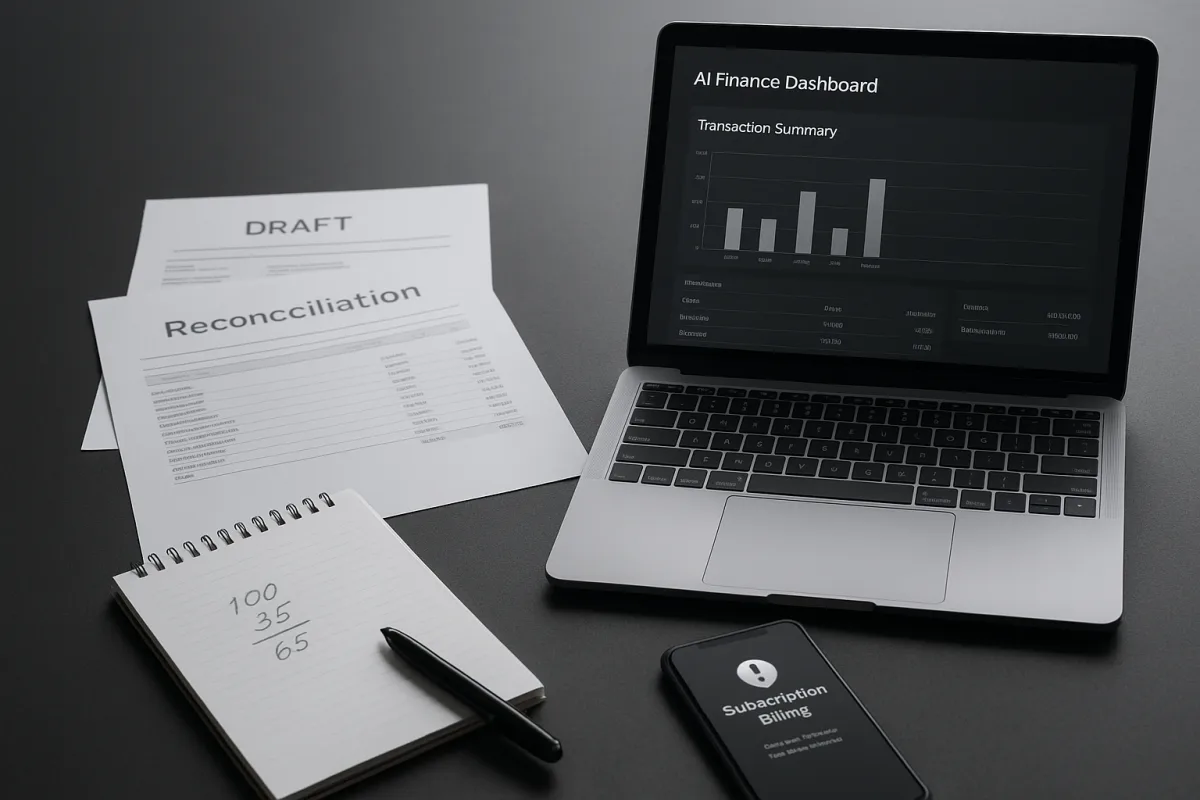
An agent is a model plus permission to act
You are deciding whether an AI tool should merely summarize your inbox or keep watching it, draft replies, organize files, and surface work without being asked again. The difference is not branding. It is an authority boundary.
A chatbot waits for a prompt and returns text. An agent gets a goal, access to data or software, and a loop: inspect the current state, choose a next action, execute or propose it, then inspect again.
That loop is what turns a strong language model into something resembling a junior operations worker. It also determines the risk. A model that can read a spreadsheet is one thing; one that can alter it, send it, or trigger a payment is another.
The current products are converging on the same structure. Anthropic’s Claude Duet, Perplexity’s Teammates, and OpenAI’s Dots are all pitched as persistent agents that can hold context and work across connected tools.
Their differences matter less than the shared design decision: where the system stops and asks you. For workplace use, the best early deployments give the agent broad visibility but narrow execution rights.
The loop behind an always-on teammate
Perplexity introduced Teammates on November 5, 2026, as persistent work agents that can take different roles inside a workspace and run jobs simultaneously.[3] The company positions them above Perplexity Computer, its system for deploying agents on a device.
A Teammate can draw on existing projects, saved skills, and memory from a Perplexity workspace. You assign a role or task, then monitor its progress in a dedicated thread or through Slack, rather than keeping one chat window open.[3]
That design changes the work from a single answer into a queue of stateful assignments. An agent needs to know what it already found, what it has already changed, what remains blocked, and which instruction has priority.
Perplexity CEO Aravind Srinivas has said he envisions organizations eventually having hundreds of agents working for each person.[3] That is a long-range ambition, not evidence that teams have solved supervision, security, or accountability at that scale.
For you, the immediate issue is coordination. Two agents can independently generate drafts, check data, and search for answers. They can also duplicate effort, apply inconsistent assumptions, or collide in the same file.
Agent systems need controls familiar from human operations: separate assignments, named owners, logged actions, and clear handoffs. If nobody can say why an agent reached a result or which data it used, reviewing the output becomes slow and expensive.
The price is not only the subscription
Perplexity Teammates is available to individual subscribers of Perplexity Max, priced at $200 per month.[3][4] It is a research-preview feature on the web, while Enterprise Pro and Enterprise Max accounts do not receive it by default.[3]
The $200 includes access to the Max subscription and its monthly credit allocation. It does not buy unlimited autonomous work, and Perplexity has not published exact credit costs for complex or parallel Teammate tasks.[3]
That missing number matters because persistent agents can consume far more model usage than a normal chat. They repeatedly read instructions, old messages, documents, tool results, and updated task state before taking another step.
A single polished answer might involve one pass over a document. An agent checking several systems every morning may run many such passes, including ones that produce nothing worth reviewing. Visibility has a cost.
We would not start with a $200 agent subscription for vague “productivity.” Start with one recurring task whose output can be measured, such as a weekly sales-data reconciliation or a contract-folder comparison against a fixed checklist.
If the agent saves a known number of staff hours while producing reviewable work, the economics are legible. If it mostly generates notifications, drafts, and status chatter, its model consumption becomes another software bill without a clear owner.
Model selection decides the operating cost
Anthropic’s Claude lineup shows why agents need routing. Haiku is the smaller, low-cost model for latency-sensitive volume work; Sonnet is aimed at coding, writing, and analysis; Opus handles deeper research and harder reasoning; Fable targets long, complex agentic jobs.[10]
All four models support a one-million-token context window and outputs up to 128,000 tokens.[10] Context is the material a model can consider at once, including your instructions, files, prior messages, tool output, and its own intermediate work.
Anthropic lists input and output prices per million tokens of $0.10 and $0.50 for Haiku, $2 and $10 for Sonnet, $4 and $20 for Opus, and $10 and $50 for Fable.[10] Reading and writing cost different amounts.
That means the cost of an agent is driven by what it rereads. A large workflow folder, long instruction file, and sprawling conversation history can cost more than the final paragraph or spreadsheet the agent produces.
Nate Herk, who runs the AI Automation channel, describes a similar division in his Claude walkthrough: clear workflows fit Sonnet, while vague planning tasks benefited from Opus. His seven-workflow comparison is a personal test, not a general benchmark.
The advice is sound even without treating it as a measured product ranking. Use a smaller model for classification, extraction, formatting, and tightly specified drafts. Escalate only the ambiguous exceptions, where better reasoning could change the outcome.
More thinking can make an agent worse
Claude also exposes effort settings, which control how much reasoning time a model spends before responding. Nate Herk reported that low effort finished one task in roughly 17 minutes for under $4 but was glitchy.
In the same personal experiment, extra-high effort took about 90 minutes and cost about $26, while maximum effort took roughly 2.5 hours and cost $50 yet remained buggy. Anthropic warns that maximum effort can overthink, Herk says.
The pattern is familiar in agent design: additional deliberation may improve a difficult plan, but it can also create needless branches, stale assumptions, and more chances to interact badly with a tool. Bigger budgets do not guarantee better completion.
For an operations team, define the acceptable failure first. If an agent is extracting invoice dates, a sampled accuracy check may be enough. If it is interpreting a contract obligation, every conclusion may need human approval.
Model robustness is another separate dimension. An arXiv study found that frontier models can retain much of their underlying capability after jailbreak attempts, with performance loss varying substantially between models.[1] A capable model remains capable under pressure.
That does not make an agent unsafe by default. It means prompt rules alone are a thin defense when an agent sees untrusted emails, documents, web pages, or Slack messages that may try to redirect its behavior.
Claude’s workplace boundary: files, tools, and approval
Claude Code is Anthropic’s work environment for operating inside a folder on your computer. It can read, create, edit, and move local files, and run commands, making it materially different from a browser chatbot.
Anthropic also calls CoWork “Claude Code for the rest of your work,” with examples including checking contract folders against a playbook and reconciling regional exports into a spreadsheet. These are file-heavy, bounded assignments.
Claude Duet extends the agent pattern across connected applications. It can review email and calendars, flag items needing attention, prepare drafts, and follow up on quiet threads, while asking before it sends messages, signs documents, deletes material, or pays.
Those approval gates are the product’s central safety feature. An agent may be allowed to gather facts and prepare an action, but you remain the person who authorizes the external commitment.
Claude Duet launched in October 2026 across mobile, web, and Claude plans, but comprehensive adoption data and independent user feedback remain unavailable. Treat its current role as an early product category, not an established workplace standard.[11]
We would configure any agent with read access before write access, then grant one action at a time. Start with drafts. Next allow prepared changes that need confirmation. Leave payments, account access, and irreversible deletions outside the workflow.
Banking access changes what the agent can see
Anthropic’s Personal Finance feature connects Claude to bank and card accounts through Plaid, the financial-data connection platform. It can answer questions such as where your money went this month or which bills remain before payday.[8]
The connection is read-only. Claude cannot move money, manage accounts, trade investments, or offer investment advice, according to Anthropic’s help documentation.[8] That sharply limits direct financial harm, but it does not remove the risk of bad guidance.
With your permission, Claude can receive the financial institution’s name, account names and types, last four account digits, balances, credit limits, and up to two years of transaction history.[8] That is a detailed behavioral record.
Plaid handles the bank authentication process, so Claude does not receive your banking password.[8] Anthropic says this data is used to answer your queries and is not used for model training.[8]
Personal Finance is in beta for US Claude Pro, Max, and Ultra subscribers.[8] Those subscriptions include access to Claude features, but they do not include professional financial planning, tax preparation, or a guarantee that transaction categories are correct.
Read-only does not mean consequence-free
The agent’s financial loop looks benign: retrieve transactions, classify spending, compare balances and bills, then explain the result in plain language. Its outcome depends on the quality of bank data, categorization, your question, and the model’s arithmetic.
A recurring merchant charge may be a subscription, rent installment, reimbursement, shared expense, or a one-time event. The model can summarize the pattern, but it does not know your intent unless you provide it.
TheStreet reports research finding average AI accuracy of 43% on financial questions, dropping to 12% on complex tax and numerical questions.[5] The reported analysis found Claude Opus failed about 40% overall and 67% on complex questions.[5]
Those figures are not a score for Claude’s Plaid integration specifically. They do show why fluent language can create false confidence when a model is asked to infer affordability, tax treatment, debt priorities, or a savings target.
Quebec’s financial-markets regulator, the AMF, similarly warns that AI-generated financial information can be incomplete, inaccurate, or poorly matched to an individual’s circumstances.[9] A personal budget contains tradeoffs that transaction history alone cannot reveal.
Use the feature to retrieve and organize your own information. Ask it to list recurring charges, explain a balance movement, or create questions for a financial professional. Do not let it make the decision you cannot independently check.
Privacy, regulation, and the missing documentation
Financial data is unusually revealing because it exposes where you live, travel, shop, borrow, donate, and seek care. Read-only access prevents transfers, but the agent still receives enough information to build a sensitive profile.
The connection relies on explicit consent and uses common data-sharing controls through Plaid.[8] Anthropic has not published detailed documentation showing how this Claude integration complies with the Consumer Financial Protection Bureau’s Section 1033 open-banking rule.
That rule governs consumer-authorized access to financial data in the United States. The absence of published integration-specific compliance detail does not establish a violation, but it leaves customers unable to inspect the full regulatory mapping.
Before connecting an account, decide whether two years of history is necessary for the question you want answered. If you only need a spending review, connect the fewest accounts possible and revoke access when the task is complete.
For workplace agents, apply the same minimization principle. Give an agent the project folder it needs, not every shared drive. Connect a single Slack channel before the whole organization. The smallest permission set is easier to audit.
Pick the narrow agent before the autonomous one
AI agents are becoming software layers for work and personal administration. Perplexity Teammates aims at ongoing workspace assignments, Claude Duet at proactive cross-app assistance, and Claude Personal Finance at read-only analysis of your banking data.
Each product offers a different kind of convenience, but all depend on the same bargain: you exchange access, context, and some oversight for automation. Your gain comes from choosing a task where the agent’s output remains easy to verify.
For work, we would pick a bounded file or reporting workflow before an always-on digital teammate. For money, we would use Claude as a transaction explainer and budget worksheet, then make major decisions with statements, calculations, and qualified human advice.
Frequently Asked Questions
What are AI agents in work and personal finance?
AI agents combine a language model with permission to act on tasks by accessing data or software, inspecting states, choosing actions, and executing or proposing them in a loop. In finance, they can draft documents, reconcile data, or compare files while holding context and working persistently across connected tools.
How do AI agents improve workplace finance tasks?
AI agents can handle bounded, reviewable tasks such as drafting, reconciliations, and document comparison, providing broad visibility but narrow execution rights to reduce risk. They operate persistently, managing queues of stateful assignments and can monitor progress through dedicated threads or communication platforms like Slack.
What are the risks of using AI agents for personal finance?
AI agents currently produce frequent confident errors on tax, numerical, and personalized financial questions, with accuracy dropping significantly on complex queries. They lack true personalization and can generate misleading advice that users may not detect, so they should be treated as supplementary tools rather than financial advisers.
How does model choice affect AI agent operating costs?
Choosing the right model balances cost and task complexity. Smaller, cheaper models like Claude’s Haiku are suited for high-volume, repeatable tasks, while more expensive models like Opus or Fable handle complex reasoning and long agentic jobs. Persistent agents consume more model usage due to repeated processing, so model selection is key to managing expenses.
What are best practices for deploying AI agents in finance?
Start agents on clearly defined, reviewable tasks with measurable output to evaluate their value. Maintain controls similar to human operations, such as separate assignments, named owners, logged actions, and clear handoffs. Treat AI finance connections as read-only reporting layers and avoid unattended actions that can alter records or send commitments.
How we researched this
This article was assembled from 1 video source, 2 published articles, 11 cited references.
Nothing here is based on hands-on testing. Where a figure or finding appears, it belongs to the source cited beside it, and the writing says so rather than implying otherwise. Every source is listed below so you can check it.
Sources
Every Claude 2.0 Concept Explained for Non-Coders, Nate Herk | AI Automation
Perplexity launches its own take on AI agents for work, The Verge AI
Claude AI can plug directly into your bank account, The Verge AI
Exclusive: Meet "sovereign agents," AI that keeps itself alive
Perplexity Teammates Bring Monitoring AI Agents | We are the Frontier
Perplexity launches Teammates, persistent AI agents for Max…
AI money advice carries risks most users overlook - TheStreet
Should You Use AI for Personal Finance? What to Consider, and Avoid - NerdWallet
Watch AI Agents in Work and Personal Finance on Youtube
Related Articles
AI Agents Action Selection
Explore AI agents' action selection, integration challenges, and security in automation. Learn about personal AI agents and best practices.
AI Automation Real-World Use Cases
Explore AI automation real-world use cases with GPT-6, Claude, Jev, and specialist tools. Learn model fits, costs, and workflow trade-offs.

AI Automation in Finance Workflows
Explore AI automation in finance workflows with GPT-6 Astra and Claude Fable, focusing on best practices, risks, and human oversight.
Anthropic Claude Fable 5.1 Cuts AI Agent Costs by 75%
Explore how Anthropic Claude Fable 5.1 reduces AI agent costs with a 75% cache-read price cut and boosts long-running workflow efficiency.