
Local Voice AI Pipeline: Privacy and Processing Explained
Explore how local voice AI pipelines work, focusing on privacy, processing boundaries, and practical speech recognition with OpenWhispr.
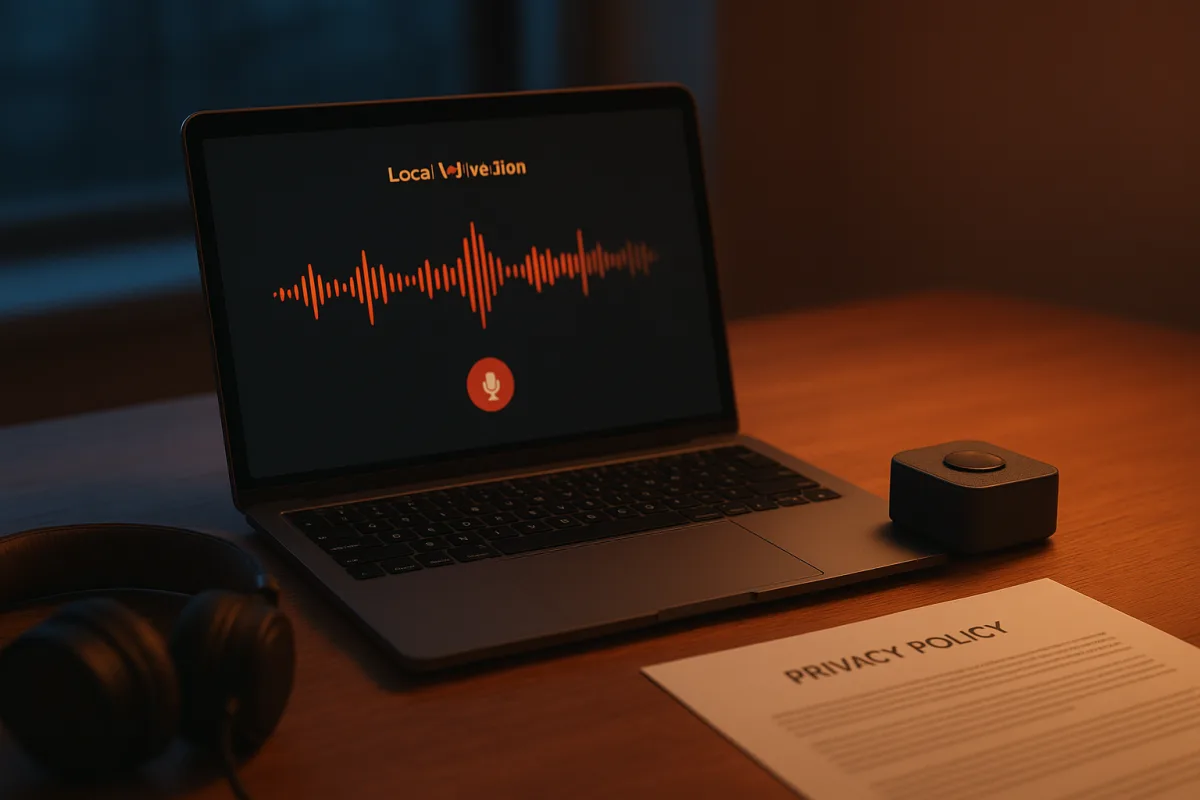
Local Voice AI Is a Pipeline, Not a Privacy Setting
“Local” describes where the pipeline runs
The important advance in AI voice tools is not simply that a machine can transcribe speech or generate an expressive voice. Those were already established capabilities. The more consequential change is that developers can choose where each stage runs.
That choice is frequently flattened into the word “local.” It should not be. A voice interface is usually a chain: microphone capture, voice activity detection, speech recognition, language-model processing, text insertion or action execution, then possibly speech synthesis.
Each link has different compute requirements, privacy implications and failure modes. A tool can run transcription on a laptop while sending selected text to a cloud language model. It can also keep speech local but call a remote service for synthesis.
This distinction matters particularly for OpenWhispr, the open-source dictation application featured by the NeuralNine channel. Its useful idea is not a novel speech model. It is a system-wide interface that routes spoken input into whichever transcription and language-model services the user configures.
What OpenWhispr actually does
OpenWhispr sits between the microphone and the active application. A configured keyboard shortcut begins recording; another ends it. The program transcribes the audio, then pastes the resulting text into a browser, note-taking application, email client or other focused field.
That sounds modest, but system-wide insertion changes the workflow. Instead of opening a chatbot or a dictation page, a person speaks directly into the place where text is needed. The relevant unit of utility is friction removed, not model intelligence.
The NeuralNine demonstration distinguishes two modes. Plain dictation produces transcribed text. Assistant mode takes selected text or spoken instructions, sends them to a language model, then replaces or reformats the selected material, such as converting prose to uppercase or restructuring notes.
Those are fundamentally different operations. Dictation asks, “What sounds occurred?” Assistant mode asks, “What transformation should be applied?” The first is an automatic speech recognition problem. The second requires a language model, and may therefore introduce both cost and semantic mistakes.
A spoken request to “make this friendlier” is not deterministic. The language model has to infer tone, retain facts, preserve formatting and decide how much to change. That can be useful for drafting, but it is not equivalent to an accurate transcription.
The three processing boundaries
OpenWhispr documents three broad processing models: local on-device models, Bring Your Own API Key, and OpenWhispr Cloud. These are not cosmetic account choices. They determine where audio and text travel, who operates the inference infrastructure, and which policies an organisation must assess. [1]
In local mode, audio is processed on the user’s device and does not leave it. For an employee dictating customer details, clinical notes, source code or internal planning, that is the strongest default from a data-exposure perspective. [1]
Local does not mean no data persists. OpenWhispr says transcriptions are stored locally, while cloud synchronisation is optional and reversible. Users can control deletion and select processing modes, rather than accepting a single all-or-nothing data path. [1]
Bring Your Own API Key changes the boundary. OpenWhispr becomes the desktop interface, but the selected speech-to-text or language-model provider processes the submitted content. The application says these providers are opted out of training on user data, but that does not remove compliance review requirements. [1]
That distinction is especially relevant for teams. “Not used for training” is not the same as “never leaves our environment,” nor is it automatically sufficient for regulated data. Retention rules, data residency, provider terms, access controls and internal approval policies still apply.
OpenWhispr Cloud is the managed middle ground. Its privacy documentation says processing occurs in real time, with no audio storage or training, and describes encryption both in transit and at rest alongside token and OAuth-based authentication. [1]
For an individual, that may be an acceptable compromise. For an enterprise, local inference remains simpler to reason about because the sensitive audio never crosses an organisational boundary. Cloud and BYO modes are useful options, not interchangeable privacy labels.
Why local dictation is more practical than local voice generation
Speech recognition and speech synthesis are often grouped together as “voice AI,” but their resource profiles differ. OpenWhispr can use local Whisper or Nvidia Parakeet-family transcription models, according to its privacy documentation, making local dictation a credible option for privacy-focused users. [1]
BreezeTTS2, presented by Sam Witteveen as a locally run, streaming text-to-speech system from the Chinese voice startup BreezeBlue, tackles the other direction. It receives text and produces audio, potentially with a designed or cloned speaking identity.
The demonstration is compelling because it combines several controls. A user can describe a voice without supplying a recording, clone a voice from reference audio, and separately direct pace, affect or delivery. These are distinct conditioning signals, not one generic “voice” parameter.
Voice design begins with a textual description: perhaps age range, accent, register and emotional trajectory. The model maps that prompt to a latent representation of a plausible speaker. The result is not an existing person’s voice, but it can still sound highly specific.
Voice cloning takes a different route. Reference audio provides acoustic evidence about speaker identity: timbre, habitual pitch range, pronunciation patterns and rhythm. The model tries to preserve those properties while speaking entirely new text, possibly in another supported language.
Voice direction then adds a third instruction. The target may retain the cloned identity while speaking slowly, urgently, sarcastically or softly. This is difficult because speaker identity and emotion are not cleanly separable in real recordings. Changing one can distort the other.
Witteveen’s examples suggest that BreezeTTS2 is especially promising at this separation, with expressive delivery from prompt-based direction. But recorded showcase samples are not a broad reliability benchmark. They do not reveal failure rates across accents, long scripts, noisy references or rare names.
What “real-time” costs
A responsive spoken assistant needs more than a fast text-to-speech model. It must detect when someone has finished talking, transcribe their utterance, generate a response, begin synthesis, buffer audio and play it without interruptions. Delay accumulates across every stage.
Streaming helps by avoiding a wait for the entire response. The language model can emit text incrementally, and the synthesiser can begin audio generation from the opening tokens. The listener hears an early phrase while later phrases are still being produced.
That is what makes Witteveen’s BreezeTTS2 demonstration feel conversational. His setup combined a small Gemma language model with the speech system and ran on a Dell workstation equipped with an Nvidia RTX Pro 6000 GPU, with output sent across Tailscale to another computer.
That hardware context should not be skipped. An RTX Pro 6000-class workstation is not evidence of real-time synthesis on typical consumer devices. Public documentation does not provide independently usable BreezeTTS2 latency figures or minimum hardware requirements for local consumer deployment.
The model was described in the Sam Witteveen demonstration as having three billion parameters, with community conversions including lower-precision variants. Quantisation can reduce memory use and sometimes improve throughput, but it is a trade-off, not a guarantee of equivalent audio quality or latency.
The broader inference picture is sobering. Large local models can demand substantial video memory even after compression. The research brief cites roughly 15 GB of VRAM for a 24-billion-parameter model at a 4K context, rising to 170 GB for a 123-billion-parameter model at 262K context.
Those figures are not measurements of BreezeTTS2. They illustrate why “runs locally” needs a hardware qualifier. The total device experience depends on model size, precision, GPU architecture, audio chunk size, context length, concurrent workloads and whether recognition and reasoning also run locally.
For developers, the practical metric is not parameters or leaderboard position. It is time to first audible token, then sustained real-time factor. A system that starts speaking quickly but cannot produce audio faster than playback will eventually stutter.
Product choices are really deployment choices
OpenWhispr is free and open source, and it suits people who want cross-platform, system-wide dictation with a meaningful local-processing option. Its cost is primarily setup time, local compute and any provider fees if the user chooses BYO APIs or paid cloud features. [1]
The NeuralNine channel found its Linux experience less polished under Wayland. Basic dictation worked, but assistant functions and shortcuts required manual workarounds. Documented issues also include paste failures caused by missing accessibility permissions or auxiliary tools, especially across desktop environments. [1]
Some failures belong to speech models rather than the interface. Whisper-family models can hallucinate stock phrases during silence. OpenWhispr advises releasing the activation key promptly to reduce this problem. Incomplete downloads, insufficient disk space and incorrect microphone selection can also yield incomplete or failed transcription. [1]
BreezeTTS2 suits experimentation, local prototypes, expressive character dialogue research and developers evaluating controllable synthesis. Its price and licensing terms are not publicly documented clearly enough to treat it as a settled commercial option, despite the impressive local demonstration.
That uncertainty matters because the Sam Witteveen video describes a research and non-commercial licence rather than unrestricted commercial deployment. A developer planning a game, support agent or monetised creator workflow should obtain current written terms directly from BreezeBlue before integration.
ElevenLabs suits teams that want a commercial hosted voice platform with published service tiers rather than a self-managed inference stack. Its free plan provides 10,000 credits per month without commercial rights, while enterprise pricing is custom and includes dedicated support and service-level arrangements.
Credits are a usage accounting mechanism, roughly corresponding to minutes of generated speech and subject to plan details. They make spending predictable, but they do not make a direct comparison with BreezeTTS2 possible because BreezeTTS2’s current public price and commercial terms remain unclear.
Aqua Voice suits users prioritising managed dictation, minimal setup and iPhone support. Aqua Voice’s comparison positions its service at approximately $8 per month on annual billing, while presenting OpenWhispr as the more open, locally controllable alternative. [2]
The market is growing, but adoption claims deserve restraint. The AI voice-generator market is projected to grow from $7.7 billion in 2026 to $21.8 billion by 2030, yet there is no reliable public breakdown showing the share held by open-source dictation tools. [2]
The developer opportunity is controlled composition
The useful architecture is modular. A developer can use a local recogniser for sensitive speech, a selected language model for text transformation, and a synthesiser only where spoken output adds value. Each component can be changed without rebuilding the entire interaction.
That modularity also makes risk visible. Dictation errors are usually transcription errors. Unexpected rewrites come from the language model. Slow replies may be caused by reasoning latency, synthesis latency or network delay. Synthetic voices introduce consent and impersonation concerns.
For creators, the immediate opportunity is not replacing every recording session. It is generating drafts, accessibility narration, placeholder dialogue, multilingual prototypes and interactive characters. Final work still benefits from editorial review, pronunciation checks and clear disclosure when a voice is synthetic.
The incremental advance is control. Tools such as OpenWhispr make local and provider-managed speech workflows easier to assemble. Systems such as BreezeTTS2 show increasingly fine-grained control over generated delivery. Neither removes the engineering, licensing or governance decisions underneath.
Frequently Asked Questions
What does local voice AI pipeline mean?
A local voice AI pipeline refers to the sequence of processing steps—microphone capture, voice activity detection, speech recognition, language-model processing, text insertion or action execution, and possibly speech synthesis—that run on the user's device rather than in the cloud. This approach allows users to control where each stage operates, which affects compute needs, privacy, and potential failure modes.
How does OpenWhispr handle local speech-to-text processing?
OpenWhispr runs speech recognition locally on the user’s device using models like Whisper or Nvidia Parakeet. It captures audio via a keyboard shortcut, transcribes it into text, and inserts that text directly into the active application. The transcription is stored locally by default, with optional and reversible cloud synchronization.
What are the privacy benefits of local voice AI?
Local voice AI keeps audio and transcriptions on the user’s device, preventing sensitive data from leaving the organizational boundary. This reduces exposure risks and simplifies compliance for regulated data since audio does not travel to external servers. Users also have control over data deletion and processing modes.
How do speech recognition and voice generation differ in local AI?
Speech recognition (turning speech into text) and voice generation (turning text into spoken audio) have different resource requirements and privacy implications. OpenWhispr focuses on local speech recognition, which is feasible on consumer hardware, while local voice generation systems like BreezeTTS2 are less documented and may require more powerful hardware, making real-time local synthesis more challenging.
What are the processing boundaries in local voice AI systems?
OpenWhispr defines three processing modes: local on-device (all processing stays on the device), Bring Your Own API Key (audio/text sent to a chosen cloud provider), and OpenWhispr Cloud (managed cloud processing with encryption and no data storage). Each mode has distinct privacy, compliance, and operational considerations, with local mode offering the strongest data control.
How we researched this
This article was assembled from 2 video sources across 2 channels, 2 cited references.
Nothing here is based on hands-on testing. Where a figure or finding appears, it belongs to the source cited beside it, and the writing says so rather than implying otherwise. Every source is listed below so you can check it.
Sources
BreezeTTS2 - 100% Local Real-Time Voice — Sam Witteveen
OpenWhispr: Use Your Voice For Everything — NeuralNine
Aqua Voice vs OpenWhispr (2026): Managed vs Open-Source Dictation
Watch Advances in AI-Powered Voice and Speech Technologies on Youtube
Also from the sources
Related Articles
Gemini 3.5 Transcribe: Advances in AI Speech-to-Text
Explore Gemini 3.5 Transcribe's AI-powered speech-to-text advances, including editing, custom vocab, and real-time transcription features.
Gemini 3.5 and 3.8 Voice AI Technologies Explained
Explore Gemini 3.5 and 3.8 voice AI technologies, including transcription, TTS models, and best practices for accurate speech applications.
AI Agents in Real-Time Applications
Explore how AI agents work in real-time sports, robotics, and voice AI, focusing on latency, specialized tooling, and practical deployment challenges.

AI in Robotics and Real-Time Applications
Explore how AI integrates with robotics for real-time control, challenges in deployment, and practical lessons from recent demos and projects.