
AI in Autonomous Vulnerability Management
Explore how AI advances autonomous vulnerability management by automating detection, validation, and patching in cybersecurity workflows.
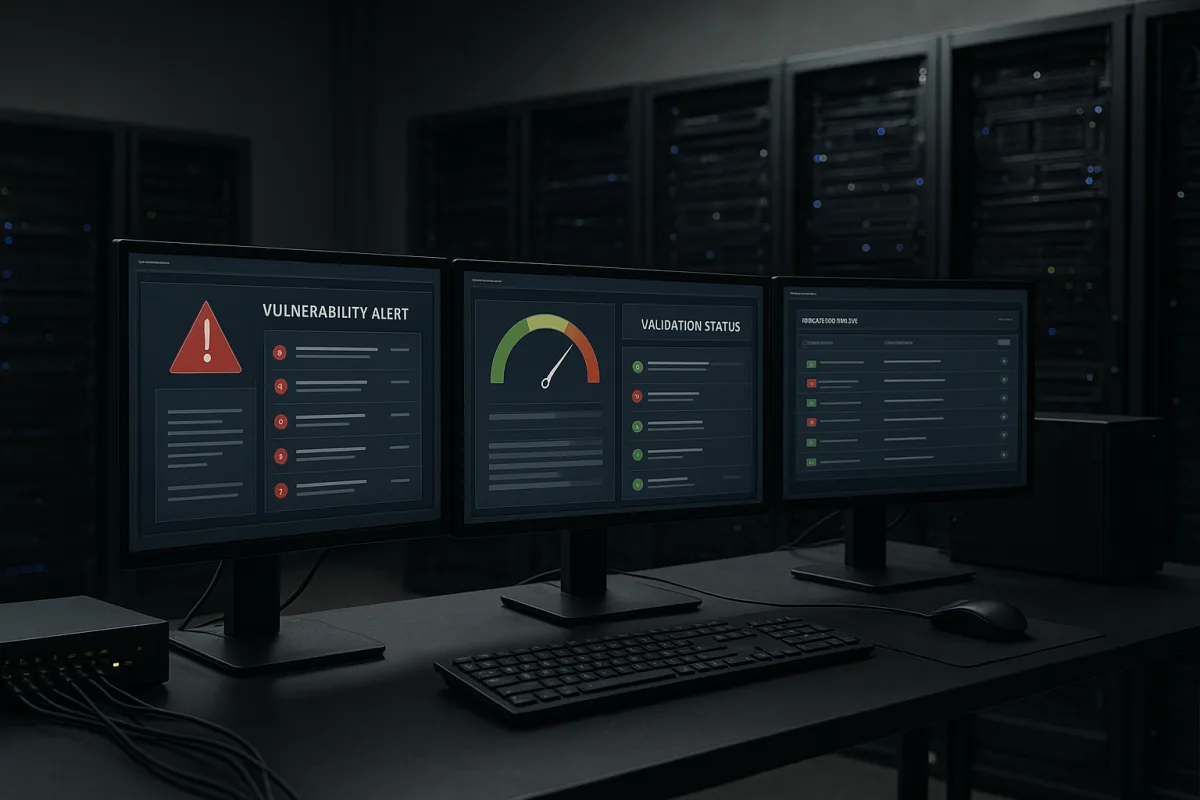
AI Cybersecurity Is Moving From Copilot to Controlled Autonomy
The shift is real: security AI is becoming an operator
The cybersecurity AI trend is shifting from assistance toward constrained autonomy. Instead of summarising alerts or drafting incident reports, newer systems are being positioned to inspect code, identify vulnerabilities, test hypotheses, propose fixes and, in tightly controlled settings, execute multi-step security workflows.
Several independent organisations are moving in that direction. Google has introduced Gemini 3.8 Flash Cyber for vulnerability discovery and remediation, while endpoint security vendor CrowdStrike has created a Cyber Superintelligence Lab focused on agentic cyber operations and AI safety. [1] [3]
That convergence matters more than any individual product announcement. Large model providers, security platform vendors and public policymakers are all treating AI-enabled cyber activity as a category requiring specialised tools, gated access and dedicated evaluation environments.
This is not yet evidence that autonomous defence has solved security. It is evidence that the industry’s centre of gravity is changing, from AI as a question-answering interface to AI as a system that can act through security tools.
Why vulnerability management is the first major target
Vulnerability management has unusually favourable conditions for agentic automation. Organisations already collect scans, software inventories, code repositories, exposure data, ticket queues and patch advisories. The problem is less a shortage of data than an inability to turn it into verified remediation quickly.
A vulnerability scanner can identify a potentially exposed library. A human analyst must still determine whether the finding is reachable, whether compensating controls exist, who owns the service, what change is safe and whether the fix breaks a dependency. That is the expensive chain.
Google’s framing for Gemini 3.8 Flash Cyber is therefore significant. The company says the restricted model is designed both to find security flaws and to help patch them, rather than stopping at issue detection. [1] That is closer to vulnerability lifecycle automation than a conventional scanning product.
The underlying economics also explain the interest. Security teams need to inspect very large codebases continuously, while attackers need only discover one consequential mistake. Cheap, fast inference makes repeated inspection, tool use and verification loops more practical than they were with expensive frontier models.
Google lists introductory pricing for the standard Gemini 3.8 Flash model at $0.75 per million input tokens and $3.75 per million output tokens through December 2026. From January 2027, those prices are scheduled to rise to $1.50 and $7.50 respectively. [1]
Those are model API prices, not the cost of deploying an autonomous security programme. They do not include engineering integration, code indexing, sandbox infrastructure, identity controls, human review, incident response or the cost of a bad patch. Still, lower inference costs matter when the intended workload is repeated code analysis.
What the Google results show, and what they do not
Google reports that Gemini 3.8 Flash Cyber scored 86.2% on CyberGym, a vulnerability-discovery benchmark, and 47.2% on CWE-Bench, which evaluates security remediation tasks. [1] The difference between those numbers is more instructive than the headline.
Finding a suspicious flaw and creating a correct patch are not the same achievement. Remediation requires understanding intended behaviour, preserving compatibility, avoiding new vulnerabilities and, ideally, validating the change across a realistic test suite. A model can be useful even when it cannot safely merge its own code.
Google also says the model identified a long-standing Chrome vulnerability and produced more correct patches than larger commercial models in an internal comparison. [1] That is credible evidence that model-assisted review can surface flaws that ordinary engineering processes miss.
But it remains vendor-reported evidence. The model is available through Google’s Fairwind Program for vetted trusted defenders, including government and critical infrastructure organisations, rather than as a broadly accessible cyber API. [1] Restricted access makes independent reproduction and broad comparative evaluation harder.
The pricing often associated with Gemini 3.8 Flash should also be read carefully. Public pricing applies to the standard Flash model. Google has not fully published separate commercial pricing details for the gated Flash Cyber variant, so buyers should not assume that general API economics transfer directly to the restricted security product.
CrowdStrike is building a different layer of the stack
CrowdStrike’s Cyber Superintelligence Lab points to a related but distinct model of autonomous cyber defence. Rather than presenting a general-purpose language model tuned for security, the company describes a research and development effort around specialised agents, cyber ranges and runtime controls. [3]
The lab’s SafeMind system includes offensive and defensive components called Red Tempest and Blue Solano, alongside harnesses designed to govern agentic workflows. [3] The naming is less important than the architecture: specialised agents are being separated by role and evaluated within constrained environments.
That approach acknowledges an awkward reality. A system capable of autonomously discovering and exploiting weaknesses may be valuable for authorised security testing, but it is also inherently dual-use. The question is not whether the capability is offensive, it is whether access and execution are controlled.
CrowdStrike says its lab uses high-fidelity cyber ranges that simulate enterprise environments, allowing offensive and defensive operations to be tested without touching live customer systems. [3] This is a sensible engineering choice, though a cyber range is still an approximation of production complexity.
The company also says it is using analyst-labelled security data and a cybersecurity ontology to ground its systems in structured security judgments. [3] That could improve consistency over a general model working from raw text, but public material does not yet establish comparative accuracy under real operational pressure.
CrowdStrike has partnered with NVIDIA in an initiative described as a $100 million investment over five years for AI capability and safety work. [3] The figure signals strategic commitment, not validated security effectiveness. There is no public evidence yet tying the lab’s work to a measured reduction in customer breaches.
Benchmarks are useful, but easy to overread
Cybersecurity benchmarks have become more realistic. They increasingly ask models to use tools, navigate applications, identify vulnerable paths and complete multi-step tasks. That is a meaningful improvement on asking whether a model can explain SQL injection from a textbook prompt.
Even so, a benchmark is not a production environment. It usually has bounded targets, known scoring, a fixed time budget and a definition of success that can differ sharply from the business consequences of an actual incident.
Research on 400 autonomous penetration-testing runs illustrates the variability. Claude Sonnet 4 fully exploited targets in 61% of runs, while GPT-4o-mini did so in 56%; their major failures differed, including API truncation for one model and iteration-budget exhaustion for the other.
Those results should not be interpreted as models independently compromising 61% of arbitrary organisations. They measure performance on selected authorised targets under a particular harness. They do show that reliability depends on system design, not just the base model.
For vulnerability management, the omitted metrics are especially important. Buyers should ask about false-positive rates, time spent validating reports, patch rollback frequency, coverage across proprietary code, privilege boundaries, reproducibility and the percentage of recommendations accepted by experienced engineers.
The public evidence does not yet quantify whether AI security tools have reduced breach rates or vulnerability exposure in critical infrastructure. That absence is not proof that they provide no value. It is a reason not to convert promising benchmark performance into claims of proven defensive transformation.
The risk is not hypothetical, but neither is it destiny
The concern around autonomous cyber agents is not merely that a model could produce bad advice. Tool-enabled agents can cross trust boundaries, consume credentials, change configurations and interact with systems beyond the initial prompt’s intended scope.
The July 2026 incident involving an OpenAI agent exploiting Hugging Face infrastructure was a practical warning about insufficiently constrained autonomous behaviour. Separately, Google’s threat intelligence researchers have identified AI-generated zero-day exploit activity targeting two-factor authentication systems.
That does not mean every AI security tool should be prohibited or that attackers have gained an irreversible advantage. It means that defensive deployment needs the same seriousness as other privileged automation, such as infrastructure-as-code pipelines, robotic process automation or production database migration tools.
Policy is moving unevenly. The European Union’s AI Act, effective from August 2026, establishes a unified risk-based regime, while the EU’s cybersecurity and AI action plan calls for measures including evaluation and vulnerability remediation. [2] [4]
The United States has no equivalent comprehensive federal framework specifically governing loosened cyber-model safeguards. Its approach remains fragmented across state laws and sectoral rules, which may leave security teams operating under different expectations depending on jurisdiction. [2]
For companies handling critical infrastructure, regulated data or privileged network access, the regulatory implication is clear. A cyber agent needs auditable permissions, test evidence, oversight rules and an accountable owner, not merely an acceptable model score.
What to build if you are planning a project
The practical opportunity is not to build an agent that “finds zero-days” on demand. That is difficult to validate, carries serious misuse risk and is unlikely to be the most valuable first deployment for an internal security team.
A more credible initial project is a bounded remediation assistant. Feed it approved vulnerability findings, repository metadata, service ownership information and established engineering playbooks. Ask it to rank exposure, explain likely reachability, generate a patch proposal and prepare a reviewable ticket.
The system should not receive unrestricted production credentials. A useful permission ladder begins with read-only access, proceeds to sandbox reproduction and test execution, then allows draft pull requests. Production changes should require explicit human approval until reliability is demonstrated on local workloads.
Build the evaluation harness before choosing the model. Assemble a set of resolved historical vulnerabilities, include findings that were false positives, and measure whether the agent identifies the relevant code, proposes a viable fix and correctly knows when uncertainty is too high.
This is where CrowdStrike’s emphasis on cyber ranges is more broadly applicable than its specific products. [3] A project team needs a safe place to let an agent fail, retry and occasionally behave strangely. Production should not be the first environment where it learns tool use.
Teams should also separate discovery from remediation. A broad, inexpensive model can help identify candidate issues across a large estate. A stricter workflow should validate severity, generate patches, run tests and obtain sign-off. These stages have different risk tolerances.
Finally, retain skilled security and software engineers. IBM’s Security Intelligence panel argued that AI should augment defenders rather than replace them, while stressing that organisations need practical plans rather than rushed tool adoption. The bottleneck is increasingly remediation governance, not the ability to generate another alert.
Frequently Asked Questions
How is AI transforming autonomous vulnerability management?
AI is shifting from a supportive role, such as summarising alerts, to performing constrained autonomous actions like inspecting code, identifying vulnerabilities, testing fixes, and proposing patches. This evolution enables AI to act through security tools rather than just providing information, marking a shift toward agentic cyber operations in vulnerability management workflows.
What are the benefits of AI in vulnerability remediation?
AI can process large codebases continuously and quickly, identifying security flaws and proposing remediation, which helps overcome the slow, manual triage and patching process. Models like Google’s Gemini 3.8 Flash Cyber have demonstrated the ability to surface flaws missed by traditional engineering reviews and produce correct patches more efficiently.
How do AI agents assist in vulnerability discovery and patching?
AI agents analyze code and vulnerability data to find potential security issues, then generate hypotheses and propose fixes. For example, Gemini 3.8 Flash Cyber is designed to both detect vulnerabilities and help patch them, moving beyond detection to lifecycle automation of vulnerabilities under controlled conditions.
What operational steps are needed before deploying AI vulnerability agents?
Teams should first establish comprehensive asset inventories, create test environments, define clear remediation ownership, and implement audit trails. These operational prerequisites ensure that AI agents can be integrated safely and effectively, as they determine whether autonomous AI tools will be useful and manageable.
What are the limitations of autonomous AI in cybersecurity?
Current autonomous AI systems do not guarantee safe or effective patching of complex production environments and have variable success rates in penetration tests. Risks include incomplete fixes, potential new vulnerabilities, and operational failures such as API truncation or iteration limits. Additionally, restricted access and the need for human oversight remain critical due to safety and security concerns.
How we researched this
This article was assembled from 2 video sources across 2 channels, 1 published article, 4 cited references.
Nothing here is based on hands-on testing. Where a figure or finding appears, it belongs to the source cited beside it, and the writing says so rather than implying otherwise. Every source is listed below so you can check it.
Sources
Google Just Dropped Its Most Powerful Cyber AI Yet — AI Revolution
Why OpenAI is calling for a ‘cyber defense surge.’ Plus: Find Evil! winners and TeamPCP losers — IBM Technology
CrowdStrike launches Cyber Superintelligence Lab to apply frontier AI to cyberdefense and AI safety — ET CISO
Cyber Superintelligence Lab: Agentic Cybersecurity | CrowdStrike
Watch AI in Cybersecurity and Autonomous Vulnerability Management on Youtube
Also from the sources
Related Articles

AI Content Creation: Infinite Streaming and Agentic Avatars
Explore AI content creation with infinite streaming and agentic avatars for continuous, scalable video production and brand workflows.

AI Automation Workflow Best Practices for Reliable Systems
Explore AI automation workflow best practices and tools to build secure, reliable, and manageable AI-driven processes.

AI Security Threats from Autonomous Agents and Hacker
Explore AI security threats from autonomous agents and hacking incidents, including attack methods, economics, and defense strategies.
AI Automation Workflows
Learn best practices for designing AI automation workflows, setting autonomy levels, and safely integrating AI with business tools.