
AI in Healthcare and Scientific Discovery
Explore how AI supports healthcare and scientific discovery with validation, workflows, and human oversight—not autonomous medicine.
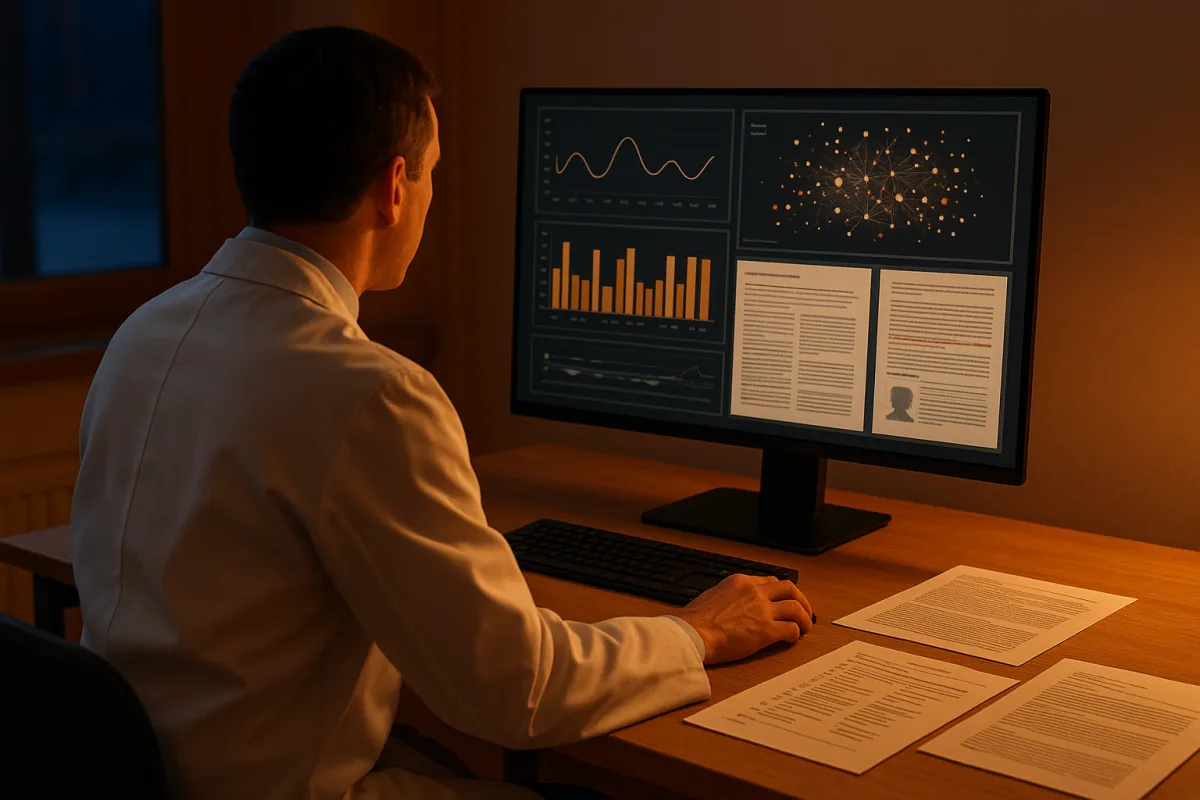
The shift is real, but it is not autonomous medicine
AI in healthcare and scientific discovery is moving from isolated prediction models toward systems that participate in a longer research workflow. They search literature, organise data, propose next analyses and sometimes rank experimental candidates for people to test.
That is a meaningful shift. It is not yet evidence that AI can independently discover safe treatments, diagnose reliably across hospitals, or replace scientific judgement. Most of the credible progress is in accelerating constrained parts of work that remain subject to human review.
Several independent strands point in this direction. News-Medical has reported machine-learning work mapping immune-response changes over time in sepsis, while Cureus has published a technical report on human-governed validation of AI-generated medical assessment artifacts. These are different applications, but both concern a practical question: how to extract useful signals without handing accountability to software.
The broader clinical literature is similarly focused on agreement and evaluation rather than machine autonomy. A Scientific Reports study benchmarked four AI platforms against published clinical-trial conclusions, an important but narrow measure of whether a model reaches similar textual conclusions to prior work. [1]
That distinction matters. Agreement with published conclusions does not establish that a model will select the right patient, recognise missing context, detect a flawed trial, or make a safe recommendation at the point of care.
Discovery agents are extending the workflow
The most ambitious version of this trend appears in scientific-agent systems. AI Uncovered describes Future House's Robin as a system used in a research loop for dry age-related macular degeneration, a leading cause of irreversible vision loss.
According to the AI Uncovered account, Robin searched literature, proposed that improving phagocytosis in retinal cells might be a useful strategy, ranked existing compounds, interpreted experimental results and suggested another round of candidates. Laboratory researchers, rather than the system, performed the physical experiments.
The reported candidate was ripasudil, a drug approved in Japan for glaucoma. In laboratory cell models, AI Uncovered says it increased the targeted phagocytic activity by an estimated 1.89-fold, compared with 1.75-fold in an independent human analysis.
That is an interesting example of closed-loop research assistance. It demonstrates a system helping form and revise a hypothesis after receiving experimental data. It does not demonstrate a treatment for macular degeneration, and it should not be reported as one.
The independent evidence gap is substantial. As of August 2026, no independent evaluation appears to assess Claude Science, or another comparable scientific agent, specifically for identifying treatments for blindness. The AI Uncovered account should therefore be read as a description of a developer-associated research workflow, not as clinical validation.
A separate ophthalmology study makes the limitation clearer. JAMA Ophthalmology reported that Claude 3.7 Sonnet achieved 73.0 percent accuracy on real-world retinal cases with full context and 73.7 percent on image-only cases. GPT-4o reached 78.4 percent, while Gemini 2.5 Pro reached 29.7 percent.
Those figures concern diagnostic classification, not treatment discovery. But they are a useful corrective to claims that language models have crossed some general threshold of medical competence. Even in a bounded specialty task, performance varied sharply by model.
Why this is happening now
The technical change is less about a single better chatbot than about tool access. AI Uncovered describes Anthropic's Claude Science as a public-beta scientific workbench that connects an agent to databases, code environments, remote computing and laboratory data pipelines.
This architecture lets a model do more than draft an answer. It can retrieve records, create analysis code, submit a job, inspect results and prepare figures. The value, if it works, comes from reducing handoffs between tools and specialists.
Google DeepMind's Co-Scientist system follows a related pattern, according to AI Uncovered. Multiple Gemini-based agents generate, criticise, rank and refine hypotheses under a human-defined objective, then propose experimental directions for researchers to evaluate.
The older idea is not new. Robot-scientist projects have generated and tested hypotheses for years. What is newer is the attempt to put general-purpose language models at the interface between literature, data, specialist software and experimental planning.
There is also a less glamorous reason this is happening: biomedical research produces more papers, datasets and possible comparisons than individual teams can inspect manually. Systems that make the search space smaller can be useful even when they cannot reliably supply the answer.
News-Medical's report on machine learning for changing sepsis immune responses reflects that more conventional side of the trend. Time-dependent clinical biology is difficult to describe with a single threshold or static score, so models can help identify patterns across repeated measurements.
That does not mean the model has explained sepsis. Mapping trajectories and establishing a causal mechanism are different tasks. Nor does identifying immune-response subgroups automatically show that acting on those subgroups improves patient outcomes.
The benchmark is usually smaller than the claim
Healthcare AI launches often pair a broad promise with a narrow evaluation. A model may be tested for agreement with clinical-trial conclusions, for example, yet promoted as a research assistant capable of evaluating evidence generally. [1]
Agreement benchmarks can be useful. They reveal whether outputs resemble known conclusions under specified conditions. They omit what happens when trials conflict, when critical information is absent, when population characteristics differ, or when a user asks an underspecified question.
Similarly, an image-classification accuracy score does not measure deployment safety. It may not capture calibration, distribution shift, equity across patient groups, clinician reliance, alert fatigue, turnaround time or whether the tool changes treatment in a beneficial way.
The American Medical Association's AI Evaluation Guide is useful precisely because it treats evaluation as a structured clinical exercise rather than a leaderboard contest. It gives physicians criteria for assessing AI tools in context, including their intended use and practical effects. [4]
Cureus's report on human-governed validation of AI-generated medical assessment artifacts points in the same direction. Its presence is notable, but the supplied excerpt does not provide enough detail to claim a particular validation protocol or implementation result.
Likewise, BBN Times frames AI in medicine around both breakthroughs and risks. That is directionally fair, though a general news treatment cannot settle whether a particular system is safe enough for a particular care pathway.
A stronger standard asks: compared with what baseline, on which patients, at which decision point, and with what downstream outcome? Without those answers, a capability demonstration may be technically impressive but clinically indeterminate.
Validation is becoming the real product requirement
The important operational trend is not that hospitals are discovering a single definitive validation recipe. It is that credible organisations increasingly describe validation as continuous, human-governed work rather than a one-time pre-launch test.
The AMA guide offers a structured physician-centred approach. [4] APPI News, writing about medical AI validation, argues that hospitals need more than accuracy scores and highlights good machine-learning practice principles including representative data and independent training and testing. [5]
These requirements sound ordinary, because they are. Clinical systems need intended-use definitions, independent test data, uncertainty handling, monitoring, escalation routes and documented accountability. Generative AI does not remove these needs, it makes them more urgent.
The CDC's guidance is similarly unambiguous on scientific work. Researchers remain responsible for accuracy and integrity when using generative AI, and disclosure is required where relevant. [2] AI can assist with writing or analysis, but it cannot carry responsibility for the claim.
This is why the phrase “AI scientist” should be handled carefully. It may describe a system's coverage of research tasks, but it does not describe an accountable author, investigator or clinician. Current scientific-governance guidance keeps those roles human. [2]
The risks are not hypothetical. A systematic review indexed by PubMed identifies privacy, security and reliability threats in healthcare AI, including re-identification risks, adversarial attacks and input manipulation. [3] These failures can occur without a model producing obviously absurd text.
A superficially coherent output is especially dangerous in research workflows. AI Uncovered describes an agent benchmark in which different attempts to retrieve Ebola sequences produced very different datasets, changing downstream phylogenetic estimates despite apparently valid analysis code.
That example illustrates a general engineering lesson. Reproducibility is necessary, but it is not enough. A fully logged pipeline can faithfully reproduce a bad cohort definition, missing records or an incorrect database query.
What this means for a new project
A team planning an AI healthcare or discovery project should begin with a bounded decision, not an aspiration to build an autonomous researcher. Define the user, the action they will take, the evidence required and the conditions under which the system must defer.
Good early candidates are tasks with inspectable outputs. A model can help screen papers against predefined criteria, identify inconsistent fields in study data, draft an analysis plan for review, or prioritise compounds for an existing experimental assay.
Those applications still need evaluation. But they make it feasible for domain experts to compare the output with source material before an error affects a patient or consumes months of laboratory time.
Next, separate deterministic steps from probabilistic ones. Database filtering, patient-eligibility logic, unit conversion and record linkage should use auditable rules where possible. A language model can coordinate the work, but it should not be the only control on factual retrieval.
Then design evaluation around the intended workflow. Measure not only task accuracy but error severity, calibration, time saved after review, disagreement rates, subgroup performance and the frequency with which experts override the tool.
For clinical tools, build governance before deployment. Establish who reviews outputs, what is logged, how patients' data are protected, how model changes are approved and how the organisation will detect deteriorating performance. The AMA guide provides a practical starting point for that process. [4]
Finally, be realistic about integration. An agent that performs well in a polished demonstration may still fail on local naming conventions, incomplete records, inaccessible systems, changing APIs and inconsistent laboratory metadata. These are not peripheral implementation problems. They are often the project.
The near-term opportunity is substantial but narrower than the marketing language suggests. AI can make scientific and medical teams faster at searching, organising, comparing and prioritising. Whether it makes them more correct will depend on validation discipline, data quality and a human team's willingness to treat every polished output as a claim that still needs evidence.
Frequently Asked Questions
How is AI currently used in healthcare and scientific discovery?
AI is primarily used to assist in longer research workflows by searching literature, organizing data, proposing analyses, and ranking experimental candidates for human testing. It helps accelerate constrained parts of work such as cohort assembly, literature screening, and quality control, but it does not independently discover treatments or replace scientific judgment.
What are the limitations of AI in medical treatment discovery?
AI-generated results, such as promising cell-model outcomes or benchmark scores, do not equate to clinical utility. There is a substantial evidence gap, and no independent evaluations currently confirm AI systems like Claude Science as effective for identifying new treatments for conditions such as blindness. Safety monitoring, prospective studies, and workflow integration remain necessary.
How can AI assist in scientific research workflows?
AI systems can connect to databases, code environments, and laboratory data pipelines to reduce handoffs between tools and specialists. They can generate, critique, rank, and refine hypotheses under human guidance, propose experimental directions, and help narrow the search space in complex biomedical research, enabling researchers to focus on the most promising leads.
What validation steps are necessary for AI in healthcare?
Validation should be built into projects from the start by retaining source data, versioning prompts and models, defining human sign-off points, and testing performance on representative local cases. Agreement with published conclusions is not sufficient; prospective clinical studies and safety monitoring are essential before AI outputs can be used in patient care.
Can AI independently diagnose or treat medical conditions?
No. AI systems have not demonstrated the ability to reliably diagnose or treat medical conditions independently. Diagnostic accuracy varies by model and task, and AI outputs require human review and clinical judgment. Regulatory guidelines also prohibit AI from autonomous decision-making or authorship in scientific publications.
How we researched this
This article was assembled from 1 video source, 3 published articles, 5 cited references.
Nothing here is based on hands-on testing. Where a figure or finding appears, it belongs to the source cited beside it, and the writing says so rather than implying otherwise. Every source is listed below so you can check it.
Sources
The First AI Scientists Have Arrived — AI Uncovered
Artificial Intelligence in Medicine: Breakthroughs, Risks, and the Future of Patient Care — BBN Times
Machine learning maps changing immune response over time in sepsis — News-Medical
Considerations for Disclosing Generative AI Use in Scientific Work | Artificial Intelligence | CDC
AI Specialty Collaborative: AI Evaluation Guide | American Medical Association
Hospitals need more than accuracy scores to validate medical AI — APPI News
Watch AI in Healthcare and Scientific Discovery on Youtube
Related Articles

AI in Mathematics and Scientific Discovery
Explore how AI aids mathematics and scientific discovery through proof assistance, hypothesis generation, and formal verification tools.
AI Solving Complex Scientific Problems
Explore how AI advances complex scientific problems in math, drug discovery, and research with formal proofs and clinical trials.
AI Applications in Healthcare: From Demos to Clinical Use
Explore AI applications in healthcare, focusing on clinical workflows, validation, deployment challenges, and biological sciences integration.

AI-Powered Multimedia Workflows for Content Creation
Explore AI-powered multimedia workflows that enhance video editing, coordination, and content creation with practical tool comparisons.