
AI Solving Complex Scientific Problems
Explore how AI advances complex scientific problems in math, drug discovery, and research with formal proofs and clinical trials.
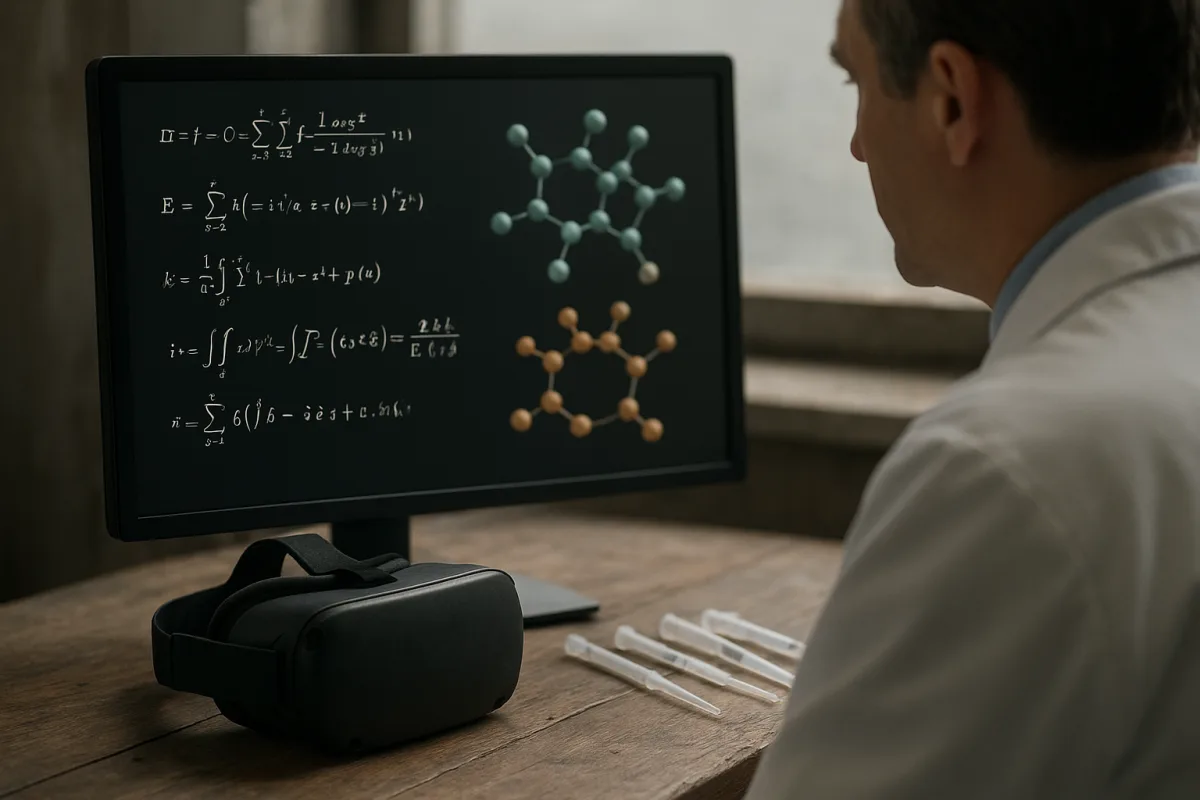
The shift is real, but it is narrower than the headlines suggest
AI is moving from assisting scientific work to generating candidates that researchers would once have expected only specialists to produce. That includes mathematical arguments, drug molecules, experimental hypotheses, and simulation surrogates.
The important qualification is that candidate generation is not the same as discovery. A model can propose a proof, predict a protein interaction, or optimize a molecule, but science still requires verification outside the system that produced it.
Recent reporting from The Verge, coverage from Two Minute Papers, and Insilico Medicine’s clinical work point toward the same underlying change. AI systems are being placed inside research loops with measurable objectives and increasingly capable automated feedback.
That is different from asking a chatbot to explain a paper. The useful systems search a large space of possible solutions, receive signals from theorem provers, assays, simulators, or clinical datasets, then revise their output repeatedly.
Navier-Stokes is a test of AI-assisted mathematics, not a completed trophy
OpenAI’s September 2026 announcement of a proposed solution to the Navier-Stokes existence and smoothness problem is the most visible example. The equations model fluid flow, from relatively ordinary engineering flows to highly turbulent regimes.
The Millennium Prize question is not whether scientists can numerically simulate fluids. It asks whether smooth, three-dimensional incompressible Navier-Stokes solutions can develop a singularity in finite time, or remain smooth indefinitely.
OpenAI says an internal system coordinated roughly 10,000 AI agents for 88 hours, using tens of millions of dollars in compute, to generate a 166-page proposed solution. The company also published a formalization in Lean, a theorem prover.
That is a meaningful advance in process, even before the mathematics is accepted. Formal proof systems provide a much stronger checking mechanism than an eloquent language-model answer, because each inference must satisfy explicit logical rules.
But Lean verification is not a universal substitute for expert review. A theorem prover can establish that a formal statement follows from encoded assumptions, while mathematicians must still determine whether those assumptions precisely capture the claimed result.
The Clay Mathematics Institute has acknowledged OpenAI’s announcement but has not verified the proof or awarded the $1 million prize. OpenAI has reportedly declined to make a formal prize claim, which is sensible given the scrutiny still required.
Two Minute Papers presented the work as a likely resolution and highlighted the apparent speed of the system. That framing captures why researchers are paying attention, but “likely solved” remains too strong for a claim awaiting community validation.
The Verge’s reporting supplies the more important context: the result emerged amid an intense dispute over priority, attribution, and training-data provenance. Those questions matter because frontier mathematics is cumulative work, not merely a final answer.
Mathematicians Tristan Buckmaster and Levent Alpöge had been independently pursuing related approaches. Buckmaster told The Verge that OpenAI learned researchers were making progress and then accelerated its own attempt using large-scale agentic search.
Buckmaster also questioned whether his use of OpenAI’s Codex could have indirectly contributed to the system’s performance. OpenAI denied direct access to his specific user data, while acknowledging uncertainty about whether derived data could have influenced models.
That uncertainty is not a side issue. If researchers cannot establish a chain of custody for unpublished ideas entered into proprietary systems, they face a practical choice between using powerful tools and protecting research priority.
The London Mathematical Society’s June 2026 guidance is clear on one point: generative AI tools cannot be authors, and human authors retain responsibility for correctness. That is necessary, though it does not by itself resolve credit or provenance disputes.
The Secretary Suite Project’s proposed chain-of-custody framework is more useful operationally. It calls for documenting human contributions, AI contributions, source data, permissions, intermediate outputs, and verification, much like a lab notebook for computational research.
Why mathematics is moving faster than many sciences
Mathematics has an unusually favorable property for machine learning: many intermediate results can be checked automatically. A proof assistant, symbolic algebra system, numerical counterexample search, or unit-test-like verifier supplies dense feedback at high speed.
This is the central observation in Two Minute Papers’ explanation of AI’s progress in mathematics. Comparing outputs manually is slow, but formally checking many mathematical candidates can be automated and repeated at a scale unavailable to individual researchers.
That does not mean models “understand mathematics” in a settled human sense. It means an optimization loop can reliably reward some useful behavior, especially when a model is paired with search, tools, memory, retrieval, and a strict verifier.
The same pattern appears in software engineering. The AI Automation channel’s video about automated video production is not scientific evidence, but it illustrates the broader tooling shift: models increasingly operate within environments containing explicit instructions, assets, checkpoints, and evaluators.
For research teams, the lesson is not to copy consumer agent demos. It is to build the equivalent of a scientific environment: well-defined inputs, constrained tools, reproducible state, domain-specific tests, and human review at consequential decision points.
Infrastructure is also becoming easier to access. The AI Automation channel highlighted NVIDIA’s free model APIs, and NVIDIA’s NIM platform does offer developers access to more than 100 open-weight models for exploration without a credit card.
That access is useful for prototyping, not a production strategy. NVIDIA’s free tier is limited to 40 requests per minute across models, prohibits commercial or production use, and requires careful API-key management after reported misuse incidents.
Drug design offers stronger evidence of utility, weaker evidence of rejuvenation
The biomedical case is more concrete in one respect: a drug candidate can be tested in people. It is also harder, because a clinical endpoint is slower and more ambiguous than a theorem-prover check.
Insilico Medicine developed rentosertib for idiopathic pulmonary fibrosis, a disease in which lung tissue progressively scars. The company used AI systems to identify a target and generate candidate molecules, then advanced rentosertib through clinical development.
AI Revolution described a later analysis of blood samples from an Insilico Phase IIa trial, framing the result as human aging reversal. That is not supported by the evidence available in the research brief.
The trial involved 71 patients with idiopathic pulmonary fibrosis during 2023 and 2024. At four weeks, several biological-age clocks estimated reductions of roughly 2.7 to 3.5 years in treated participants, depending on the measurement model.
Those clocks infer age-associated biological patterns from molecular features, such as proteins in blood. They do not directly measure lifespan, restored organ function, reduced frailty, or reversal of every process conventionally grouped under aging.
The agreement among multiple clocks is encouraging, particularly when their inputs and training data differ. It makes the signal more interesting than a result from a single proprietary biomarker model, but it does not establish causality.
Patients in the study had a serious lung disease, which creates an obvious confound. If treatment changes inflammation, tissue damage, oxygenation, or disease burden, aging clocks may interpret an improved disease state as a younger biological profile.
The trial also did not demonstrate clinical efficacy improvements such as improved lung function. Its primary endpoint concerned adverse-event rates, and its safety profile was comparable to placebo, both useful findings but not proof of disease modification or rejuvenation.
Insilico Medicine has appropriately described the aging finding as potential rather than proof. The next meaningful study would test pre-registered endpoints, include healthy and disease populations where justified, and connect biomarker shifts to clinical outcomes.
There is a regulatory obstacle as well. Aging is not generally recognized as a disease indication, so even a drug that consistently improved aging biomarkers would need a viable approval pathway tied to defined clinical conditions.
What is actually changing in AI for science
The common thread between formal mathematics and drug discovery is not that general-purpose language models have become omniscient. It is that more research tasks can be decomposed into generation, evaluation, filtering, and escalation to human experts.
In mathematics, the evaluator may be Lean or a set of formal checks. In chemistry, it may include docking scores, synthesis constraints, toxicity models, laboratory assays, and eventually controlled trials.
Each evaluator has blind spots. A proof checker cannot decide whether the right theorem was formalized, while a biological-age clock cannot decide whether a patient will live longer or remain healthier.
This is why headlines about AI “solving science” are misleading. The systems do best where researchers can specify a narrow target and build a cheap proxy for quality, then reserve scarce expert or experimental capacity for the strongest candidates.
OpenAI’s proposed Navier-Stokes proof and Insilico Medicine’s rentosertib programme are therefore not equivalent evidence. One is an unverified claim about a landmark mathematical question; the other is evidence that AI-assisted drug pipelines can reach human trials.
Neither case supports either extreme reaction. There is no reason to dismiss AI as autocomplete when it can produce formalizable mathematical work or candidate drugs, and no basis for assuming it has bypassed scientific validation.
Planning an AI-for-science project
Start by specifying the scientific decision your system will improve. “Discover new biology” is not an executable objective, while “rank candidate compounds for a defined assay under synthesis and toxicity constraints” is at least testable.
Then design the evaluator before choosing the model. If success cannot be measured independently of the model’s own confidence, the project will produce persuasive-looking outputs without a reliable route to learning whether they are correct.
Use multiple validation layers where possible. A promising workflow might combine computational filters, held-out historical data, adversarial checks, replication by independent tools, and prospective experimental or clinical evaluation.
Keep a durable provenance record from day one. Record model versions, prompts, retrieved documents, tool calls, datasets, researcher edits, random seeds where applicable, and every external result used to promote or reject a candidate.
This is particularly important when using proprietary systems. The Verge’s reporting on the Navier-Stokes dispute shows how quickly questions about prompts, training data, and informal collaboration can become disputes about authorship and research integrity.
Open-weight models run in controlled environments may reduce some data-exposure concerns, but they do not eliminate responsibility for validation. Privacy, attribution, reproducibility, and scientific quality are separate requirements, and a project can fail on any one of them.
The near-term opportunity is substantial but practical: AI can increase the number of hypotheses a small team can examine, improve access to formal and computational tools, and help prioritize expensive experiments. It cannot make weak measurements decisive.
The projects most likely to matter will not be those with the loudest claim of autonomous discovery. They will be the ones that make their assumptions inspectable, their evaluations rigorous, and their human scientific accountability impossible to evade.
Frequently Asked Questions
How is AI used to solve complex scientific problems?
AI systems generate candidate solutions by searching large spaces of possibilities and receiving automated feedback from tools like theorem provers, simulators, assays, or clinical datasets. These systems operate within research loops that include measurable objectives and repeated revision, enabling them to propose mathematical arguments, drug molecules, experimental hypotheses, and simulation surrogates. However, AI-generated candidates require independent verification by human experts.
Can AI generate formal mathematical proofs?
Yes, AI can assist in generating formal mathematical proofs, as demonstrated by OpenAI’s proposed solution to the Navier-Stokes problem, which included a formalization in the Lean theorem prover. Formal proof systems provide strong checking mechanisms because each inference must follow explicit logical rules. Nonetheless, formal verification does not replace expert review to confirm that encoded assumptions accurately represent the claimed mathematical result.
What role does AI play in drug discovery and clinical trials?
AI can design drug candidates and support clinical trials by generating molecules and analyzing biomarkers. For example, Insilico Medicine’s AI-designed drug rentosertib showed a shift in biological-age clocks in a Phase IIa trial for lung disease patients. However, such findings do not establish causality or clinical efficacy, and regulatory and healthcare system challenges remain significant barriers to adoption.
How reliable are AI-generated scientific hypotheses?
AI-generated hypotheses are useful starting points but are not discoveries until verified outside the AI system. The reliability depends on the quality of evaluation, provenance records, experimental controls, and domain expert review. Without these safeguards, AI outputs risk being mistaken for validated scientific results.
What are the challenges of verifying AI-generated scientific results?
Verification challenges include establishing a clear chain of custody for data and ideas used by AI, ensuring transparency of human and AI contributions, and confirming that formal assumptions match the intended claims. The scientific community also faces ethical and attribution issues, as AI tools cannot be credited as authors, and human researchers remain responsible for correctness. These factors complicate acceptance and reproducibility of AI-generated findings.
How we researched this
This article was assembled from 3 video sources across 3 channels, 2 published articles.
Nothing here is based on hands-on testing. Where a figure or finding appears, it belongs to the source cited beside it, and the writing says so rather than implying otherwise. Every source is listed below so you can check it.
Sources
- I Never Thought I’d See This Happen — Two Minute Papers
- GPT-6 Astra Finally Solves AI Video Editing (full guide) — Nate Herk | AI Automation
- AI Just Did the Impossible: Reversed Human Aging — AI Revolution
- OpenAI just wants to win — The Verge AI
- Artificial Intelligence Succeeds in Solving the Navier–Stokes Equation — Sudan Horizon
Watch AI Solving Complex Scientific Problems on Youtube
Also from the sources
Related Articles

AI in Healthcare and Scientific Discovery
Explore how AI supports healthcare and scientific discovery with validation, workflows, and human oversight—not autonomous medicine.

AI Biological Age Prediction
Explore AI biological age prediction, its role as a proxy, and what it truly measures in aging and drug discovery research.

Unreal Engine 5 Real-Time Path Tracing: Revolutionizing Gaming
Unreal Engine 5 introduces real-time path tracing, revolutionizing gaming with stunning visuals. Learn about spatial and temporal sampling techniques, denoising algorithms, and the future of real-time ray tracing in this exciting Two Minute Papers update. Free master-level course available for programming enthusiasts.

AI-Powered Multimedia Workflows for Content Creation
Explore AI-powered multimedia workflows that enhance video editing, coordination, and content creation with practical tool comparisons.