
AI in Mathematics and Scientific Discovery
Explore how AI aids mathematics and scientific discovery through proof assistance, hypothesis generation, and formal verification tools.
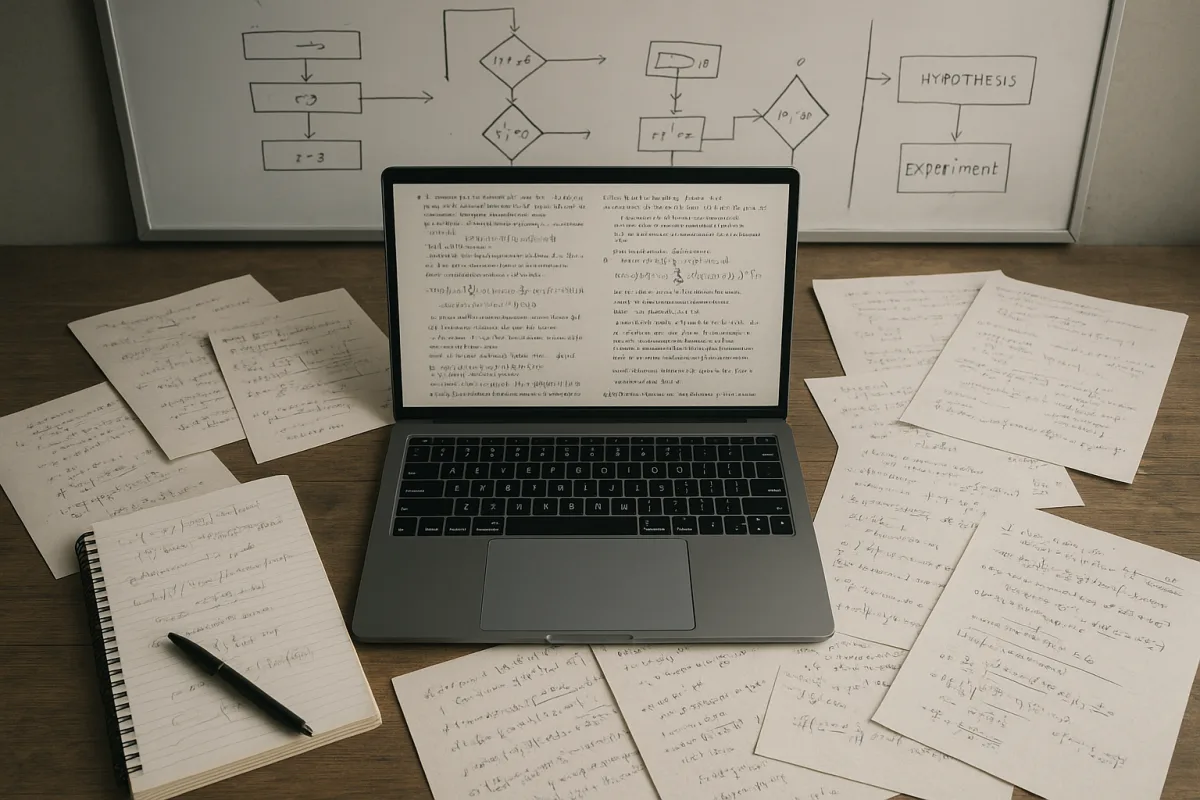
AI in Mathematics and Scientific Discovery: The Shift From Answer Engines to Research Instruments
The shift is real, but it is narrower than the headlines suggest
AI is becoming a practical component of mathematical and scientific research workflows. The important change is not that a model can answer textbook questions, but that systems are now being aimed at open-ended search spaces: proofs, conjectures, genomic mechanisms and experimental hypotheses.
Several groups are moving in that direction independently. OpenAI has released a large batch of AI-generated mathematics manuscripts, Meta has publicised model-assisted mathematics papers, Anthropic has reported formal-proof work, and Google DeepMind has built models for biological prediction at genomic scale.
That convergence matters more than any single launch. Different labs, model families and scientific domains are testing a similar proposition: language-model-style systems, paired with search, tools and structured data, may be useful upstream of publication rather than merely downstream of it.
Still, “useful upstream” is not equivalent to “solves science.” A system can produce a plausible theorem, rank promising genetic variants or identify a candidate mechanism without providing the causal evidence, conceptual explanation or replication needed for a scientific claim.
Mathematics is the most visible stress test
Mathematics is a particularly clean place to test this trend because its claims can, in principle, be checked exactly. A proof is either valid under its axioms or it is not, even if assessing a long argument can be difficult for humans.
The AI Revolution channel reported that OpenAI placed 722 mathematics manuscripts in a public GitHub repository, organised into 372 result families. The claims reportedly range across number theory, geometry, complexity theory and mathematical physics, including work related to famous open problems.
That volume should not be read as 722 settled results. The independent research brief supplied for this article states that only 162 manuscripts, about 22 percent, had been formalised in Lean as of October 2026, and none had completed academic peer review.
This is an important correction to the promotional framing around such releases. A manuscript can be public, formatted like a paper and accompanied by a model-generated rationale while still containing a subtle gap, an unstated assumption or an invalid reduction.
The IBM Technology panel made the underlying issue plain in its discussion of OpenAI’s release. A formal counterexample can settle some questions regardless of how it was found, but mathematics also values explanations that generate new questions, reusable methods and human understanding.
That distinction is easy to miss in capability reporting. Finding an answer to a known conjecture is valuable, but a field advances differently when researchers understand why a method works, when it generalises and what new objects or questions it exposes.
The current evidence is therefore strongest for AI as a high-throughput conjecture and proof-search system. It is weaker for the claim that models have acquired the kind of mathematical taste that decides which questions deserve decades of attention.
Formal verification changes the economics of trust
Lean and related proof assistants are central to why this moment is more substantial than earlier waves of mathematical text generation. A formal proof is not merely reviewed by a person, it is translated into a representation whose inference steps can be checked mechanically.
That does not make the whole research process automatic. Humans must define the theorem precisely, select the formal framework, translate relevant background results and decide whether the formal statement actually captures the intended mathematical claim.
But it does change what a small team can attempt. A model can generate candidate lemmas, proof outlines and formal code, while a proof assistant rejects invalid steps. The model supplies breadth and iteration, and the checker supplies a hard correctness constraint.
This is a much healthier arrangement than accepting polished prose at face value. Earlier reasoning-model evaluations have shown a recurring trade-off: models can improve at coding and mathematics while still hallucinating more frequently in some settings, which is precisely why external verification matters. [1]
The bottleneck moves rather than disappears. Instead of spending all available time constructing a proof, researchers may spend more time specifying problems, repairing formalisation failures, interpreting surprising results and checking whether a generated proof teaches anything beyond its final statement.
For applied teams, that is the useful design lesson. If a project cannot support an independent verifier, executable simulation, lab experiment or trusted reference calculation, it is a poor candidate for broad autonomous generation.
Biology offers a different, more practical version of the same trend
The Two Minute Papers channel framed Google DeepMind’s AlphaGenome around a concrete scientific task: predicting the molecular consequences of changes in DNA sequence. That is not theorem proving, because biology does not offer a complete checker for whether a prediction is true.
AlphaGenome is designed to model regulatory effects as well as protein-coding sequence. The relevant challenge is that a genetic variant can affect activity through distant regulatory interactions, so a useful model needs both fine sequence resolution and substantial genomic context.
According to the interview featured by Two Minute Papers, AlphaGenome operates at base-pair resolution across a large sequence window, attempting to connect a local change with effects that may arise far away in the genome’s regulatory machinery.
Google DeepMind reported that AlphaGenome matched or exceeded comparison systems on 25 of 26 variant-effect benchmarks. That is a notable result, but it measures predictive performance on selected benchmark tasks, not whether a model can diagnose a patient or establish disease causality. [2]
Scientific American’s reporting makes the boundary clearer: AlphaGenome is a research tool, not a clinically approved system. Predicting gene activity and interpreting variants in individual people remain difficult, especially for complex traits shaped by many genes and environmental factors. [2]
This is a better template for interpreting AI discovery claims generally. The model may narrow an enormous search space and improve experimental prioritisation, while the decisive work remains experimental validation in the relevant cells, tissues, organisms and patient populations.
Why this is happening now
The basic ingredients have existed for years: large biological datasets, digital mathematical literature, GPUs, automated theorem provers and neural sequence models. What has changed is their integration into longer-horizon systems that can propose, test and revise intermediate steps.
Reasoning-oriented models can now produce much longer chains of structured work than standard chat systems. Tool use lets them call search systems, symbolic engines, code interpreters, theorem provers and domain databases rather than relying entirely on next-token prediction.
Training also increasingly rewards outputs that can be checked. Code can be compiled, proofs can be formally verified, molecular predictions can be scored against experimental datasets, and game-like scientific tasks can provide tighter feedback than ordinary prose generation.
Scale is relevant, but not sufficient. A model with more compute and more scientific text may produce fluent nonsense at greater speed. The technical advance comes from coupling generation with evaluators that reject some classes of error.
That is why mathematics and genomics are prominent early targets. Both have substantial digitised corpora, structured representations and measurable intermediate tasks. Neither is easy, but both offer more feedback than a broad request to “make a discovery.”
Benchmarks show progress, but omit the work researchers care about
A benchmark tells us whether a system performs well on a defined distribution of tasks. It does not automatically tell us whether the system will formulate worthwhile research programs, survive noisy data, respect hidden assumptions or produce results other scientists can build upon.
In mathematics, a benchmark may reward finding a valid proof or answer. It usually does not score exposition, conceptual compression, pedagogical value, originality of the question or whether a proof opens a productive new line of inquiry.
In genomics, variant-effect benchmarks can measure correspondence with known assays. They may omit population diversity, disease mechanisms at the organism level, dataset shift across cell types and the practical question of whether an experimental team can act on the prediction.
These omissions are not a reason to dismiss the systems. They are reasons to attach the right claim to each result. Better benchmark performance is evidence of improved task capability, not evidence that automated science has arrived.
The risk is amplified by publication incentives. Researchers already face a growing volume of low-quality AI-assisted writing, which can strain peer review and make it harder to locate genuine contributions among plausible but weak manuscripts. [4]
The governance problem is about accountability, not machine personhood
AI-generated research raises ordinary but consequential questions: who is responsible for a false claim, who receives authorship credit, who can reproduce the result and what training data or proprietary computation shaped the output?
The legal position is still fragmented. The research brief notes that authorship and inventorship protections generally attach to natural persons, while purely autonomous outputs have uncertain or unavailable protection without meaningful human involvement.
European policy also adds transparency requirements. The EU AI Act’s provisions on watermarking and detection aim to make AI-generated material more identifiable, though technical watermarking remains imperfect and its practical interpretation is still evolving. [3]
For research groups, the operational implication is simple. Keep a provenance record: model version, prompts or task specification, tool calls, retrieved documents, code revisions, seed values, datasets, costs and every human decision that changed the result.
That record is not bureaucracy for its own sake. It is what enables another group to distinguish a reproducible finding from a compelling demonstration, and it protects researchers when a result later proves incomplete or wrong.
What to build if you are planning a project
Start with a task where the model’s output enters a reliable validation loop. Good examples include generating Lean proof candidates, ranking protein or variant hypotheses for a fixed assay, proposing code that is covered by tests, or extracting structured claims for expert review.
Avoid starting with a general-purpose “AI scientist” interface. The hard part of scientific work is usually not generating possible ideas. It is selecting a tractable question, obtaining trustworthy data, resolving ambiguity and paying for the experiment that distinguishes competing explanations.
Define success in operational terms before selecting a model. A useful target might be reducing the number of experiments needed to find a viable candidate, increasing formally verified lemmas per researcher-week, or improving recall of known mechanisms without overwhelming experts with false positives.
Measure the full workflow, not just model accuracy. Count expert review time, false-positive cost, verification latency, the percentage of outputs that become usable artifacts and whether the tool changes which projects the team chooses to pursue.
Use an adversarial evaluation set when possible. Hold out recent results, include cases known to mislead domain experts and evaluate whether the model communicates uncertainty. A system that abstains appropriately can be more valuable than one that answers every prompt confidently.
Finally, retain human ownership of the research agenda. Current systems are increasingly capable of searching within a problem formulation. They are much less proven at deciding which formulation is scientifically important, ethically acceptable and worth the scarce resources required to test it.
Frequently Asked Questions
How is AI used in mathematical proof verification?
AI systems generate candidate lemmas, proof outlines, and formal code, which are then checked mechanically by proof assistants like Lean. This formal verification ensures each inference step is valid, reducing errors compared to accepting polished prose alone. However, humans still define theorems precisely and interpret the results, so AI assists rather than fully automates verification.
What role does AI play in scientific hypothesis generation?
AI helps by producing a high volume of conjectures, proofs, or candidate mechanisms that researchers can examine. It acts as a high-throughput search tool to expand the number of hypotheses a small team can consider, rather than replacing the need for domain expertise or causal explanation.
What are the limitations of AI in scientific discovery?
AI-generated results often lack causal evidence, conceptual explanations, or replication needed for scientific claims. Models can hallucinate or produce invalid steps, and many AI-generated mathematical manuscripts remain unreviewed or only partially verified. Additionally, AI systems do not yet possess the judgment to decide which problems deserve deep, long-term attention.
How does formal verification improve trust in AI-generated math?
Formal verification translates proofs into a machine-checkable representation, allowing each inference step to be validated mechanically. This reduces reliance on human review alone and helps catch subtle gaps or errors. It also changes research workflows by shifting effort toward specifying problems and interpreting verified results rather than solely constructing proofs.
How we researched this
This article was assembled from 3 video sources across 3 channels, 4 cited references.
Nothing here is based on hands-on testing. Where a figure or finding appears, it belongs to the source cited beside it, and the writing says so rather than implying otherwise. Every source is listed below so you can check it.
Sources
OpenAI Just Broke Math With Its Most Powerful AI Yet — AI Revolution
DeepMind's New AI Just Cracked The Code Of Life — Two Minute Papers
OpenAI's always-on agents, 700+ math manuscripts & HackerRank's AI interviewer — IBM Technology
Watch AI in Mathematics and Scientific Discovery on Youtube
Also from the sources
Related Articles
AI Solving Complex Scientific Problems
Explore how AI advances complex scientific problems in math, drug discovery, and research with formal proofs and clinical trials.

AI in Healthcare and Scientific Discovery
Explore how AI supports healthcare and scientific discovery with validation, workflows, and human oversight—not autonomous medicine.

Revolutionizing AI: Gpark's Super Agent vs. Byte Dance's Dream Actor M1
Gpark's Super Agent and Byte Dance's Dream Actor M1 revolutionize AI technology. Super Agent offers phone call capabilities for tasks like reservations, while Dream Actor M1 animates images into dynamic videos. Both showcase AI's potential in everyday tasks and image animation, but ethical concerns arise.
Ultimate Guide: Setting Up Cloudflare Tunnel for Naden Instance
Learn how to set up a Cloudflare tunnel to connect your local Naden instance with external apps like Google and Telegram. Follow step-by-step guidance to configure the tunnel, install the connector, and adjust docker settings for seamless data transfer. Empower your digital connectivity today!