
Synthetic Data in Financial AI: Use Cases and Challenges
Explore synthetic data's role in financial AI, including synthetic personas and agentic AI challenges in banking applications.
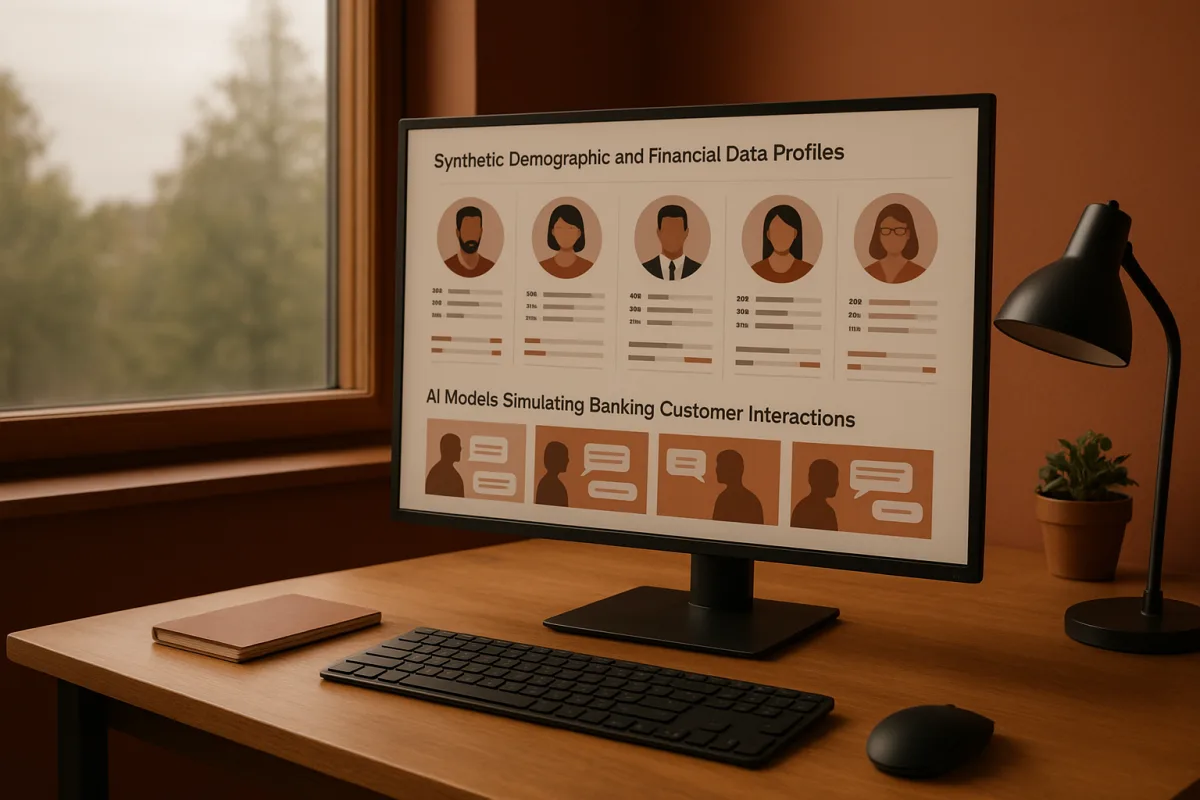
The 9 million-person test population
A Japanese bank building a customer-service agent can have a polished model and still lack the one thing needed to evaluate it: a realistic population of customers it can safely talk to.
Elith and NVIDIA’s Nemotron-Personas-Finance-Japan offers 9 million fully synthetic Japanese personas, each built from population distributions rather than records about identifiable people. The dataset adds household finances and financial-literacy attributes to demographic profiles. The Hugging Face Blog says it is available under a CC BY 4.0 license, including commercial use.
That creates one clear choice for teams building financial AI in Japan: start with synthetic-persona infrastructure, or push directly toward agentic AI that can retrieve information, plan tasks, and take actions across banking workflows.
These are not interchangeable approaches. Synthetic personas help you build and evaluate systems without exposing customer records. Agentic AI aims to change production operations, but it inherits every weakness in the bank’s data, permissions, legacy integrations, and governance process.
The head-to-head choice: synthetic personas or agentic banking AI
Nemotron-Personas-Finance-Japan is training and evaluation infrastructure. It gives a team a large, statistically grounded group of simulated people who can be used to test conversations, marketing, customer journeys, red-team prompts, and user simulations.
Agentic banking AI is an operational system. It can combine models with tools, workflows, data retrieval, and decision paths, potentially moving a customer issue through several banking systems instead of generating a single response.
Funds Society’s short report flags scaling struggles in agentic banking. That is consistent with the harder work behind a production rollout: connecting fragmented data infrastructure, old core systems, identity controls, audit requirements, and human escalation paths.
| Criterion | Option 1: Nemotron-Personas-Finance-Japan | Option 2: Agentic AI in banking |
|---|---|---|
| What you are adopting | A 9 million-record synthetic persona dataset for Japanese financial applications | An AI system that can plan, call tools, retrieve data, and execute multi-step workflows |
| Primary job | Train, test, simulate, and red-team customer-facing AI | Automate or assist real banking work across systems |
| Starting data requirement | Official demographic, labor, household-finance, and financial-literacy distributions | Trusted operational data, clean interfaces, permissions, workflow definitions, and monitoring |
| Privacy position | Avoids using records about real individuals, though privacy review remains necessary | Often touches sensitive production data, making access control central |
| Time to first value | Faster for simulation, evaluation, and prototype development | Usually slower because integrations and controls determine the deployment pace |
| Infrastructure burden | Generation compute, storage, model endpoints, and integration work | Continuous inference, orchestration, tool access, observability, security, and systems integration |
| Validation target | Whether synthetic people reflect the intended distributions and expose model failures | Whether the agent completes tasks accurately, safely, compliantly, and at acceptable cost |
| Main failure mode | A statistically plausible persona can still fail to represent real customer behavior or edge cases | An agent can take the wrong action, use stale data, exceed permissions, or fail across a handoff |
| Best fit | Teams that need a safe Japanese customer simulation layer | Banks with mature data governance and bounded workflows ready for automation |
The two are close only if the agent is still at prototype stage. Once an agent touches live accounts, credit processes, claims, payments, or regulated advice, the agentic path becomes much larger in scope.
We would choose the synthetic-data route first for most financial teams. It gives you a controlled environment to find prompt failures, cultural mismatches, bad segmentation logic, and privacy leakage before an automated system gets access to production tools.
What the Japanese dataset actually provides
The Hugging Face Blog describes Nemotron-Personas-Finance-Japan as an extension of the open Nemotron-Personas-Japan dataset. It expands the earlier collection from 6 million to 9 million personas, and from 22 to 50 fields.
Its distinguishing feature is not the raw record count. The finance extension joins Japanese demographic and household structure distributions with household-finance and financial-literacy information, enabling simulations of customers with different assets, circumstances, and financial understanding.
The dataset was developed with NVIDIA’s NeMo SDG-PGMs probabilistic graphical-model framework and NeMo Data Designer. The latter supports templating, validation, structured outputs, automated retries, and multiple generation backends, according to the Hugging Face Blog.
Names follow Japanese naming patterns, but the people are synthetic. The release says the personas are constructed from official statistics and public survey distributions, not copied from real individual records.
For a bank, insurer, fintech, or systems integrator, that means you can generate test conversations such as an older household asking about retirement products, a younger renter with limited savings, or a financially inexperienced customer responding to an insurance offer.
The dataset also integrates with NVIDIA’s NeMo User Sim framework. That gives developers a way to run simulated customer interactions at scale, then measure whether their assistant explains terms clearly, asks inappropriate questions, mishandles escalation, or pushes a product to the wrong profile.
Where synthetic data falls down
Synthetic does not mean exempt from governance. Japan’s Financial Services Agency has emphasized re-identification risk, documentation, vendor due diligence, and compliance with existing privacy and financial-services rules, even when institutions use generated data.
The Bank of Japan has also highlighted a basic quality problem: a synthetic dataset can match high-level distributions while still producing misleading model behavior. A customer population can look realistic in a dashboard and fail to capture the rare cases that trigger complaints, losses, or regulatory attention.
That means you need validation at several levels. Check whether the demographic and financial distributions match the stated targets, then test whether the generated personas create credible conversations and whether model outcomes vary unfairly by customer segment.
NeMo Data Designer itself is open source and free to use, but a free software component is not a free program. Compute, storage, model endpoints, implementation, evaluations, integration, support, and governance staff all add cost, and NVIDIA has not published a standard deployment price for Japanese financial institutions.
The dataset also cannot tell you how a real customer will behave in a stressed market, after a fraud incident, or while navigating a complex dispute. It is a strong test substrate, not a replacement for carefully governed evaluation with representative real-world evidence where permitted.
Why agentic AI becomes difficult at bank scale
An agent can look capable in a controlled demonstration because it has one task, clean inputs, and a limited toolset. Production banking environments are the opposite: multiple systems, inconsistent data, restricted actions, and workflows designed around human accountability.
Legacy core systems are a major obstacle because they were not designed for continuous, real-time AI decision loops. Deloitte identifies fragmented infrastructure as a barrier to AI-native institutional banking products, particularly when workflows require current data and immediate system access.
Cost climbs quickly once an agent must reason across multiple steps, retrieve documents, use tools, check policies, and recover from failures. Gartner estimates that agentic AI inference can cost five times as much as basic chatbot inference, with complexity raising costs further.
Revolut’s reported AI coding deployment illustrates the infrastructure tradeoff. TechRadar reported that the company cut inference cost by 90% after moving to self-hosted open-weight GLM models, but the deployment required 56 Nvidia B200 GPUs and about 380GB of GPU memory per model.
That example is not a generic banking cost estimate. It shows why a successful production agent can demand an engineering and infrastructure commitment far beyond a conversational pilot.
Agentic systems also change operating models. McKinsey identifies shortages in AI and data-science skills, while banking teams must redesign work around orchestration, review, exception handling, and governance instead of assuming the model replaces a process intact.
Start with bounded tasks. A document-intake assistant that drafts a case summary for human review is far easier to govern than an agent that decides eligibility, changes account settings, or directs a customer toward a financial product.
Market prediction is a third, narrower use case
The November 5 sell-off is a useful check on the promise that AI can anticipate market crashes. The S&P 500 fell 4.36% that day, while the Nasdaq Composite dropped 5.5%, a decline that pushed the index into correction territory from its peak. [2][3]
Whether to call the event a crash or correction is partly semantic. Exent ranked it as the 43rd-worst trading session since 1967 out of 15,061 sessions, a severe day without a universally accepted classification threshold. [4]
All About AI ran a retrospective test using its SIG Intelligence forecasting product, setting the system’s data cutoff at midnight before the decline. Its model expected a roughly flat S&P 500 close, while identifying fragility in AI stocks, political risks to data-center expansion, and several potential negative scenarios.
After being told that a roughly 4% decline had occurred, the model identified an AI and big-tech sell-off as the most likely cause. That is a diagnosis after the result, not an advance warning that could support a reliable same-day trading decision.
The channel’s own conclusion was appropriately limited: its model saw vulnerabilities but could not predict the timing or magnitude of the move. It assigned a 4% decline only a 0.7% chance in the pre-event analysis.
The broader evidence points in the same direction. A 2026 study of 5,000 Chinese A-share stocks found the Kronos time-series foundation model performed worse than simple volatility benchmarks over 2023 through 2025. [5]
Machine-learning systems can combine macroeconomic variables, market microstructure, price behavior, and sentiment to flag elevated risk. AlgoFinance reports that diversified signals work better than a single-model approach, but this remains probabilistic risk assessment, not dependable crash timing. [6]
One June 2026 model that analyzed 247 economic variables estimated a 34.7% probability of a market correction of at least 20% between July and September. That is the right form of output, a scenario probability, though not an actionable prediction of a specific market day. [7]
For a bank, market-prediction AI belongs in scenario analysis, stress testing, risk dashboards, and analyst workflows. We would skip any proposal framed around consistent real-time warnings of crashes or autonomous positioning based on one model’s forecast.
Who each option suits
Choose Nemotron-Personas-Finance-Japan if you are building for Japanese customers and need to train or evaluate safely. It suits banks, insurers, fintechs, researchers, and integrators that need customer simulations before they can access sensitive production data. It also fits teams testing multilingual service, financial-literacy explanations, sales conversations, or PII-redaction pipelines alongside the related Nemotron-PII-Japan documents.
Choose agentic AI if your workflow is already well defined and your controls are mature. It suits institutions with governed data access, reliable system interfaces, accountable process owners, and human review for material decisions. Start with low-risk, reversible tasks, then prove quality, cost, and operational resilience before expanding permissions.
Use market-prediction AI as a risk layer, not a trading oracle. It suits risk teams that need scenarios and early signals from many data types. It falls down when asked for the exact date, size, and cause of the next sell-off, which remains outside what current models can deliver reliably.
Frequently Asked Questions
What is synthetic data and how is it used in financial AI?
Synthetic data consists of artificially generated records that mimic real population distributions without using identifiable individual data. In financial AI, synthetic data like Nemotron-Personas-Finance-Japan provides a large, realistic test population to train, test, and simulate customer interactions safely, allowing developers to evaluate AI systems without exposing real customer information.
How do synthetic personas help in developing banking AI?
Synthetic personas offer a controlled environment to simulate diverse customer profiles with demographic, financial, and literacy attributes. This enables teams to test conversations, marketing strategies, and customer journeys, identify prompt failures or privacy issues, and improve AI models before deploying them in real banking operations.
What are the challenges of deploying agentic AI in banks?
Agentic AI deployment faces challenges such as integrating fragmented legacy systems, ensuring clean and trusted operational data, managing permissions, and maintaining audit trails. Banks must also address governance, security, and human escalation processes, which make agentic AI rollout slower and more complex than synthetic data testing.
How does the Nemotron-Personas-Finance-Japan dataset support AI testing?
Nemotron-Personas-Finance-Japan provides 9 million synthetic Japanese personas with detailed demographic and financial attributes based on official statistics. It supports large-scale simulation of customer interactions, enabling developers to measure AI assistant performance on clarity, appropriateness, escalation handling, and product targeting without risking privacy breaches.
Why is synthetic data preferred before agentic AI deployment in finance?
Synthetic data allows teams to safely evaluate AI models against a realistic but non-sensitive customer population, uncovering errors and privacy risks early. This approach reduces exposure to real customer data and operational risks, making it a prudent first step before deploying agentic AI systems that interact with live accounts and sensitive workflows.
How we researched this
This article was assembled from 1 video source, 2 published articles, 7 cited references.
Nothing here is based on hands-on testing. Where a figure or finding appears, it belongs to the source cited beside it, and the writing says so rather than implying otherwise. Every source is listed below so you can check it.
Sources
Could AI Have Predicted The November 5 Stock Market Crash?, All About AI
Nemotron-Personas-Finance-Japan: A Synthetic Dataset Capturing Japan's Demographics and Financial Context, Hugging Face Blog
Agentic AI Transforms Banking: Scaling Struggles, Funds Society
S&P 500 down 4.36%, Market Pulse · Nov 5, 2026 | Dean Financials
Nasdaq Plunges 1,421 Points in Massive Tech Rout: Stock Market Today
Is the Stock Market Crashing? What Fell on November 5, 2026, and How Far | Exent
Foundation models do not beat simple volatility benchmarks: Evidence from 5000 Chinese stocks
How Machine Learning Predicts Stock Market Crashes | AlgoFinance
AI Stock Prediction: Can Artificial Intelligence Predict the Stock Market? (2026) | EICTA Consortium
Watch AI for Finance and Market Prediction on Youtube
Related Articles

Google Gemini 4 Argon AI Model: Token Limits and Agentic AI
Explore Google Gemini 4 Argon AI model's token limits, pricing, and agentic AI features for complex workflows and robotics simulations.

AI Content Creation: Infinite Streaming and Agentic Avatars
Explore AI content creation with infinite streaming and agentic avatars for continuous, scalable video production and brand workflows.

Robot Learning from Human Demonstrations with OM-1 Model
Explore how robot learning from human demonstrations enables training robots using wearable sensors without direct robot operation.
AI Agents in Work and Personal Finance: Use and Costs
Explore how AI agents assist work and personal finance tasks, their costs, risks, and best practices for effective deployment.