
AI Workforce Transformation and Its Impact on the Job Market
Explore AI workforce transformation, its costs, and job market impact beyond layoffs, including automation and capital allocation challenges.
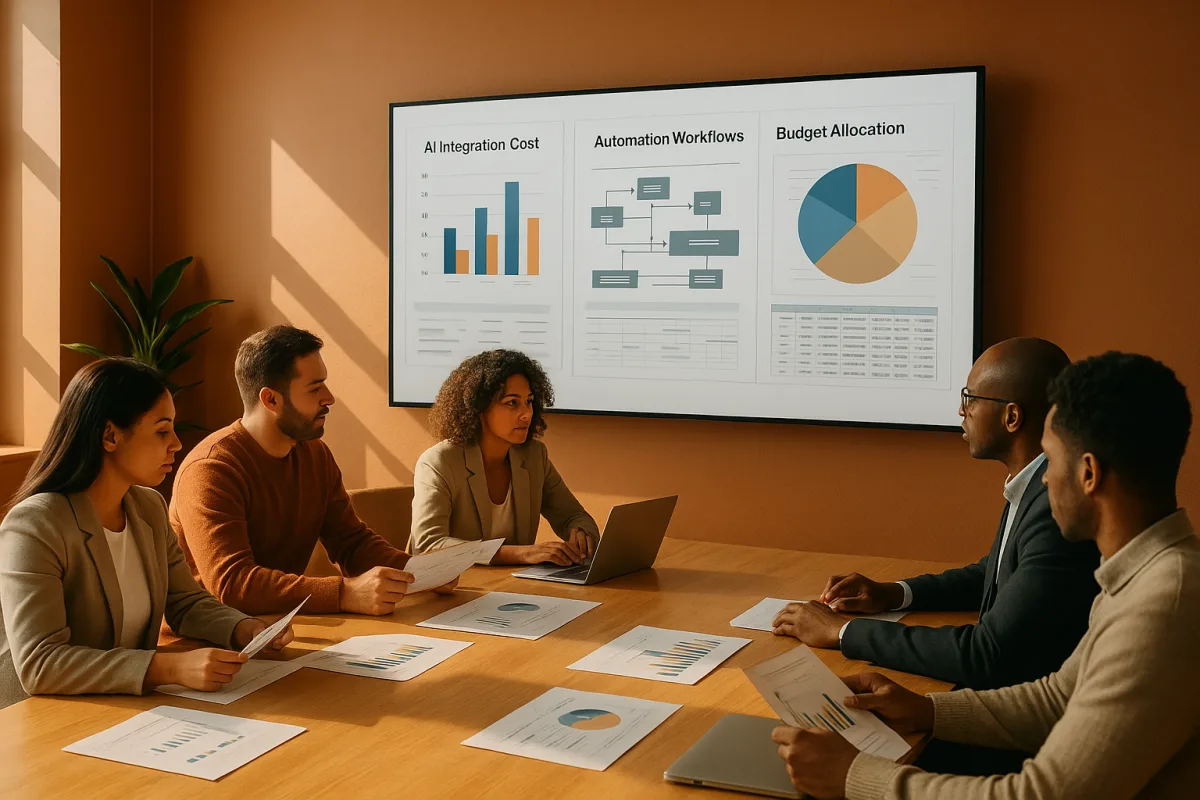
AI Workforce Transformation Is Really a Capital Allocation Problem
The number to understand is not jobs lost, but the cost of replacing work
The recurring story about AI and employment is usually told as a headcount story. A company deploys AI, eliminates roles, then invests the savings in new products. That sequence is plausible, but it skips the machinery between “software purchased” and “work replaced.”
A more useful concept is the automation substitution loop. It describes the attempt to replace a recurring unit of human work with an AI-assisted process, then capture enough savings or revenue to justify the cost of doing so.
This matters because workforce change is increasingly tied to infrastructure spending. In a Krish Naik video on Microsoft’s reported buyout programme, the machine-learning educator frames the contest as one over GPUs, data centres, networking, energy and inference costs, rather than simply model quality.
That framing is directionally right, although it should not be read as evidence that a particular layoff directly paid for a particular cluster of GPUs. Corporate budgets are not that tidy. Still, labour and infrastructure now compete for capital inside the same planning process.
Microsoft’s October 2026 voluntary buyout offer makes the distinction especially clear. The company offered buyouts to about 60,000 employees, reportedly covering vice-president level and below in the US, Canada, India and the UK. [1]
That figure represents roughly 27 percent of Microsoft’s global workforce, an unusually large offer. Yet it does not establish that 60,000 jobs were cut, or even that 60,000 workers will leave. The number of acceptances has not been disclosed. [1]
The difference is not pedantic. A voluntary buyout is a financial instrument for reducing headcount and reshaping staffing. An accepted buyout is an actual departure. An eliminated role is a further decision, and automation of its former tasks is another decision again.
How the automation substitution loop works
The first step is to identify a workflow with repetitive, measurable outputs. Customer-support triage, invoice matching, document summarisation, software test generation and internal knowledge search are common candidates because firms can count volume, turnaround time and error rates.
The second step is decomposition. Most jobs are bundles of tasks, including data retrieval, judgment, communication, exception handling and accountability. A generative model may make the first two faster while leaving the difficult, high-consequence parts with a human employee.
This is why “AI replaces a job” is often an imprecise description. The immediate change is usually redistribution: a smaller team reviews more cases, a support agent handles escalations rather than routine queries, or an analyst checks AI-produced drafts rather than creating every first version.
The third step is system integration. A model needs access to documents, databases or applications, plus identity controls, permissions, logging and a user interface. A chatbot without reliable access to the relevant systems usually becomes a polished search box with unreliable answers.
Then comes evaluation. A business needs to know whether the system is accurate enough for its purpose, whether performance drifts, and whether its mistakes are detectable before reaching customers or regulators. Benchmark scores rarely answer those operational questions on their own.
For a coding assistant, a benchmark might measure whether generated code passes tests. It may omit whether engineers can understand the patch, whether the model introduces a security flaw, how often it sends developers down an unproductive path, or who reviews its output.
For a hiring or credit workflow, the gap is larger. A model can appear efficient by processing applications quickly while creating legal, fairness or reputational risks that only emerge after deployment. This is where governance stops being a compliance add-on and becomes part of the system cost.
Finally, the company decides whether it can reduce hiring, redeploy staff, eliminate roles, or expand output with the same workforce. Those are materially different outcomes. A system that lets a team serve twice as many customers may create jobs even if it reduces labour per transaction.
Why cutting staff does not necessarily pay for AI
The attraction of the substitution loop is obvious. Labour is a recurring expense, while executives can present AI investment as a route to lower operating costs and new products. The catch is that AI deployment has recurring costs too.
Model inference costs money every time a user submits a request. Training and fine-tuning can cost more. Companies also pay for cloud capacity, data preparation, monitoring, software licenses, cybersecurity, legal review, vendor management and employees who maintain the redesigned process.
The infrastructure bill is real at industry scale. Major technology companies are collectively planning roughly $735 billion in 2026 capital expenditure, a reported 77 percent increase from 2025, led by spending from Amazon, Alphabet, Microsoft and Meta. [5]
Those figures cover much more than any one workforce programme, and capital expenditure should not be confused with direct spending on generative AI. But they explain why firms are scrutinising costs elsewhere, including hiring plans, support functions and internal operations.
Oracle’s reported reduction of about 21,000 jobs during the year ending May 2026 illustrates the pressure. The company reported $1.84 billion in severance costs, while reporting linked the reductions to AI adoption and expensive infrastructure ambitions. [8]
Severance is a useful reminder that workforce reduction is not free. A firm pays to remove expertise, then may need to hire contractors, specialists, data engineers, security staff or product managers to make an AI system usable and compliant.
The reported outcomes are mixed. Axios cited findings that 31 percent of organisations spent more on rehiring than automation saved, while 42 percent broke even. [3] That does not prove AI projects fail, but it does challenge the assumption that headcount reduction is immediate return on investment.
Gartner makes the same point more directly: reducing the workforce can create budget room, but does not itself create a sustainable return. [10] Savings become returns only if the remaining organisation can deliver equivalent or better service, safely and repeatedly.
What the job numbers do and do not measure
The headline figures are substantial. Reporting cited nearly 200,000 technology-sector layoffs in 2026, including reductions at large companies pursuing AI programmes. [7] That is evidence of disruption, but it is not a clean measure of jobs “destroyed by AI.”
Companies cut staff for overlapping reasons: slowing growth, duplicated teams after acquisitions, changes in product strategy, shareholder pressure, broader macroeconomic conditions and investment shifts. “AI cited as a factor” does not mean a model performed the laid-off employee’s former work.
Barclays offers a more legible example of reallocation. The bank plans to cut about 5,000 jobs, around 5 percent of its workforce, with 60 percent of the reduction reportedly concentrated in support functions as it redirects spending toward AI. [2]
Support functions are attractive targets because they often contain standardised processes. But standardisation is not the same as full automation. Payroll, compliance operations, procurement and internal service desks still require exception handling, policy interpretation and accountable human sign-off.
Retailers and public institutions face the same tension. Kroger has reportedly planned 3,000 corporate job cuts over three years to fund AI initiatives, while nonprofit and state-level programmes are being developed to help communities prepare for displacement. [9]
The evidence is much weaker on what happens next to affected workers. There is no robust, comprehensive dataset showing the long-term career trajectories, earnings or retraining outcomes of employees displaced from technology roles in this cycle. [3]
That gap should temper both triumphalism and catastrophe claims. We can document job reductions, investment and worker anxiety. We cannot yet responsibly claim that the current wave has permanently eliminated a known number of careers, or that retraining programmes have reliably repaired the damage.
Regulation changes the economics of deployment
Workforce automation is also regulated differently depending on where it is deployed. The European Union’s AI Act became fully applicable on August 2, 2026, creating broad obligations that include transparency requirements and substantial penalties for non-compliance. [6]
The potential fines are significant, up to €15 million or 3 percent of global annual turnover for certain violations. [6] For an employer, that means governance costs are part of the business case before an AI system reaches workers or customers.
The picture is more nuanced for high-risk systems. The EU’s Digital Omnibus amendment delayed some obligations, with standalone high-risk systems scheduled for December 2, 2027 and embedded systems for August 2, 2028. [6]
That delay is not a regulatory exemption from good practice. It gives employers time to establish data governance, impact assessment, monitoring and human oversight before the stricter obligations arrive. The firms that wait may discover that retrofitting these controls is expensive.
The US has no comparable comprehensive federal AI statute as of late 2026. Instead, employers face a patchwork of state laws, privacy rules, discrimination law, sector regulation and contractual obligations, with rules including Colorado’s AI Act and California provisions taking effect in 2027. [6]
Fragmentation can lower the immediate barrier to experimentation, but it raises coordination costs for national employers. A company may need different policies, notices and review procedures across jurisdictions, particularly where AI affects employment, eligibility, performance assessment or consumer decisions.
Adaptation is a systems problem, not a training-course problem
Retraining is often proposed as the answer, but a course alone cannot fix a workflow designed around unrealistic assumptions. Workers need time to learn tools, clear authority to challenge bad outputs, and processes that specify when human review is mandatory.
The World Economic Forum describes workforce transformation through five connected elements: vision, skills, technology, process and culture. [9] That is more useful than treating AI skills as an isolated training budget, because poor process design can neutralise competent employees and capable tools alike.
Supply-chain organisations offer a warning. Although 91 percent plan AI augmentation, 83 percent report that their workforce is unprepared. [11] The benchmark measures preparedness as reported by organisations, not whether each planned deployment will fail, but the implementation gap is notable.
For managers, the practical metric is not “how many roles can AI replace?” It is: which tasks can be augmented without unacceptable quality loss, who owns failures, what new work is created, and whether the full system costs less than the work it replaces.
For workers, the durable strategy is less glamorous than chasing every new model release. Learn how AI tools interact with the data, constraints and failure modes of a specific profession. Domain knowledge is what lets someone verify output, escalate exceptions and redesign a process responsibly.
The current transformation is therefore neither a simple productivity windfall nor a single automated apocalypse. It is a contest between expensive infrastructure, imperfect software, organisational redesign, regulation and human expertise. The outcome depends on whether firms can make that whole system work, not merely whether they can reduce a payroll line.
Frequently Asked Questions
How does AI workforce transformation affect job roles?
AI workforce transformation often redistributes tasks rather than fully replacing jobs. AI can automate routine, repetitive tasks like data retrieval or document summarization, allowing human workers to focus on higher-consequence activities such as judgment and exception handling. This typically results in smaller teams managing larger workloads with AI assistance, rather than outright job elimination.
What is the automation substitution loop in AI adoption?
The automation substitution loop describes the process of replacing recurring units of human work with AI-assisted workflows. It involves identifying repetitive tasks, decomposing jobs into components, integrating AI systems with existing infrastructure, evaluating performance and risks, and deciding on workforce changes such as reducing hiring or redeploying staff. The loop highlights that AI adoption is a complex cycle, not a one-time substitution.
Why don't AI layoffs always lead to cost savings?
AI-related layoffs do not automatically generate cost savings because AI deployment incurs significant recurring expenses. These include costs for model inference, training, cloud infrastructure, data preparation, monitoring, software licenses, cybersecurity, and governance. As a result, the financial benefits of workforce reductions can be offset by the ongoing costs of maintaining AI systems.
How do companies balance AI infrastructure costs with workforce changes?
Companies must allocate capital between labor and AI infrastructure within the same planning process. While layoffs may free budget space, infrastructure investments in GPUs, data centers, networking, and energy are substantial and ongoing. Effective balancing requires understanding that workforce reductions and AI spending compete for resources rather than one simply funding the other.
What metrics should companies use to measure AI workforce impact?
A credible workforce plan should measure more than just jobs eliminated or software licenses purchased. Key metrics include the amount of work redesigned, service quality, error rates, and rehiring costs. These operational indicators provide a clearer picture of AI’s impact on productivity and costs than simple headcount changes.
How we researched this
This article was assembled from 1 video source, 3 published articles, 11 cited references.
Nothing here is based on hands-on testing. Where a figure or finding appears, it belongs to the source cited beside it, and the writing says so rather than implying otherwise. Every source is listed below so you can check it.
Sources
Microsoft Offer Buyouts to 60k Employees- AI Race continues — Krish Naik
Artificial intelligence transforms the workforce, regulations — KTTC
Artificial intelligence transforms the workforce, regulations — Gray TV
Microsoft to Trim Workforce With Buyout Offers for 60,000 Staff - Bloomberg
Barclays is latest to redirect spending toward AI as it trims its workforce
Former Commerce Secretary warns of AI disruption to job market
Microsoft offers buyouts to nearly 30% of workforce in ongoing AI shift | Fortune
60,000 Microsoft employees offered voluntary buyouts as AI buildout costs bite
Tech Layoffs 2026: 196,000 Workers Affected as Amazon, Meta, and Microsoft Cut Jobs
21,000 jobs gone in a year: Oracle becomes the latest tech giant to cut workers due to AI adoption
The AI-driven workforce is here. How should your industry transform? | World Economic Forum
Supply Chain AI: 83% Say Workforce Isn’t Ready | ASCM & DSCI
Watch AI Workforce Transformation and Job Market Impact on Youtube
Related Articles

AI Agent Workflows for Reliable Decision Automation
Explore AI agent workflows that enable auditable, human-approved automation for reliable decision-making and coding practices.

AI Automation in Finance Workflows
Explore AI automation in finance workflows with GPT-6 Astra and Claude Fable, focusing on best practices, risks, and human oversight.
AI in Autonomous Vulnerability Management
Explore how AI advances autonomous vulnerability management by automating detection, validation, and patching in cybersecurity workflows.
AI Market Dynamics: Nvidia, Bill Gates, and Investment
Explore AI market dynamics covering Nvidia's pricing, Bill Gates' AI policy, and current investment trends shaping the AI industry.