
AI Video Generation Models Comparison
Compare AI video generation models Kling 4.0 and Seedance 2.5 for scene control, realism, costs, and workflow insights.
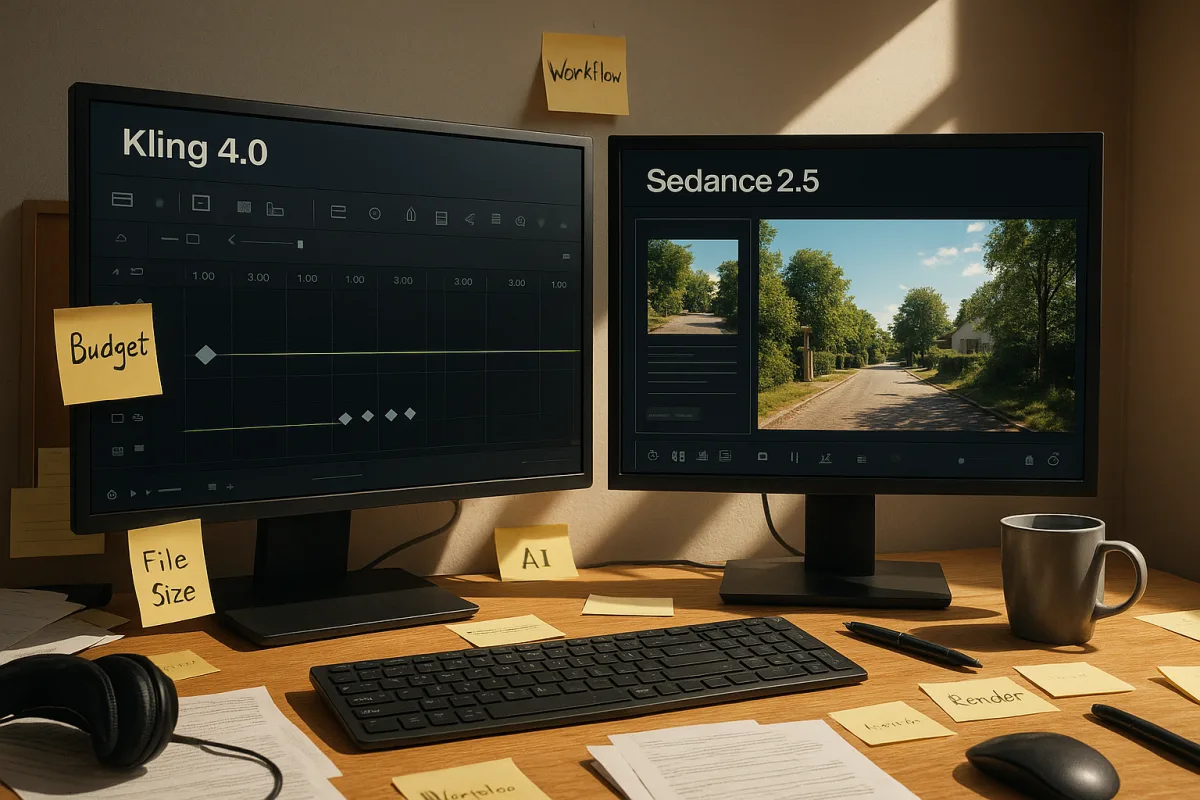
The decision: Kling 4.0 or Seedance 2.5?
For a creator choosing between two video models, the decision here is Kling 4.0 versus Seedance 2.5. Kling 4.0 is the better fit for directed scenes that need supplied visual beats. Seedance 2.5 is the better fit for prioritising photographic plausibility.
That is a narrower decision than a general “best AI video model” contest. Neither model removes the need for shot selection, rerolls, sound review, rights checks, and editing. The useful question is what kind of failure you can tolerate.
AI News compared both models using the same destructive-action prompt, a ten-second duration, 16:9 framing, and 1080p where supported. The channel judged prompt accuracy, motion, consistency, audio, and overall look from first-generation outputs.
That setup is more informative than a collection of hand-picked demonstrations, but it is still a single prompt with subjective scoring. It stresses fast motion, destruction, synchronised sound, and multiple causal events, not dialogue scenes, product shots, animation, or documentary reconstruction.
Head-to-head comparison
| Criterion | Kling 4.0 on Higgsfield | Seedance 2.5 on Higgsfield |
|---|---|---|
| Primary strength | Scene direction with supplied frames, longer generated clips, and comparatively strong object continuity | Visual realism in the AI News same-prompt comparison |
| Prompt accuracy | Respectable, but its strongest result in the comparison was consistency rather than completing every event exactly | Not identified as the prompt-accuracy leader in the AI News comparison |
| Motion | Can handle staged movement, but complex action may introduce cuts, direction changes, or unexpected camera motion | Looked more convincing than Kling 4.0 overall in the comparison, though that does not establish broad motion leadership |
| Character and object consistency | The strongest of the two for continuity according to AI News’s scoring | Less clearly distinguished for consistency in the published comparison |
| Scene control | Supports up to ten keyframes and can use references to establish required moments | The supplied source does not demonstrate comparable keyframe-led scene direction |
| Clip duration | Up to 30 seconds in the AI News Kling 4.0 walkthrough | Tested at 10 seconds in the AI News comparison; no longer-duration claim is established by the supplied material |
| Audio | Audio can be generated with the scene, but spoken words and timing still need checking | The comparison presents it as visually strong, not as the audio leader |
| Price information | Higgsfield plans start at $19 monthly for 270 credits; a 30-second Kling 4.0 generation costs 150 credits at 720p or 225 credits at 1080p, subject to change | No price was supplied in the provided research, so buyers should verify current access and credit terms before choosing |
| Best suited to | Previsualisation, music-video fragments, ads, and narrative beats where the creator can supply frames and reroll selectively | Short clips where the immediate visual impression matters more than tightly specified intermediate beats |
| Main weakness | A “continuous take” request does not guarantee a continuous take, and rerolls can rapidly consume credits | Strong visual output from one benchmark does not demonstrate controllability, reliable continuity, or predictable costs |
The table’s outcome is deliberately not a broad victory for either system. Kling 4.0 wins the control-oriented case. Seedance 2.5 wins the realism-oriented case, on the limited evidence available from AI News’s prompt-matched exercise.
What Kling 4.0 actually adds
The useful Kling 4.0 feature is not simply that it generates video. AI News’s walkthrough on Higgsfield shows a more directed workflow: provide keyframes for critical events, then use a prompt to define the camera path and action connecting them.
In the channel’s example, three frames establish a futuristic medical procedure, a robot dragging a character into a room, and a terminal with a decision interface. The prompt asks Kling 4.0 to move through those states as one continuous shot.
That is closer to constrained interpolation than to traditional film direction. The creator specifies endpoints and important waypoints, while the model invents the movement, framing, object interactions, speech performance, and transitions between them.
Kling 4.0 can accept up to ten keyframes, according to AI News. In practice, fewer better-defined frames may be more valuable than filling all ten slots, because every additional required event gives the model another way to drift from the intended sequence.
The 30-second clip limit matters because it can contain a whole dramatic beat without manually stitching together short fragments. But duration is not equivalent to reliable coherence. A 30-second output may still contain cuts, re-framing, or altered character positions.
The independent research brief flags the central limitation plainly: prompts for a single continuous take can still yield unintended edits, erratic camera changes, and characters or objects changing direction between implied shots. Complex sequences can require four or five rerolls per usable cut.
That cost changes the apparent value proposition. Higgsfield’s Starter subscription is $19 a month for 270 credits, while a 30-second Kling 4.0 generation costs 225 credits at 1080p. One full-resolution attempt can therefore consume nearly the whole entry plan.
The same plan permits one 1080p 30-second generation with 45 credits left, assuming the stated rates remain current. Credits expire monthly and do not roll over, so a subscription is not a bank of permanent production capacity.
A more sensible workflow is to block composition at shorter durations and 720p, then reserve 1080p, 30-second runs for a scene that already has a credible prompt and reference setup. That does not remove failure risk, but it contains credit waste.
Why Seedance 2.5 remains a close alternative
In AI News’s nine-model comparison, Seedance 2.5 received the highest realism score, nine out of ten. Kling 4.0 received six for realism but was named the consistency winner under the channel’s criteria.
That result should not be turned into an unsupported claim that Seedance 2.5 is generally “better.” The model was judged from one first attempt on a deliberately chaotic prompt involving a speeding car, collapsing building, helicopter crash, gas-station explosion, and sinkhole.
A model can make a dramatic destruction scene look convincing while still failing on product identity, wardrobe persistence, dialogue timing, or camera blocking. Conversely, a model that looks less photographic can be more useful when a client needs specific assets to survive a sequence.
There is also a rights question that should not be treated as an afterthought. The Associated Press reported that Hollywood organisations criticised ByteDance’s Seedance video generator over alleged copyright infringement concerns. [1] Allegations are not findings of liability, but they are relevant to commercial risk assessment.
The broader issue is not confined to any one vendor. Researchers behind a copyright-leakage detection method reported 99.6 percent accuracy on a 50-concept test set, illustrating that memorisation-style output detection is becoming a concrete technical concern rather than a purely legal abstraction. [2]
For commercial work, retain prompts, references, intermediate edits, source licences, and records of human creative choices. The U.S. Copyright Office’s position remains that AI output without human authorship is not itself copyrightable, while human selection, arrangement, editing, and compositing may be protectable. [4][5]
The wider video field, without pretending it is one ranking
AI News also included Seedance 2.0, MiniMax H3, WAN 3.0, Grok Imagine 1.5, Flux 3, Gemini Omni Flash 1.1, and Kling 3.0. Their comparison provides useful category signals, but not enough information for a purchasing ranking.
Seedance 2.0 was the channel’s prompt-accuracy winner and scored eight for realism. It suits users whose first concern is event order. No price was supplied in the provided material, so its real cost cannot be compared responsibly here.
MiniMax H3 was one of the stronger audio outputs in the AI News test and scored seven for realism. It suits audio-forward experiments, but its available setup used automatic format and 2K rather than the matched 1080p setting.
WAN 3.0 was identified as particularly strong for motion and destruction, with an eight realism score. It suits kinetic action concepts, although the tested interface did not offer an explicit format setting. No price information was supplied.
Grok Imagine 1.5 was described as strongest on audio but inconsistent elsewhere, receiving five for realism. It may suit rough concepts where generated sound matters, not polished scenes requiring stable objects, strict sequencing, or a credible photographic finish.
Flux 3 earned an 8.5 realism score in AI News’s test, with strong audio and photorealistic environments. It suits short atmosphere-led scenes, but the source does not establish whether it offers Kling-like keyframe control or what it costs.
Gemini Omni Flash 1.1 showed strong sound and motion but weaker prompt accuracy and photorealism, receiving six for realism. It suits fast exploratory generation where movement or sound is more important than exact visual fidelity. Pricing was not supplied.
Kling 3.0 received a nine for realism and was described as realistic and consistent. It suits creators who prefer its output character, but AI News states its clip limit is 15 seconds, half Kling 4.0’s claimed 30-second maximum.
Those price gaps are important. A price field that says “not supplied” is more honest than inventing a comparison from different subscription bundles, regional billing, promotional credits, or unofficial reseller listings.
Multimodal production needs transcription too
Generated video increasingly arrives in workflows that also contain interviews, voice-over, source footage, and multilingual reviews. NVIDIA Nemotron 3.5 Transcribe, announced on the Hugging Face Blog, addresses that adjacent but consequential problem.
Nemotron 3.5 Transcribe is an open-weight, promptable speech model for recorded audio. It combines transcription, English translation, speaker attribution, timestamps, and audio question answering in one checkpoint, rather than requiring a separate diarisation pipeline for every job.
NVIDIA says it transcribes 40 languages, translates 31 to or from English, and attributes speakers in 13 languages. It supports recordings up to one hour and up to eight speakers, which makes it relevant to meetings, interviews, classes, and multilingual productions.
The important word is “recorded.” NVIDIA explicitly positions the model for recorded audio rather than live streaming. Reports of 80-millisecond streaming latency concern a smallest-chunk configuration, not an established end-to-end live-captioning guarantee.
Its benchmark claims are notable but should be read precisely. NVIDIA reports 5.33 percent average word error rate on the English Hugging Face Open ASR Leaderboard among open-weight models, where lower word error rate means fewer word-level transcription mistakes.
The Hugging Face Blog also reports a 18.26 percent diarisation error rate across 21 languages on David AI’s diarisation benchmark. That measures mistakes in speaker-time attribution, not merely whether individual words were recognised correctly.
Those numbers do not establish performance in noisy restaurants, poor phone calls, distant microphones, or highly compressed social-video audio. The research brief specifically notes the absence of detailed noise-robustness results, so names, speaker changes, and technical terms still need human review.
For specialised vocabulary, the model’s promptability is more useful than generic transcription claims. NVIDIA’s medical case study reports that fine-tuning reduced held-out speaker word error rate from 22.44 percent to 12.17 percent, a 45.8 percent relative reduction over the best-prompt baseline.
That is a domain-adaptation result, not a promise that every organisation should fine-tune. It involved curated medical material, synthetic speech, public datasets, explicit transcript conventions, and approximately 14 GPU-hours on an NVIDIA GB300.
Hardware is another dividing line. NVIDIA says quantised variants will support local execution on systems such as Jetson AGX Thor and DGX Spark, while its throughput figure, 100 hours of audio in under three minutes, used an RTX PRO 6000 Blackwell at high concurrency.
No minimum internet-speed requirement is established in the supplied research. A fast connection may help when downloading weights, moving recordings, or serving concurrent remote jobs, but it would be speculation to assign a required bandwidth number.
Who each option suits
Kling 4.0 on Higgsfield suits directors, agencies, and technical creators who need to specify visual waypoints. Its keyframe workflow is useful for previsualisation and designed sequences where the important moments are known in advance and rerolling is acceptable.
Kling 4.0 does not suit low-budget production schedules built around one-shot success. At the reported 225-credit cost for a 30-second 1080p run, the Starter plan is effectively a single full-length attempt. Continuity problems can make long clips expensive.
Seedance 2.5 suits creators selecting for immediate visual realism in short outputs. AI News’s controlled comparison gave it the strongest realism score, making it a reasonable candidate for atmospheric shots, concept material, and clips judged primarily by visual plausibility.
Seedance 2.5 does not yet have enough supplied evidence for control-heavy work. The available comparison does not demonstrate a keyframe-led directing workflow, reliable multi-event compliance, pricing, or commercial-rights terms. Its reported copyright criticism also warrants due diligence. [1]
NVIDIA Nemotron 3.5 Transcribe suits teams that need multilingual transcripts, speaker labels, translation, timestamps, and controlled deployment. It is especially relevant where video archives need to become searchable, captioned, or reviewable across languages.
NVIDIA Nemotron 3.5 Transcribe does not replace human transcription review in difficult audio. Its reported benchmarks are strong, particularly for open-weight speech tooling, but the evidence supplied does not quantify robustness to real-world noise, and specialised names remain a verification task.
Frequently Asked Questions
What are the differences between Kling 4.0 and Seedance 2.5 AI video models?
Kling 4.0 excels at scene direction with supplied keyframes and longer clips, offering comparatively strong object continuity and control over visual beats. Seedance 2.5 prioritizes visual realism and produces more photographic-looking results but lacks comparable keyframe-led scene direction and continuity. Kling 4.0 supports up to ten keyframes and longer clips (up to 30 seconds), while Seedance 2.5 has been tested mainly with shorter clips (10 seconds).
Which AI video generation model is better for scene direction?
Kling 4.0 is better suited for directed scenes requiring planned visual beats and keyframe control. It allows creators to specify critical frames and uses prompts to interpolate between them, supporting more structured scene blocking. Seedance 2.5 does not demonstrate comparable scene direction capabilities in the available comparisons.
How does AI video generation handle continuity and realism?
Kling 4.0 is stronger in maintaining character and object continuity but can still produce unintended cuts, erratic camera movements, and direction changes that disrupt continuous takes. Seedance 2.5 delivers higher visual realism but is less consistent in continuity and scene control. Both models require rerolls and human editing to manage continuity and realism effectively.
What are the cost considerations for AI video generation with Kling 4.0?
Kling 4.0 on Higgsfield uses a subscription and credit system. The Starter plan costs $19 per month for 270 credits, and generating a 30-second video at 1080p consumes 225 credits, leaving limited credits for additional attempts. Complex scenes often require multiple rerolls, which can quickly increase costs and reduce cost efficiency.
Can AI video generation models produce continuous shots without cuts?
Kling 4.0 aims to create continuous shots using keyframes and prompts, but in practice, continuous single-take videos often contain unintended cuts, camera angle changes, and continuity errors. Multiple rerolls are usually necessary to achieve a usable continuous shot, and perfect continuous takes are not guaranteed.
How we researched this
This article was assembled from 2 video sources, 1 published article, 6 cited references.
Nothing here is based on hands-on testing. Where a figure or finding appears, it belongs to the source cited beside it, and the writing says so rather than implying otherwise. Every source is listed below so you can check it.
Sources
How to Direct a 30-Second AI Video Scene With Kling 4.0 — AI News
Top 9 AI Video Generators Showdown: SAME Prompt (New Kling 4.0 vs Seedance 2.5) — AI News
NVIDIA Nemotron 3.5 Transcribe and Granary v2: Intelligent Multilingual Transcription You Can Prompt and Adapt — Hugging Face Blog
Hollywood groups condemn ByteDance's AI video generator, claiming copyright infringement
Watch AI Video Generation and Multimodal AI Tools on Youtube
Also from the sources
Related Articles

AI-Powered Tools and Interfaces: Innovations and Comparisons
Explore innovations in AI-powered tools and interfaces, comparing features, use cases, and trade-offs for users and developers.
Open Source AI Models for Coding and Image Generation
Explore open source AI models and tools for coding and image generation, including APIs, local deployment, and licensing details.
AI Tools for Marketing Workflow Optimization and Asset
Explore AI tools that optimize marketing workflows by generating ads, managing assets, and creating virtual influencers for efficient campaigns.
Mistral AI Le Chonk vs Reflection AI Beam
Compare Mistral AI Le Chonk and Reflection AI Beam open-weight models, their specs, benchmarks, pricing, and deployment readiness in 2026.