
AI in Consumer Applications
Explore AI in consumer applications, from personalized menus to AI virtual pets and creative tools, including challenges and privacy considerations.
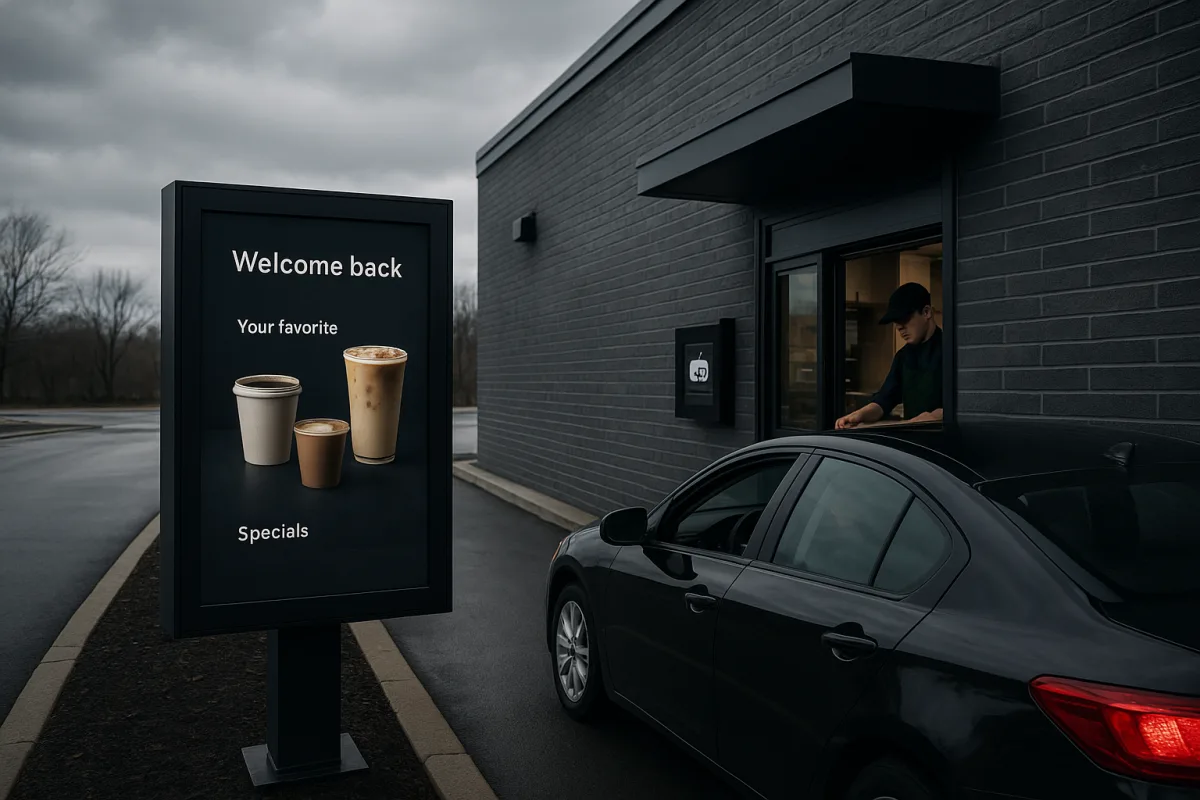
AI Is Moving Into the Small Decisions, From Drive-Thru Screens to Digital Pets
A consumer AI market built around moments
On October 30, 2026, Starbucks said it would explore drive-thru experiences that recognize participating customers on arrival, display personalized digital menus, and make payment easier. It also plans to test background AI models that help baristas enter orders beginning in 2027.
That announcement lands in a consumer AI market that is already broad, though not necessarily deep in every category. Menlo Ventures reported in September that 64 percent of U.S. adults use AI and estimated global consumer AI spending at $40 billion. [1]
The important change is where these systems are appearing. Consumer AI is moving out of the standalone chatbot tab and into the small recurring decisions people make while driving, shopping, playing, and creating.
That does not make every AI feature valuable. A drive-thru menu has to make ordering faster, a companion device has to earn space in a pocket, and a creative tool has to give someone a result they could not easily produce alone.
Personalized menus are becoming a retail interface
Starbucks CEO Brian Niccol described personalized menus as exploratory and said the company would test, learn, and scale what works. That language is appropriate, because Starbucks has published no results showing that personalization improves order speed, basket size, accuracy, or customer satisfaction.
The proposed system has several parts that are often bundled together under “AI.” It needs a way to identify an enrolled customer, access their account history and preferences, select menu items, present them on a screen, and connect the choice to payment and store operations.
Taco Bell is experimenting with digital drive-thru boards that can change layout, content, and visuals on a car-by-car basis. McDonald’s has also shown an ArchIQ pilot that identifies repeat customers and lets them order their usual at a handful of drive-thrus.
These are not identical products. Taco Bell’s reported work emphasizes menu-board adaptation, while McDonald’s pilot centers on repeat-order recognition, and Starbucks is pairing customer recognition with menu and payment ambitions. Still, each company is trying to turn a static sign into an adaptive interface.
For a restaurant operator, the case for this is straightforward. The menu can foreground a customer’s normal drink, account for time of day, direct attention to available items, and reduce the number of choices presented at a busy lane.
The risks arrive at the same point. A recommendation engine can increase confusion if it hides a wanted item, promotes something unavailable, or guesses badly about dietary needs. It can also feel intrusive when a customer has not clearly agreed to being recognized.
Starbucks has already introduced ChatGPT ordering and Green Dot Assist, an employee-facing system for questions about recipes and service standards. The 2027 background-model test is different, because it aims to assist the barista without becoming the visible ordering interface.
That distinction creates a sensible deployment order for builders. Start where the model helps an employee retrieve policy or structure an order, then measure error rates and task time. Add customer-facing personalization only after the underlying transaction works reliably.
Starbucks has learned this lesson before. Its earlier AI inventory system, used from September 2025 through May 2026, was retired after inaccuracies. A background model at the drive-thru may be less exposed than a customer chatbot, but no public performance data exists for the new pilot.
The privacy obligations are also more complicated than a loyalty-app recommendation. As of September 2026, 19 U.S. states had comprehensive privacy laws with AI or data-security provisions, with requirements varying by state.
Illinois is especially consequential for systems that use biometric identifiers. The state’s Biometric Information Privacy Act requires informed consent and provides statutory damages of $1,000 to $5,000 per violation, depending on the conduct involved.
For anyone planning a recognition-based product, “opt in” cannot be a line buried in a terms screen. You need to decide what identifies a person, how long that signal is retained, whether it is shared with vendors, and how users can revoke permission.
There is no unified federal AI privacy law governing these systems. Federal COPPA rules still affect services directed toward children under 13, while state laws govern much of the broader consumer-data landscape. Designing one national flow without state-specific review invites trouble.
The AI Tamagotchi is really a programmable device bet
The other consumer AI direction is more intimate. Meta has announced Muse Charm, a keychain-sized device with a 2-inch touchscreen, fingerprint sensor, built-in 5G, and voice access to its Muse AI without requiring the user to unlock a phone or launch an app.
Meta plans to ship Muse Charm in December 2026, but has not announced a retail price. That leaves no basis for a direct price comparison with a retail alternative, and there is little published evidence of a mature, comparable AI virtual-pet hardware category.
The Verge’s Victoria Song built a rough alternative around a $50 Waveshare ESP32-S3 1.75C touchscreen development pendant. The device connects to Meta’s Muse cloud and became more capable after Song used Claude Code to modify its software.
Her additions show why the category is appealing to builders. A basic push-to-talk pendant gained a readable conversation-history screen, an ElevenLabs voice, phone-camera controls, a Bluetooth camera preview, multiple avatars, and a Tamagotchi-style care game.
The care game is the revealing feature. Song added hunger, boredom, dirt, treats that create messes, and play that can tire the virtual pet. None of those mechanics require a frontier model, but they make the device feel like a character instead of a tiny speaker.
That is a better creative direction than putting a general chatbot behind a cute face. A pet has state, routines, consequences, and visual feedback. The model can make interactions less repetitive, while conventional game design supplies the structure that keeps the experience legible.
Generative coding changes who can attempt this. Song, who said she had no coding experience, could describe desired features and have Claude Code generate revisions in short cycles. The result is not proof that the generated code is secure or maintainable, but it lowers the cost of prototyping.
The device’s initial limits are equally instructive. Meta’s software first misinterpreted voice clips as transcription requests, answers arrived slowly, text was hard to read on the small display, and the initial avatar mostly sat idle. The hardware did little on its own.
Song also found that smart-home discovery was absent and the camera-viewfinder sample lacked a remote shutter button. Those gaps are what happen when a product roadmap presents a device category before the surrounding workflows are complete.
Latency remains outside the builder’s control when the core interaction depends on a cloud model. Song reported that the most visible remaining delay came from Meta’s servers, which could be responsive at times and lag substantially at others.
The privacy burden is higher than the device’s toy-like appearance suggests. A voice companion can collect speech, behavior, and routines, while a device with cameras or home-network access creates still more sensitive pathways. Song kept her pendant on guest Wi-Fi and declined to connect it to email or her home network.
That caution is justified by the broader history of AI hardware. Humane’s AI Pin suffered battery-life and overheating problems before a recall, and AI companion projects can face production delays, software dependency, durability issues, and limited post-launch support.
Consumer adoption figures for AI Tamagotchi-style products are thin. Common Sense Media found in December 2025 that 49 percent of U.S. parents had bought or considered AI toys, but that survey does not establish demand for AI virtual pets specifically.
Creativity moves from output generation to behavior design
The creative opportunity here is not only image generation, music generation, or chat. It is the ability to specify behavior in plain language, then quickly turn that specification into a working interaction, whether it is a pet that gets dirty after treats or a menu that reorganizes itself.
That favors teams that can combine model access with product judgment. You need someone to decide which variables matter, what should persist between sessions, how the character should fail, and where the system must stop making choices for a user.
A virtual pet that remembers everything a child says may be technically impressive and socially reckless. A drive-thru system that predicts an order may be convenient, but only if the customer can see, correct, and bypass the prediction in seconds.
We would begin with one bounded loop. For a companion, that might be a character with visible needs and local game state, plus optional conversational features. For food ordering, it might be an opt-in “order again” panel without biometric recognition.
Skip the temptation to add a camera, payment credential, location trail, and emotional memory on day one. Each addition changes the security model, the moderation burden, and the cost of support, often without making the first user experience better.
The emerging pattern is not that AI replaces creativity or human service. It gives product teams cheaper ways to produce variants, prototype interactions, and personalize an existing experience. The hard work remains choosing what deserves to be adaptive, and what should stay predictable.
Frequently Asked Questions
How is AI used in consumer applications like drive-thru menus?
AI in drive-thru menus is used to recognize enrolled customers, display personalized digital menus based on their order history and preferences, and streamline payment. Companies like Starbucks, Taco Bell, and McDonald’s are experimenting with adaptive menus that change content per customer or time of day to speed ordering and improve accuracy. Some systems also assist employees in entering orders without being visible to customers.
What are the challenges of AI personalization in retail?
Personalized AI menus must handle customer recognition, consent, order accuracy, and integration with staff workflows, which can be complex and error-prone. Poor recommendations may confuse customers by hiding desired items or suggesting unavailable products. Privacy laws vary by state, requiring clear opt-in consent and careful data management, making compliance a significant challenge.
How do AI virtual pets work and what features do they have?
AI virtual pets run on small devices with touchscreens, sensors, and connectivity to cloud AI models. They offer interactive features like voice conversation, multiple avatars, and care games involving hunger, boredom, and play, creating a character-like experience. These pets can also include phone camera controls and Bluetooth previews, enhancing engagement beyond simple voice interaction.
What privacy concerns arise with AI consumer devices?
AI consumer devices that use biometric data or track user behavior face stringent privacy regulations, such as Illinois’s Biometric Information Privacy Act, which requires informed consent and imposes penalties for violations. There is no unified federal AI privacy law, so compliance with varying state laws and federal rules like COPPA is necessary. Privacy risks also include data sharing with vendors and long-term retention of personal information.
How can generative AI improve creative product iteration?
Generative AI tools can shorten the time needed to develop and refine creative products by quickly producing new variations. However, users need durable controls and authored constraints to ensure the results feel intentional and aligned with their goals, rather than random or accidental. This approach helps maintain creative direction while benefiting from faster iteration.
How we researched this
This article was assembled from 5 published articles, 1 cited reference.
Nothing here is based on hands-on testing. Where a figure or finding appears, it belongs to the source cited beside it, and the writing says so rather than implying otherwise. Every source is listed below so you can check it.
Sources
I built an AI Tamagotchi before Meta could, The Verge AI
Starbucks wants to use AI to show you a ‘personalized digital menu’ at the drive-thru, The Verge AI
Google value plummets by $500 billion as artificial intelligence searches impact ad revenue., AppleValleyNewsNow.com
As the use of artificial intelligence tools has …, HoopsHype
The State of Consumer AI: 2026 Statistics & Trends | Menlo Ventures
Related Articles
AI Robotics Hardware Innovations for 2027
Explore AI robotics hardware innovations for 2027, including integrated joints, tactile sensors, and subsystem trends shaping practical robot design.

AI Applications in Healthcare: From Demos to Clinical Use
Explore AI applications in healthcare, focusing on clinical workflows, validation, deployment challenges, and biological sciences integration.
Generative AI Content Creation
Learn how generative AI content creation tools and workflows boost marketing efficiency and ensure compliance with best practices.

AI Model Fine-Tuning and Deployment Tools Explained
Learn about AI model fine-tuning and deployment tools, including best practices, PII protection, and cost-effective strategies for open LLMs.