AI Workforce Preparation Strategies for Education
Explore AI workforce preparation strategies, role-based learning paths, and responsible AI use in education to build career-ready skills.
Pick the role you are preparing for
You have limited study time, perhaps a Python course open in one tab and a job board in another. Start by naming the job you want to be credible for, because “AI” is too broad to organize a portfolio around.
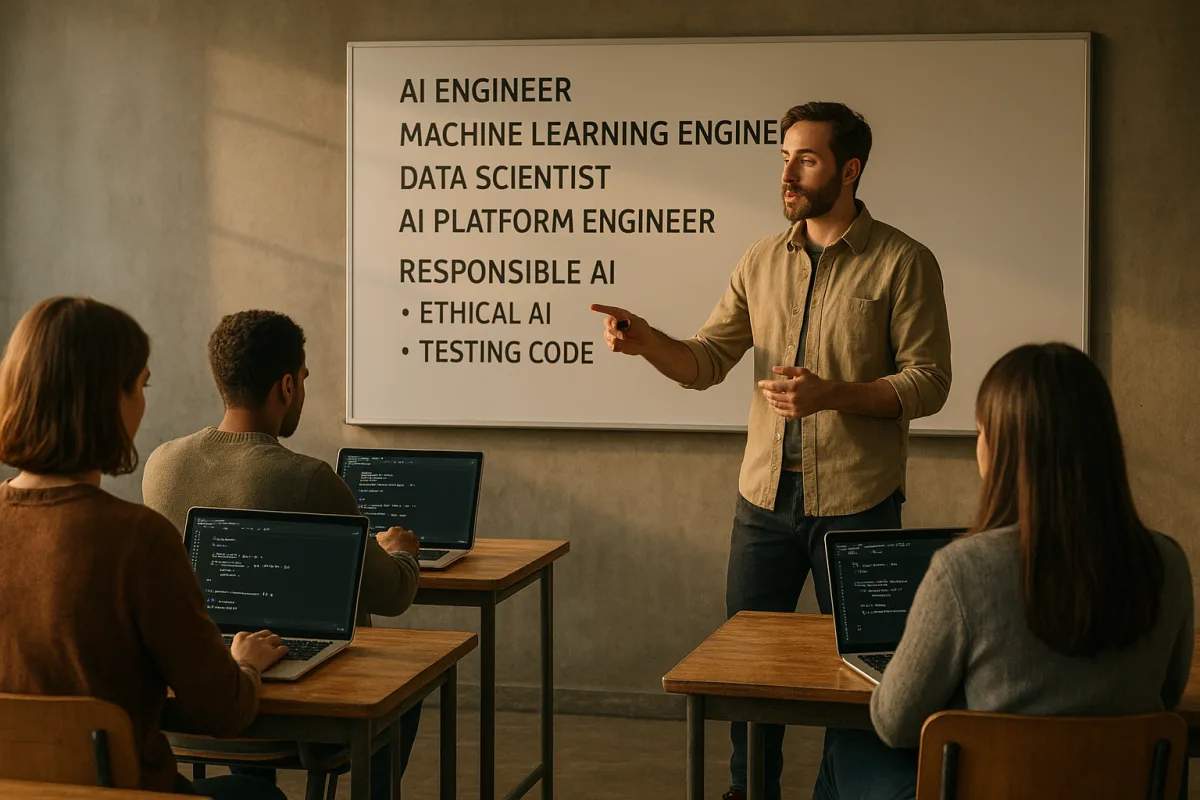
Krish Naik, an AI educator and YouTube creator, groups current opportunities into three paths: AI engineer, AI forward-deployed engineer, and AI platform engineer. His categories overlap in real companies, but they provide a strong way to choose what you must learn first.
Choose AI engineer if you want to build user-facing AI applications. This is the builder path: Python, application development, LLM integration, agent workflows, evaluation, and the work of getting a generative AI feature into production.
Your portfolio should show complete systems, not isolated prompts. Build a small application with an interface, retrieval or tool use where appropriate, logging, error handling, an evaluation set, and a short explanation of failure cases.
Choose the forward-deployed path if you can translate between a customer's operations and a technical implementation. Naik describes this role as working with client systems, legacy platforms, security requirements, and compliance constraints while designing a tailored AI deployment.
Make your evidence customer-shaped. Document a business process, identify where an AI system could help, map data movement, state who approves outputs, and explain how the system handles confidential information or incorrect answers.
Choose AI platform engineering if your experience already leans toward cloud, DevOps, security, or production operations. This work centers on scalable infrastructure, deployment, observability, model operations, guardrails, and reliable inference rather than building a single application feature.
We would pick the path closest to work you already understand. A backend developer can credibly move toward AI engineering, while a cloud engineer can produce stronger evidence faster through platform work than by rushing through a generic machine learning curriculum.
Turn the job description into a learning map
Open ten listings for the same role and make a spreadsheet with repeated requirements. Separate requirements into language fundamentals, framework knowledge, production systems, domain knowledge, and communication, then count which skills recur.
For an AI engineer, your map may include Python, APIs, LLM application frameworks, agent workflows, testing, evaluation, and deployment. For platform work, cloud services, containers, Kubernetes, observability, access control, and model serving may appear much more often.
Do not mistake a long tool list for a syllabus. Frameworks change quickly, but being able to reason about inputs, outputs, costs, latency, reliability, permissions, and evaluation carries across frameworks.
Give every learning block a deliverable. “Learn LangGraph” is vague; “build a tool-using workflow, log each step, and explain what happens when a tool fails” produces material that a reviewer can inspect.
Keep a decision log as you build. Record why you used a hosted model or local model, where data is stored, what prompts or retrieval rules changed outcomes, and which tradeoffs you accepted.
That log becomes interview material. It also teaches the habit classrooms should cultivate: AI literacy means understanding how a system affects a result, not only being able to obtain an answer from it.
Build Python skill you can demonstrate aloud
Python supports work across software development, analytics, automation, and machine learning, which is why it appears in many technical interviews. Simplilearn’s interview-preparation guide emphasizes that a candidate needs to reason with Python, explain choices, and solve problems, not recite syntax.
Start with the fundamentals that fail under pressure: mutable and immutable data types, scope, functions, loops, conditionals, string and list operations, indexing, slicing, dictionaries, and exceptions. Type short examples from memory in a Python shell.
Then study the concepts that reveal whether you understand Python’s behavior: iterators and generators, list comprehensions, flexible function arguments, decorators, closures, object-oriented programming, dunder methods, and shallow versus deep copying.
For each concept, write one tiny program that has a real output and one sentence explaining why it works. A generator example should address memory use, while a copying example should show what changes after a nested object is modified.
Move next to timed patterns: arrays, strings, dictionaries, recursion, and two-pointer problems. Simplilearn recommends practicing under a 15- to 20-minute limit and speaking through the approach before writing code.
Use a three-pass routine. First, restate the problem and ask clarifying questions. Second, describe the data structure and complexity you expect. Third, code, test edge cases, and explain what you would improve with more time.
Tailor the last portion of preparation to the job. Data candidates need pandas, NumPy, data cleaning, aggregation, and missing-data handling; backend candidates need web framework and REST API fundamentals; QA and automation candidates need file handling and testing libraries.
Make AI part of the lesson, not the answer sheet
In a STEM class, begin with the learning outcome and the evidence you need from a student. If the objective is solving a physics problem, the student’s own setup, assumptions, intermediate steps, and explanation must remain visible.
Use a model to generate competing approaches to the same question, then ask students to identify the assumptions, compare the methods, and verify calculations. That makes AI output an object of analysis instead of a replacement for reasoning.
Purdue Polytechnic has reported that its researchers are examining how students engage with AI in STEM classrooms. Engagement is a relevant question, but an engagement study alone cannot establish long-term retention, conceptual understanding, or equitable outcomes.
The University of Minnesota’s expert consensus report frames generative AI as capable of both supporting and threatening learning across K-20 education.[2] Build assignments around that tension: permit assistance for brainstorming or feedback, but require disclosure and independent evidence of mastery.
Ask students to submit an AI-use note alongside major work. It should identify the tool, the task it helped with, what the student accepted or rejected, and how the final answer was checked.
This is also career preparation. Engineers and analysts increasingly need to explain where AI contributed to a deliverable, where it failed, and why a human decision remained necessary.
Verify AI-generated code before you learn from it
Coding agents can accelerate a prototype, especially for boilerplate, tests, and unfamiliar library syntax. They can also produce code that runs while misunderstanding requirements, mishandling user input, exposing secrets, or using an unsafe dependency.
Never submit code you cannot explain line by line. Before accepting generated code, write test cases for normal behavior, empty inputs, malformed inputs, permission failures, and the boundary conditions the model was least likely to consider.
Check what data leaves the system. In a classroom, remove personal information from prompts; in a job project, do not paste proprietary code, customer records, credentials, or internal architecture into an external model without authorization.
Treat model suggestions as claims that require evidence. Run tests, read library documentation, inspect error handling, and ask the model to identify its own assumptions, then verify those assumptions independently.
For interviews, this discipline changes your answer. You can say where AI accelerated your work while clearly describing your own system design, debugging, validation, and security decisions.
Rehearse the interview as a working conversation
A technical interviewer is evaluating how you work when the answer is incomplete. Start practice by speaking before coding, because silent implementation makes it hard to demonstrate judgment, tradeoffs, and recovery from a mistake.
Record a mock session with a peer or use an AI interviewer for repetition. Ask for a prompt in your target role, set a timer, explain your plan aloud, write the solution, and review both the code and the explanation.
Use AI feedback carefully. It can flag a missing edge case, unclear explanation, or weak structure, but it cannot reliably decide whether you meet a particular team’s bar or whether its suggested answer fits that company’s systems.
Prepare three project stories using a consistent structure: the context, constraint, decision, implementation, result, and what you would change. Forward-deployed candidates should emphasize stakeholder discovery; platform candidates should emphasize reliability and controls; builders should emphasize product and evaluation decisions.
Do not overclaim projects built with substantial AI help. State the tools you used, the parts you designed, and the evidence that the system worked. A truthful, specific explanation is stronger than a polished claim you cannot defend.
Set access and policy rules before deployment
Before adopting an AI tool across a class, program, or career center, decide who can use it, for what tasks, with what data, and how they disclose use. Leave no ambiguity around graded work, personal data, or human review.
Policy varies sharply. New York City has banned AI use by public-school students through eighth grade, according to The Week, while other institutions are developing frameworks for guided adoption.[3]
European education guidance addresses the ethical use of AI and data in teaching and learning, including responsibilities for educators and institutions.[5] The European Union’s 2026 education-focused ethics guidance also raises compliance expectations for schools using these systems.[4]
China’s Ministry of Education has released a digital-education ethics document, another sign that AI literacy is increasingly paired with governance rather than treated as a standalone software skill.[6] If you teach or run training, make policy literacy part of the curriculum.
Plan for unequal access from the beginning. Stanford’s reporting on AI and education has highlighted learning and equity as linked concerns, so do not design required work around a paid tool, a high-end device, or constant access without an alternative path.[1]
We would provide a common baseline tool, an offline or non-AI option where possible, and shared instruction on verification. The goal is for each learner to build transferable judgment, even when access to models, devices, or institutional approval changes.
Frequently Asked Questions
How can I prepare for different AI career roles?
Start by selecting a specific AI role such as AI engineer, forward-deployed engineer, or AI platform engineer, since each requires distinct skills and evidence. Tailor your learning and portfolio to the role’s demands, for example, build full applications for AI engineers, document customer processes for forward-deployed engineers, or focus on cloud infrastructure and deployment for platform engineers. Align your preparation with your existing experience to progress efficiently.
What are effective strategies for learning AI skills?
Analyze multiple job listings for your target role to identify common skill requirements and organize them into categories like language fundamentals, frameworks, and production systems. Set clear deliverables for each learning block and keep a decision log documenting your choices and tradeoffs. This approach helps build AI literacy by emphasizing reasoning about system behavior rather than just tool usage.
How should AI be integrated into STEM education?
Use AI to generate alternative problem-solving approaches and critiques but require students to show their own reasoning, assumptions, and verification steps. AI output should serve as a subject for analysis rather than a substitute for student work. Establish clear classroom rules on AI use early, considering uneven access and institutional policies.
What is the best way to demonstrate Python skills for AI jobs?
Focus on writing and explaining Python code under timed conditions rather than memorizing syntax or solving random problems. Practice fundamental concepts like data types, loops, and exceptions, then advance to iterators, decorators, and object-oriented programming. Use a three-step problem-solving routine: restate the problem, discuss data structures and complexity, then code and test while explaining your approach aloud.
How can students responsibly use AI tools in learning?
Students should use AI to explore different methods and critique their work but remain responsible for final explanations and verifying results. AI-generated code or answers must be treated as starting points that require testing and understanding. This maintains accountability and supports learning rather than replacing it.
How we researched this
This article was assembled from 2 video sources across 2 channels, 1 published article, 6 cited references.
Nothing here is based on hands-on testing. Where a figure or finding appears, it belongs to the source cited beside it, and the writing says so rather than implying otherwise. Every source is listed below so you can check it.
Sources
Which AI Role Should You Prepare For?, Krish Naik
Get Python Interview Ready in 2026 | Top Python Interview Questions & Answers | Simplilearn, Simplilearn
Purdue researchers explore how students engage with artificial intelligence in STEM classrooms, Purdue Polytechnic
AI+Education Summit addresses learning and equity | Stanford Report
EU AI Ethics Guidelines for Education (2026): What Schools Must Do
Watch AI in Education and Workforce Preparation on Youtube
Also from the sources
Related Articles
AI in Education and Career Development: Roadmaps and Tools
Explore how AI supports education and career development with course choices, skill building, and effective AI tutoring strategies.

AI Career Roadmaps: Skills and Upskilling for 2026
Explore AI career roadmaps and professional upskilling to choose roles, build skills, and prepare projects for AI jobs in 2026.

AI Career Paths and Learning Resources for 2027
Explore AI career paths in 2027 with key skills and learning resources to build a strong foundation for AI and machine learning roles.

AI Code Review Best Practices for Software Development
Learn AI code review best practices, including evidence-based gates and modular skills, to improve software development and review workflows.