
AI Decision Queue Automation for Business Workflows
Learn how AI decision queue automation routes tasks, prioritizes inquiries, and integrates human review for effective business workflows.
AI Automation Works Best as a Routing System, Not a Replacement for Judgment
The useful unit of automation is a decision queue
The recurring idea across business automation is not that an AI model “does the job.” It is that it turns an unstructured stream of messages, documents or requests into a queue of actions.
That distinction matters. A voice note, customer email, supplier quotation and inbound lead are all messy inputs. Someone must determine what they mean, where they belong, what must happen next, and whether a human should intervene.
A well-designed system separates those steps. It captures the input, extracts facts, classifies the case, retrieves relevant context, creates a draft action, and assigns a confidence threshold. Low-risk, routine cases proceed. Uncertain or consequential cases are escalated.
This is the practical meaning of an AI agent in most small-business deployments. It is usually a workflow with an LLM embedded at a few decision points, connected to forms, a CRM, document storage, messaging software and perhaps a ticketing system.
The agent is not normally discovering its own goals. A business owner or implementation partner has already defined the goal, the acceptable inputs, the systems of record and the cases that require approval.
Why voice-note automation is more than transcription
A construction example from Nate Herk | AI Automation makes the distinction clear. A community member reportedly built a system in which site foremen send WhatsApp voice notes that become project-linked, branded PDF documents stored in SharePoint.
The claimed £4,500 price, described as roughly $6,000 in the Nate Herk | AI Automation video, should not be read as the going rate for speech-to-text. The value, if the project delivered it, lies in workflow integration and risk reduction.
The system must identify the correct job, transform spoken observations into a particular register or assessment format, route the draft to the right reviewer, retain it in the right repository and preserve an audit trail.
That is a decision queue. The foreman supplies evidence in the least burdensome form available, a voice message. The system turns it into a structured draft. A responsible person reviews and signs off before it becomes an official record.
The human review is not a minor detail. Speech recognition can mishear a site name, a measurement or a safety-critical instruction. A language model can also turn incomplete notes into prose that sounds more complete than the source material warrants.
Nate Herk | AI Automation frames the business case as five foremen each spending five hours weekly on paperwork, or 25 paid hours. That is a useful sales calculation, but only if the documents are truly required and the review burden does not simply reappear elsewhere.
The pricing range shows why it is misleading to call this a standard $6,000 automation. VoxDraft is listed in the research brief at £4.99 a month for unlimited notes and multiple output formats, which suits individual users or simple document generation.
Skywork Note AI is listed at $158 yearly, with the vendor claiming 98% transcription accuracy, and is positioned as an AI workflow recorder rather than a construction compliance system. That makes it more suitable for users who need inexpensive transcription and reusable notes, not deeply customised approvals. [3]
UMEVO Note Plus is listed at $109, discounted from $169, in the research brief. It suits a buyer seeking a lower-cost note-taking device or service, rather than a business commissioning integrations across messaging, storage and operational software. [4]
FieldMemo AI Pro, listed at $14.99 monthly in the research brief, combines voice-to-document generation with AI cost estimation. Its natural audience is a field-service operator who wants lightweight mobile reporting rather than an enterprise records workflow.
At the other end, Mobian’s AI Document Automation System starts at €7,900, with integration work charged additionally by the hour. That price point suits organisations needing implementation support, bespoke connections and a more formal operational deployment. [2]
These products do not necessarily compete feature for feature. The meaningful comparison is not monthly price alone, but whether a tool handles the company’s document type, storage location, approval rules, retention requirements and error accountability.
Customer inquiry priority is the same problem in a different costume
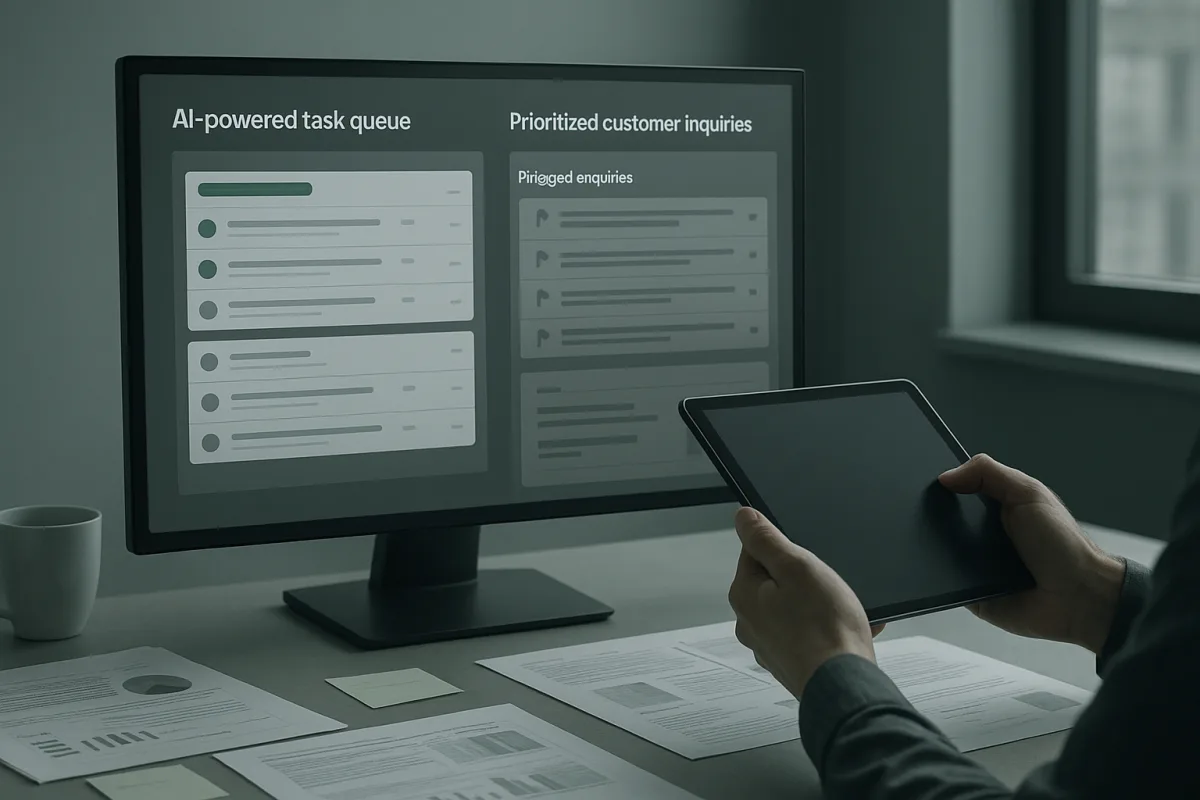
EIN Presswire’s report on AI identifying and prioritising time-sensitive customer inquiries points to a more mature application of the same pattern. The useful system does not need to compose a brilliant answer to every customer.
It first determines which incoming messages should not wait. A cancellation request, fraud report, delivery failure, sales-ready lead or safety complaint should not sit behind routine password-reset questions simply because it arrived later.
A typical prioritisation pipeline begins with an inbound email, chat, call transcript or form submission. The system extracts entities such as account, product, order number, stated problem, sentiment, deadline and language.
It then assigns labels and a priority score. The score may combine explicit rules, such as words indicating a security issue, with predictive signals, such as a customer’s contract tier, repeat contacts or likelihood of churn.
The output should be a routing decision, not an unexplained number. For example: urgent because the customer says a payment was taken twice, the account has a high-value contract, and prior tickets remain unresolved.
Research cited in the briefing reports that median first-response time fell from 4.1 hours under manual handling to 0.9 hours with AI pre-qualification, across a study of 2.9 million tickets. That measures speed to first response, not necessarily correctness or resolution quality.
The same distinction applies to reports that AI can handle up to 80% of inquiries autonomously or reduce communication costs by 40% to 60%. Those outcomes depend on the inquiry mix, available knowledge base, escalation policy and definition of “handled.”
A cancellation threat from an angry customer may deserve immediate human ownership even if the model is highly confident about its category. Emotionally sensitive, legally significant or financially consequential cases are poor candidates for fully automatic resolution.
The engineering work is therefore in calibration. Teams must decide which errors are tolerable, measure false urgency and missed urgency, and review whether the system systematically gives lower priority to unfamiliar phrasing or underserved customer groups.
Agents can start a sourcing process, not finish a product business
Siraj Raval’s sponsored Alibaba.com AI Mode demonstration illustrates the same routing model in physical product development. The system turned a short brief, products for home workers that are small, giftable and under $20 to make, into supplier candidates and questions.
The agent’s productive role was constrained. It compared apparent margin potential, market crowding and ease of branding, then drafted a request for quotation. Alibaba.com supplied the marketplace data, supplier profiles, prices and minimum order quantities.
That is useful work, but it is not autonomous manufacturing expertise. Siraj Raval explicitly retained the decision when a supplier asked which finish to use, because finish is partly a taste and brand-positioning judgment.
The sample order is also an early checkpoint, not proof that the business exists. A product business needs acceptable sample quality, packaging accuracy, reliable production capacity, compliant materials, freight planning, duties, returns handling and actual customer demand.
The briefing notes that 50% of CPG leaders report sample-quality problems linked to inaccurate product data, including mislabelling and packaging errors. An agent may notice contradictions in a specification, but it cannot inspect physical workmanship from a spreadsheet.
Negotiation is similarly more complicated than sending an RFQ. Agents can generate requests, compare offers and monitor supplier confirmations. They are less reliable when deals involve payment anomalies, landed-cost calculations, multi-leg logistics or specialised manufacturing constraints.
This is where a human approval gate has direct economic value. A buyer should validate the bill of materials, incoterms, payment terms, customs assumptions, sample photos and contractual commitments before an automated workflow approves a purchase.
The bill is integration, governance and exception handling
The implementation costs for inquiry prioritisation explain why simple demos often look more impressive than production deployments. The research brief estimates basic LLM feature integration at $6,000 to $28,000 over two to four weeks.
More complex retrieval-augmented systems, which search internal policies and customer history before making recommendations, are estimated at $20,000 to $70,000 over four to eight weeks. Those figures are ranges, not standard market rates.
The expensive work is often mundane: matching customer identifiers across systems, defining ticket categories, removing duplicated records, setting access controls and documenting escalation paths. Poor data quality reportedly affects 54% of AI projects and can add 15% to 25% to budgets.
Privacy is another operational constraint. An inquiry-ranking agent may receive account histories, health details, payment information, contracts or employee messages. Sending that material into an unapproved tool creates a governance problem, even if the resulting answer is useful.
The right question is not whether AI can automate a department. It is whether one queue has enough volume, repetition and measurable outcomes to justify building a controlled routing layer around it.
For construction paperwork, that queue may be daily field reports awaiting review. For support teams, it is incoming customer cases awaiting prioritisation. For product development, it is supplier options awaiting a commercial decision.
That framing is less dramatic than an “AI business in a day” claim, but more durable. AI can make the path from input to action substantially faster, provided an organisation is clear about who owns the exceptions.
Frequently Asked Questions
What is AI decision queue automation and how does it work?
AI decision queue automation processes unstructured inputs like messages or documents by extracting facts, classifying cases, and creating draft actions. It assigns confidence levels to these actions, allowing routine cases to proceed automatically while escalating uncertain or high-risk cases to human reviewers. This system acts as a routing layer rather than an autonomous decision-maker.
How can AI improve customer inquiry prioritization?
AI improves customer inquiry prioritization by analyzing incoming messages to identify urgent or high-value cases, such as cancellations, fraud reports, or safety complaints. It extracts relevant information and assigns priority scores using rules and predictive signals, ensuring that critical issues are routed promptly to the appropriate team members while routine inquiries wait their turn.
Why is human review important in AI business automation?
Human review is essential because AI systems can misinterpret or inaccurately transcribe critical details, such as site names or safety instructions. Reviewers verify and approve AI-generated drafts to ensure accuracy and compliance, preventing errors that could arise from overconfident or incomplete AI outputs.
What are practical examples of AI routing systems in business?
A notable example is a construction workflow where foremen send voice notes that AI converts into project-linked documents, routes them for review, and stores them with an audit trail. Another example is AI prioritizing customer service inquiries by urgency and risk, ensuring timely handling of critical issues without attempting to answer every query autonomously.
How does AI assist in product sourcing without replacing judgment?
AI agents can generate requests for proposals and negotiate with suppliers at scale, speeding up the sourcing process. However, they cannot fully assess product viability, quality, landed costs, compliance, or demand, so human judgment remains necessary to evaluate these complex factors and make final decisions.
How we researched this
This article was assembled from 2 video sources across 2 channels, 1 published article, 4 cited references.
Nothing here is based on hands-on testing. Where a figure or finding appears, it belongs to the source cited beside it, and the writing says so rather than implying otherwise. Every source is listed below so you can check it.
Sources
Sell These 4 Claude Systems for $3700+ Right Now (as a beginner) — Nate Herk | AI Automation
An AI Agent Just Started a Product Business for Me (Alibaba.com AI Mode) — Siraj Raval
Artificial Intelligence Helps Businesses Identify and Prioritize Time-Sensitive Customer Inquiries — EIN Presswire
Building Customer Support AI Agents at 100M-User Scale: An Evaluation-Driven Framework
Skywork Note + Plus Skywork AI yearly - AI Workflow Recorder | Skywork
Watch AI-Driven Business Automation and Product Development on Youtube
Also from the sources
Related Articles
AI for Business Productivity: Enhancing Workflows and ROI
Learn how AI boosts business productivity by optimizing workflows, marketing, and data integration with measurable ROI.

AI Automation in Finance Workflows
Explore AI automation in finance workflows with GPT-6 Astra and Claude Fable, focusing on best practices, risks, and human oversight.

AI Agent Workflows for Reliable Decision Automation
Explore AI agent workflows that enable auditable, human-approved automation for reliable decision-making and coding practices.
AI Agents Action Selection
Explore AI agents' action selection, integration challenges, and security in automation. Learn about personal AI agents and best practices.