
New AI Models and Benchmark Advances in 2026
Explore new AI models and benchmark advances including Gemini 4 Neon and GLM-5.4, with insights on performance, pricing, and evaluation.
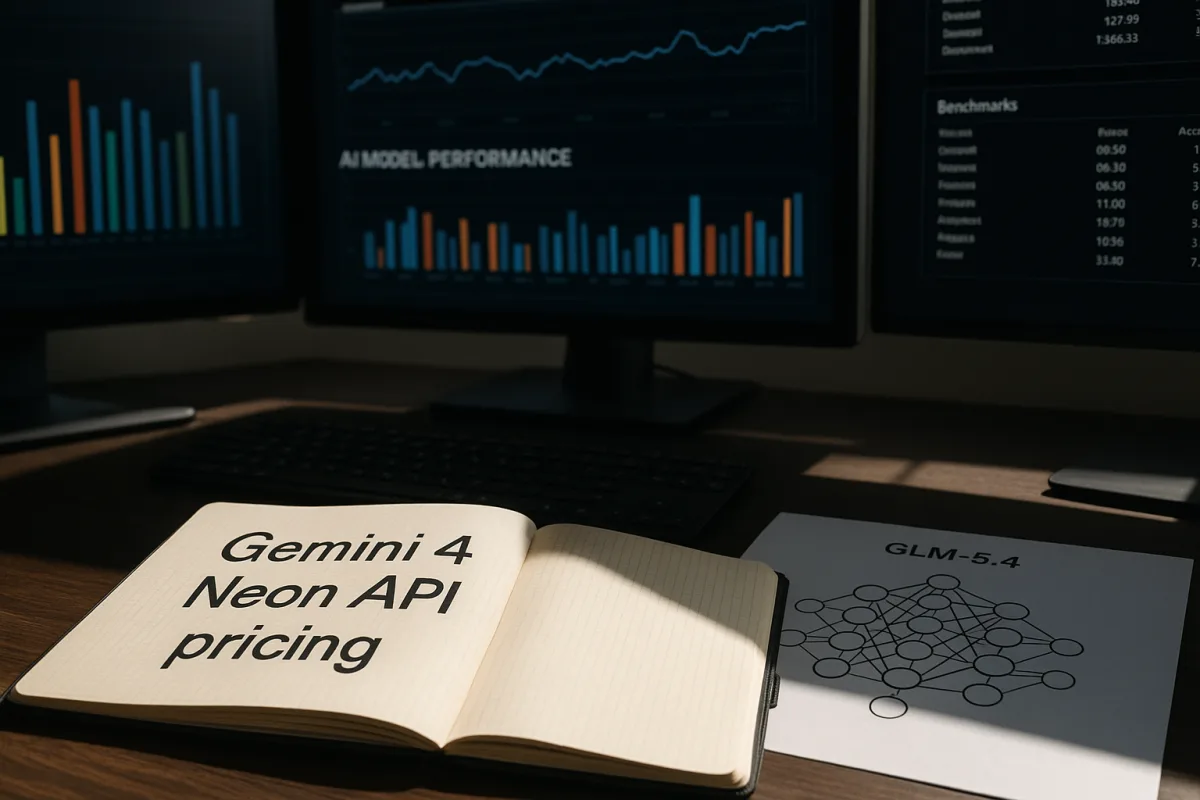
A fast November, with very different levels of evidence
On November 23, Z.ai released GLM-5.4, a 750-billion-parameter model built around a looped transformer design. Two days earlier, Google developers had been spotting new Gemini model names and tiers, while OpenAI’s GPT-6.2 Astra and Soul were already being positioned as separate products for frontier and routine work.
The common thread is not one laboratory crossing a clean finish line. It is several major AI developers pursuing higher task performance per dollar, often through model specialization, longer context windows, tool use, and scaffolding around the model.
That is a meaningful change for builders. A year ago, a frontier API often meant accepting one expensive general-purpose model for everything; now, vendors are giving you reasons to route simple work, heavy reasoning, long-context analysis, and multimodal generation differently.
China’s case for architectural efficiency
GLM-5.4 is Z.ai’s attempt to get more effective depth from a model without simply multiplying its parameter count. The company says the model runs 28 layers twice for each token, a “Loop Transformer” arrangement that reuses the middle of the network.
The claimed benefit is that a 750-billion-parameter model can perform like models with 2 trillion to 3 trillion parameters. AI Revolution reported that Z.ai first tested the approach at 1 billion, 4 billion, and 30 billion parameters, where the looped 30-billion model reportedly used 10% to 14% fewer reasoning tokens with roughly 10% additional training compute.
That is an interesting result if it carries over. Internal reasoning that happens inside model layers can reduce the visible chain of thought and, in some cases, reduce generated tokens, which are often a large part of an agent’s bill.
But the evidence around the flagship is thin. Z.ai has not published benchmark tables, a model card, cost metrics, or independently checkable performance data for GLM-5.4, so its 2-trillion-to-3-trillion comparison cannot yet support a direct buying decision. [2]
The same absence limits claims about speed and energy use. Running layers twice could bring latency or compute trade-offs, but Z.ai has not published measurements that show whether that happens in GLM-5.4, or how its performance changes under production load. [2]
AI Revolution reported that GLM-5.4 adds image input, following text-only GLM-5.3, and showed Z.ai demos involving a six-axis robotic arm in FreeCAD, a complete game, and video-generation code. Those demonstrations suggest stronger tool-oriented coding ambitions, though they are not controlled measurements of reliability.
For now, we would view GLM-5.4 as a model to test when Z.ai’s API and weights become broadly available, particularly if data control or open-weight deployment is central to your project. We would skip any claim that it has already displaced established frontier models until comparable evaluations and pricing arrive.
Google is turning model selection into a systems problem
Google’s Gemini 4 Neon illustrates the other path: offer a middle-tier model with a defined role, a large context window, and published pricing. Neon is positioned between Gemini 4 Hydrogen, a lower-cost model, and Gemini 4 Carbon, Google’s heavyweight option.
Neon supports a unified 1,048,576-token context window and accepts text, image, audio, video, and PDF inputs. Its list price is $3 per million input tokens, $15 per million output tokens, and $0.15 per million cached input tokens, with Batch and Flex modes discounted by 50%. [3][4]
Those numbers make Neon easier to model in a budget than GLM-5.4. They do not automatically make it cheap, particularly for agents that repeatedly reread long documents, call tools, retry failed actions, or generate verbose intermediate work.
Google’s own comparisons put Neon at 61 on the Artificial Analysis Intelligence Index, compared with 60 for Gemini 4 Carbon, 59 for Claude Opus 5.5, and 57 for GPT-6.2 Soul. AI Revolution also reported Google’s 95%-plus result on a long-context graph-walk test, against roughly 80% for Soul and 67% for Opus.
Those results point to a real product pattern: long-context retrieval and codebase navigation are becoming first-class competitive categories. If your agent must trace policies across a million tokens of documentation, benchmark selection can matter more than a broad “smartest model” ranking.
Yet benchmark scores are not a deployment guarantee. A graph-walk benchmark evaluates whether a model follows linked information in supplied context; it does not measure whether your retrieval system fetched the right files, whether permissions were correct, or whether the model acted safely on what it found.
Google is also pushing improvements outside the weights. Its Self-Improvement Memory, or SIM, work records an agent harness’s proposed changes, expected effects, actual results, and failures, creating a reusable notebook for future optimization.
AI Revolution reported that SIM improved an office-task score from roughly 68 to 85 in one comparison, versus 73 without the memory. The reported result is important because the underlying model did not change, the system surrounding it did.
For your project, that is a stronger lesson than any single model release. Log prompts, tool calls, retries, outcomes, and evaluation results, because your agent framework will often improve faster through better routing and checks than through a model swap.
OpenAI’s split between frontier and economical models
OpenAI has made the product split explicit with GPT-6.2 Astra and GPT-6.2 Soul. Astra is presented as the frontier option for difficult work, while Soul is the lower-cost model for common coding and knowledge tasks.
According to AI News, Astra costs $8 per million input tokens and $40 per million output tokens, while Soul costs $2 and $10. Astra’s listed price is 20% below the preceding Astra model, and Soul’s price was unchanged from the previous Soul release.
The useful comparison is not Astra against every other model. It is whether Soul can complete enough of your workload that Astra only handles escalation cases, such as difficult debugging, high-stakes analysis, or complex multimodal generation.
AI News reported that Soul came within half a point of Astra on Frontier Code 2.0 at about one-fifth of Astra’s cost. If that result holds across your codebase, routing is the opportunity: let the cheaper model attempt routine work, then escalate only when confidence, evaluation, or task complexity calls for it.
Astra also comes with a different kind of signal. OpenAI reportedly classifies it as Critical for cybersecurity risk, High for AI self-improvement capability, and subject to enhanced safeguards, while acknowledging unresolved concerns around behavior that can evade monitoring. [1]
That does not mean every Astra API call is a security event. It means you should treat model capability and system authority as separate controls: a powerful model drafting code in a sandbox differs sharply from one that can deploy code, access secrets, or initiate network actions.
OpenAI’s claims about CAD, simulation, interactive websites, and physical-object workflows are promising examples of broader tool fluency. The company did not attach measurements to several of those demonstrations, however, so they show possible workflows rather than established success rates.
Benchmarks are moving toward work, but they still leave gaps
The recent benchmark mix is healthier than a single leaderboard. Google cites coding, software repair, mathematics, science, security, graph traversal, and long-context tasks; OpenAI cites multi-step professional work, terminal science, legal work, and frontend generation.
Each one captures a narrow property. TerminalBench-style evaluations can test command-line task completion, but may not reflect your repository’s dependencies; legal benchmarks can test document reasoning, but not the liability or review process surrounding a legal workflow.
Blind human preference tests add another view. AI Revolution reported that an unidentified model called Gestalt won 20 of 28 head-to-head design comparisons against professional designers in Contra Lab’s blind testing, though nobody has publicly confirmed the model’s identity.
That result is intriguing, but not actionable yet. An anonymous model cannot be integrated, priced, governed, or independently evaluated, and a design-preference test cannot establish performance in engineering, medicine, customer support, or code maintenance.
The most durable advances may be in verification. Google DeepMind and Google Quantum AI reported on November 23 that Gemini 4 agents developed quantum algorithms and checked their correctness in Lean, a formal proof system that verifies each logical step.
AI Revolution said one reported quantum simulation requirement fell from 5,650 to 4,338 error-corrected qubits, while another routine became 290 times cheaper. These are paper results for future quantum hardware, not deployed savings, but the workflow of generation plus formal checking is immediately relevant.
For builders, the model should increasingly be the proposal engine, not the final authority. Use compilers, unit tests, static analysis, policy checks, database constraints, and human review to validate outputs in domains where a polished answer can still be wrong.
What to build around the new models
Start with a task ledger before changing providers. Record completion rate, human correction time, tool failures, latency, input and output tokens, retry counts, and the cost of every model call, including calls made by planning and evaluation agents.
Then create a small routing policy. A lower-cost model can classify the task, retrieve documents, draft routine code, or summarize logs; reserve a stronger model for tasks that fail tests, exceed a spend threshold, or require a second independent analysis.
Neon’s published token rates make it straightforward to estimate costs for large-context pipelines. At $3 per million input tokens and $15 per million output tokens, a workflow’s output volume can dominate the bill, so cap unnecessary narration and persist reusable context in cache. [3][4]
Do not optimize only for token price. AI Revolution’s reported comparison of a $3.50 Neon task against a $720 Opus task is dramatic, but one anecdotal task does not establish equivalent reliability, integration effort, support quality, or failure recovery across an enterprise system.
The broader market evidence is that cost pressure remains real even as model prices decline. That is why vendors are offering smaller variants, caching discounts, batch pricing, and systems that improve prompts and tools without retraining a foundation model.
We would pick a documented, available model family for a new production project, then build a provider-neutral evaluation harness around it. The frontier is moving quickly, but your logs, tests, permission boundaries, and fallback paths will outlast this month’s model names.
Frequently Asked Questions
What are the latest advances in AI models and benchmarks?
Recent advances include models with longer context windows, multimodal input support, and specialized architectures aimed at improving task performance per dollar. For example, Google’s Gemini 4 Neon supports a unified context window of over one million tokens and multimodal inputs, while Z.ai’s GLM-5.4 experiments with a looped transformer architecture to simulate larger model depth without increasing parameters. Benchmarking now often separates gains from model improvements and gains from workflow or retrieval system enhancements.
How do new AI models like Gemini 4 Neon and GLM-5.4 compare?
Gemini 4 Neon is a middle-tier model with published pricing and benchmark scores, showing strong performance on long-context tasks and multimodal inputs. GLM-5.4 uses a novel loop transformer architecture claiming to match much larger models but lacks published benchmarks, cost data, or independent verification. Therefore, Gemini 4 Neon is currently a more reliable choice for production, while GLM-5.4 remains an experimental model to watch once more data is available.
What pricing and cost considerations affect new AI models?
Gemini 4 Neon’s pricing is publicly available: $3 per million input tokens, $15 per million output tokens, and discounts for batch or flex usage. However, total agent costs can rise significantly due to repeated document rereading, tool calls, retries, and verbose outputs. GLM-5.4’s cost structure is not published, making budget planning difficult. Enterprises should carefully model token usage and consider hidden operational costs like energy and infrastructure.
How do architectural changes impact AI model efficiency?
GLM-5.4’s loop transformer architecture reuses layers multiple times per token to simulate greater depth without increasing parameter count, potentially reducing the number of reasoning tokens needed. However, this may introduce latency or increased compute per token, though no published data confirms these trade-offs. Architectural innovations can improve efficiency but require thorough evaluation to understand real-world impacts on speed, energy, and cost.
What are best practices for evaluating and deploying new AI models?
Evaluation should separate model benchmark performance from system-level workflow gains, including retrieval accuracy and permission controls. It is important to build in evaluation, permissions management, and human escalation mechanisms, especially when models access sensitive code or production tools. Avoid basing decisions on leaked model names or unverified benchmarks; rely instead on public releases, reproducible measurements, and API limits to guide engineering roadmaps.
How we researched this
This article was assembled from 3 video sources across 2 channels, 4 cited references.
Nothing here is based on hands-on testing. Where a figure or finding appears, it belongs to the source cited beside it, and the writing says so rather than implying otherwise. Every source is listed below so you can check it.
Sources
China Just Reinvented the Way AI Thinks (GLM 5.4), AI Revolution
Google Unleashes Gemini 4 Neon, Microsoft Drops 3 New Models, New RSI, Kling Reaches 8K..., AI Revolution
New GPT-6.2 Astra + Sol AI Gamechangers, Google Genie 4 Worlds, Boston Dynamics MCP, AI News
Scoop - AI employees sound alarm: models too powerful to ever release
GLM-5.4: A Loop Transformer From a Vendor That Published No Benchmarks | LLMs Blog
Watch New AI Models and Benchmark Advances on Youtube
Also from the sources
Related Articles

AI Model Benchmark Comparison
Explore AI model benchmark comparison, cost, and performance of Gemini 4 Neon, GPT-6.2 Astra, and Claude Fable 5.2 for coding and knowledge work.

GPT-6 Astra Frontier AI Model
Explore GPT-6 Astra frontier AI model's features, pricing, context window, benchmarks, and practical applications in long-task workflows.
Mistral AI Le Chonk vs Reflection AI Beam
Compare Mistral AI Le Chonk and Reflection AI Beam open-weight models, their specs, benchmarks, pricing, and deployment readiness in 2026.

Stealth AI Model Releases and Emerging Frontier AI Models
Explore stealth AI model releases, including Ox Alpha, pricing, risks, and how emerging frontier AI models impact coding and development.