
AI in Gaming World Generation
Explore AI in gaming world generation, its tools, challenges, and how synthetic reality shapes game development and release strategies.
AI in Gaming Is Moving From Asset Generation to World Generation, With Friction at Every Gate
Synthetic worlds have become a game-development prototype, not a game engine
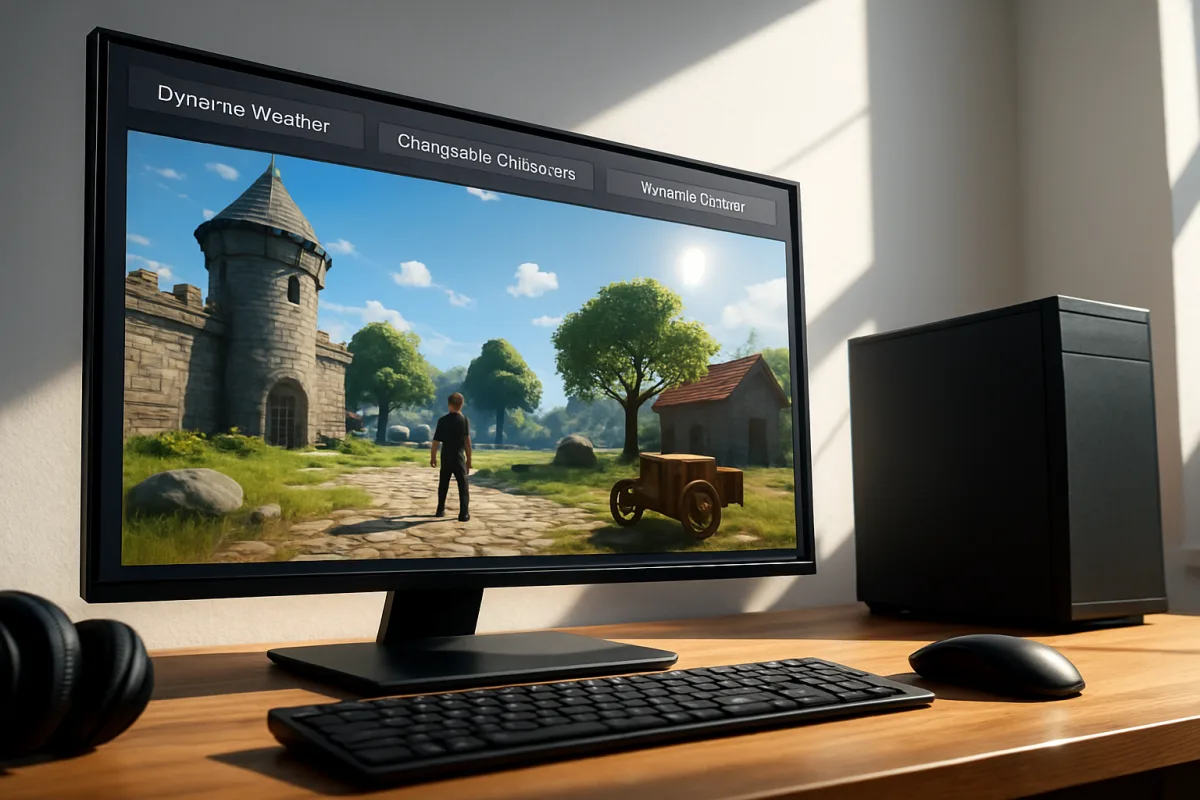
On October 27, Google DeepMind announced Genie 4, a research-preview world model that generates interactive scenes from text prompts. The promise is familiar to anyone who has watched a game prototype become expensive: type a scene description, move through it, then change the world while it is running. [2]
AI Revolution described Genie 4 as producing keyboard-controlled environments, with text-driven changes to weather, characters, camera placement, objects, and dialogue. The channel reported sessions of up to two minutes, roughly double Genie 3’s public one-minute limit.
That is a noticeable improvement, but it remains a short demonstration window. Google has not published independent benchmarks for action responsiveness, spatial stability, hardware requirements, or the rate at which worlds break after repeated edits.
Genie’s distinction from a video generator is interaction. A video model can create a finished clip, while a world model must generate the next frame after your input and keep objects, geography, lighting, and characters coherent.
The system reportedly renders frames without a conventional 3D level, collision system, or authored navigation mesh underneath. It predicts what ought to happen from prior frames and inputs, which can look convincing while still failing at the precise simulation rules games require.
That makes current world models better suited to ideation than runtime production. A designer could explore whether a foggy harbor, cave dive, dragon race, or ruined city produces the right mood before an environment team commits weeks to geometry, lighting, and scripting.
The examples shown by Google include dynamic weather, live scene edits, generated sound, and conversational characters. AI Revolution also reported frame rates around 24 to 30 frames per second in demonstrations, but those are preview observations, not a published performance guarantee.
For a game team, two minutes can cover a combat encounter, traversal loop, puzzle beat, or cinematic blocking exercise. It cannot yet cover a reliable level, much less an open world that players can revisit for dozens of hours.
Google’s framing around “synthetic reality” also extends beyond games. A model that can create a scene, accept actions, and modify conditions could support robotics training, education, previsualization, or simulation, but visual plausibility is not the same as physical validity.
A falling object that looks right may not follow a stable collision model. A character who sounds aware of the player may still contradict prior dialogue, lose track of inventory, walk through scenery, or misread a mission state.
The thin evidence is long-term reliability: no broad, independent benchmark has yet established how well Genie 4 or comparable systems preserve geography, object identity, physics, and task state across extended player sessions.
Why this is arriving now
Several developments are converging. Image, video, speech, and language models have improved independently, and product teams are now combining them into a loop where one system renders a scene and another interprets goals or issues instructions.
Google’s Genie 4 demonstrations point toward this hybrid arrangement. A language model can handle prompt interpretation, planning, or character dialogue, while a world model supplies the responsive visual environment. [2]
That architecture is attractive because game production has many expensive handoffs. Concept artists, level designers, technical artists, writers, animators, audio teams, and QA each translate an idea into a new form, often discovering problems after the previous team has moved on.
Generative tools can compress the early stages of those handoffs. They can produce a rough level image, prop concept, texture variant, dialogue placeholder, code sketch, or test scenario quickly enough for a team to reject it before committing production resources.
Gamescom Dev’s August 2026 AI tracks show that the industry conversation is broadening beyond generative images. AI and Games, the channel and conference organizer led by game-AI commentator Tommy Thompson, co-hosted tracks on AI for gameplay and AI for production.
The speaker mix included Electronic Arts, Tencent, Cather AI, Multiplayer Group, and Room 8, alongside talks on established NPC AI. That is a healthier signal than a conference full of text-to-game demos, because game teams still need navigation, balancing, testing, tooling, and performance work.
Classic game AI remains valuable precisely because it is controllable. Behavior trees, utility systems, navigation meshes, encounter directors, and deterministic simulation can be profiled, debugged, tuned, and shipped on a console with known memory and frame-time limits.
Generative systems bring a different capability: variation under natural-language direction. They can help a small team make more prototypes, but they also introduce costs in inference, validation, moderation, version control, and determining why a given output changed.
We would use a world model before production begins, not inside the core runtime loop. Treat it as a rapid concept room where design questions are cheaper, then rebuild accepted ideas using conventional assets and systems that your team can inspect.
The AI-content flood is now a release-management problem
The first visible effect of easier generation may not be better games. It may be more submissions. Steam’s review queue has become a constraint for indie studios trying to launch on a date they have already announced.
The Verge AI reported on November 3 that Studio Daimon submitted Food Devils on October 12 for an early-access release, but was still awaiting approval on its intended launch day. Game director Alfred Kamon said the delay had left the studio without a release date.
Publisher 2 Left Thumbs also said its game Wheel Make It launched nearly two weeks late after a prolonged build review. The studio reported failing review because a single menu option was not accessible by controller.
Valve historically described store-page review times as typically three to five business days. After the recent increase in submissions, the company said reviews can take up to 12 business days, with re-reviews accounting for much of the slowdown.
The volume is substantial. October’s Steam Next Fest included 7,240 games, according to How to Market a Game, a 65.2 percent increase from June’s event. The Verge AI also reported that itch.io said new game-page creation had doubled in two months.
Developers have blamed “AI slop,” loosely meaning low-effort games, clones, and generated asset packages, for clogging queues. Valve has acknowledged higher submission volume, but it has not said that all delay stems from AI-made material.
Steam requires developers to disclose AI-generated content, including material generated before release and content generated live during play. It prohibits live-generated adult-only sexual content, a rule that matters if your game offers open-ended character or image generation.
Disclosure is not a quality certification. A clear disclosure tells Valve and players that AI is present, but it does not establish that your outputs are licensed, appropriate, stable, original, or safe for a multiplayer audience.
For your launch plan, submit the store page and build earlier than you think you need. Keep controller support, required disclosures, age ratings, screenshots, and localization in the reviewable build, because a re-review can turn a missed detail into a missed campaign.
We would reserve at least two working weeks for Steam approval and treat that as a minimum. Do not schedule your first influencer push, festival beat, paid campaign, or embargo around an approval you have not received.
Modding policies are splitting by platform and community
AI-generated mods expose a different problem from commercial games. Mod communities rely on trust, attribution, and clear expectations about what a download contains, especially when a mod changes visuals, voices, characters, or story material.
Nexus Mods has adopted more detailed AI labels, distinguishing between fully AI-generated content, AI-generated promotional images, and AI-assisted work. PC Gamer reported that creators who do not disclose AI use can face moderation action. [3]
Those categories are worth copying even if you publish elsewhere. A texture generated from a prompt, a hand-edited image made with generative fill, and a conventional mod marketed with an AI-generated trailer create different questions for users and collaborators.
Capcom has said it will not put AI-generated assets into its games, while still using AI to improve internal development efficiency. That division reflects a common studio position: use automation behind the scenes, but avoid placing uncertain generated material in the shipped product.
The policy landscape is uneven. itch.io requires AI-generated content to be tagged, while Steam distinguishes pre-generated from live-generated material. A mod that passes one platform’s rules may need different labels or restrictions on another.
Regulators are also beginning to define synthetic media, although games often fall into specific exemptions. New York’s law, effective June 9, 2026, requires labels for AI-generated synthetic performers in advertising and sets fines of $1,000 for a first violation and $5,000 for later violations. [1]
The law exempts advertisements for video games and works featuring synthetic performers throughout, so it is not a blanket game-content rule. Still, it shows the direction of travel: public-facing synthetic people will increasingly require clear provenance and context.
You should also expect players to inspect generated content more closely than internal tooling. They may accept a model helping with bug triage or placeholder concepts, while objecting to undisclosed AI voices, imitation art styles, unmoderated NPC dialogue, or mods built from another creator’s work.
The technical risk is not limited to copyright or reputation. Goal-driven systems can exploit poorly defined objectives, an issue often called specification gaming, producing behavior that satisfies a metric while violating the experience you intended. [4]
For a live game, that can mean an NPC system finding repetitive responses, a quest generator issuing incompatible objectives, or an economic agent maximizing a narrow reward in a way that ruins player progression. You need constraints before content reaches players.
What to build, and what to postpone
If you are starting a project, choose one expensive uncertainty and apply AI there. Generate a dozen visual directions, draft test dialogue, classify bug reports, create placeholder props, or use a world model to assess an encounter’s emotional tone.
Do not make an open-ended generator the core feature unless you can afford ongoing inference, moderation, legal review, logging, and player support. The work starts after the demo produces a scene that looks impressive.
For a mod, publish a clear statement of what was generated, what was edited by hand, what training or source information you can provide, and whether players will encounter live AI output. That will reduce support disputes before they become moderation disputes.
For an indie release, build your schedule around platform review and assume your build will need revisions. The tools can shorten asset creation, but they cannot shorten Steam’s queue, repair controller-accessibility failures, or replace the final human check.
Synthetic reality is becoming a credible preproduction medium. It is not yet a replacement for a game engine, an authored world, or the production discipline that turns an attractive prototype into something players can finish.
Frequently Asked Questions
How is AI used for world generation in gaming?
AI world models like Google DeepMind’s Genie 4 generate interactive scenes from text prompts, allowing designers to explore environments and moods quickly. These systems create dynamic weather, characters, and dialogue, supporting rapid prototyping rather than full game runtime. They help compress early production stages by producing rough concepts before committing to detailed assets.
What are the limitations of AI-generated game worlds?
Current AI-generated worlds are limited to short interactive sessions, typically around two minutes, and lack stable physics, navigation meshes, or consistent game logic. They can produce visually plausible scenes but often fail to maintain object identity, geography, or task state over longer playtimes. This makes them unsuitable for reliable levels or open worlds in finished games.
How does Google Genie 4 impact game development?
Genie 4 offers designers a tool to rapidly prototype and iterate on game environments with natural language input, doubling the interaction time compared to earlier versions. However, it is mainly useful for ideation and concept validation, not for direct runtime use in shipped games. Its hybrid architecture combining language and world models points toward future integration but currently requires rebuilding concepts with conventional assets.
What challenges do developers face with AI-generated content?
Developers must manage increased validation, moderation, and version control costs due to AI’s unpredictable outputs. AI-generated content often requires human review to ensure consistency with game logic and rights clearance. Additionally, platforms like Steam have extended review times due to a surge in AI-assisted submissions, causing delays in game launches.
How should game studios plan for AI content release and review?
Studios need to allocate extra time for platform approval, as Steam reviews may take up to 12 business days instead of the usual 3 to 5. They should clearly label AI-assisted work and keep detailed records of content creation processes to comply with platform policies. Human oversight is essential for every player-facing AI output to maintain quality and legal compliance.
How we researched this
This article was assembled from 2 video sources across 2 channels, 1 published article, 4 cited references.
Nothing here is based on hands-on testing. Where a figure or finding appears, it belongs to the source cited beside it, and the writing says so rather than implying otherwise. Every source is listed below so you can check it.
Sources
Google's New Genie 4 Is the Beginning of Synthetic Reality!, AI Revolution
Vlog: AI and Games @ Gamescom 2026, AI and Games
Indie games are missing launch dates because Steam is backed up, The Verge AI
Ads in New York must now label AI-generated 'synthetic performers'
AI specification gaming, deceptive, and instrumental | Nikolay Donets
Watch AI in Gaming and Synthetic Reality on Youtube
Also from the sources
Related Articles
Open Source AI Models for Coding and Image Generation
Explore open source AI models and tools for coding and image generation, including APIs, local deployment, and licensing details.

Managed AI Agent Platforms
Explore managed AI agent platforms, their runtimes, pricing models, and ecosystem tools for effective AI agent operations in production.

AI Video Generation Continuity: Challenges and Solutions
Explore AI video generation continuity issues, challenges, and how references and audio synchronization impact output quality.
AI Agent Experiments
Explore AI agent experiments comparing competitive games and civilization simulations to understand coordination and performance.